 Add to Chrome
 Add to Firefox
 Add to Edge
Speech Meets ELF: Audio Conditional Continuous-Target Diffusion for Speech Recognition and Translation
Jun 09, 2026
Speech-to-text (S2T) systems for recognition (ASR) and translation (S2TT) typically generate discrete text tokens. In contrast, continuous-target language modelling performs generation in a continuous space, yet its potential for S2T remains unexplored. To bridge this gap, we propose ELF-S2T, an audio-conditioned continuous-target generative model for S2T. Built upon the pre-trained Embedded Language Flows (ELF) backbone, ELF-S2T processes speech via a frozen Whisper encoder and a single linear projector, prepending the resulting audio condition to the noisy text latent for in-context, flow-matching denoising. To prevent the model from over-relying on its pre-trained text context, we introduce audio forcing during training, and further amplify the audio condition via classifier-free guidance at inference. Experiments on LibriSpeech and CoVoST2 show that ELF-S2T achieves competitive ASR and S2TT performance. Crucially, our error analysis reveals that, although ASR and S2TT errors look very different on the surface, both stem from the same underlying cause, a close distance confusion in the continuous latent space. This finding naturally aligns with the continuous representation generation paradigm, indicating a common semantic mapping process beneath recognition and translation. Our code and pretrained models are publicly available at https://github.com/Sslnon/ELF-S2T.

Enhancing Text-to-SQL Capabilities of Large Language Models via Domain Database Knowledge Injection
Sep 24, 2024
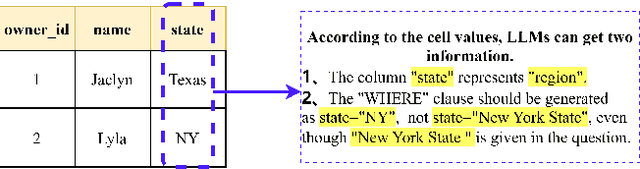
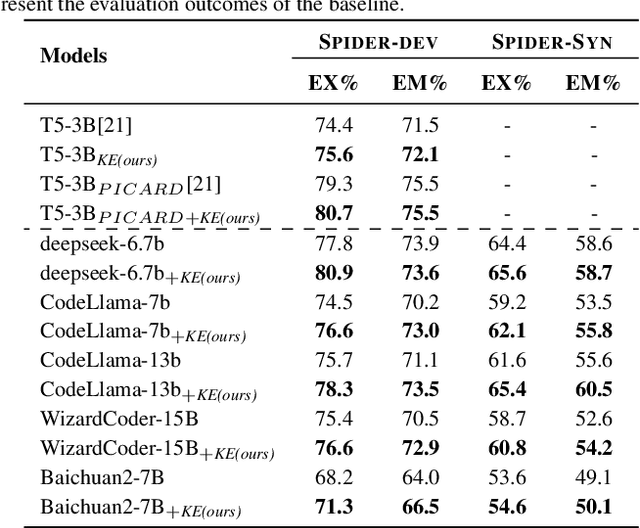
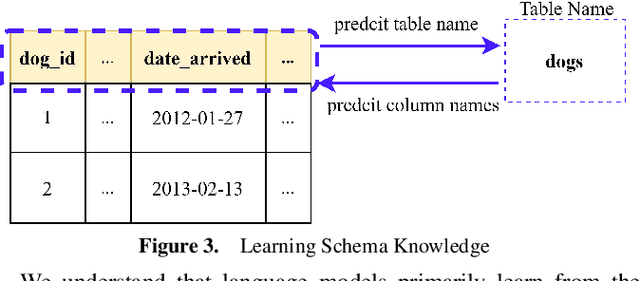
Text-to-SQL is a subtask in semantic parsing that has seen rapid progress with the evolution of Large Language Models (LLMs). However, LLMs face challenges due to hallucination issues and a lack of domain-specific database knowledge(such as table schema and cell values). As a result, they can make errors in generating table names, columns, and matching values to the correct columns in SQL statements. This paper introduces a method of knowledge injection to enhance LLMs' ability to understand schema contents by incorporating prior knowledge. This approach improves their performance in Text-to-SQL tasks. Experimental results show that pre-training LLMs on domain-specific database knowledge and fine-tuning them on downstream Text-to-SQL tasks significantly improves the Execution Match (EX) and Exact Match (EM) metrics across various models. This effectively reduces errors in generating column names and matching values to the columns. Furthermore, the knowledge-injected models can be applied to many downstream Text-to-SQL tasks, demonstrating the generalizability of the approach presented in this paper.