 Add to Chrome
 Add to Firefox
 Add to Edge
Vid2WAM: Distilling Video Diffusion Priors into World Action Models
Aug 09, 2026
World Action Models (WAMs) improve robot policy learning by jointly modeling future visual dynamics and actions. However, their scalability and generalization remain constrained by their reliance on costly expert demonstrations. We challenge this by asking whether future supervision for WAMs must originate from target-task expert trajectories. In this paper, we propose Vid2WAM, an offline distillation framework that transfers visual diffusion priors from a large video foundation model into a compact WAM student. Given an observation and language instruction, Vid2WAM distills supervision through two complementary channels: task-conditioned future rollouts directly supervise the student's future prediction branch, while an inverse dynamics model recovers embodiment-specific pseudo-actions for action learning. To robustly integrate synthetic and real supervision, we introduce source-aware residual action adaptation that learns source-specific corrections around a shared action backbone and mitigates interference from noisy pseudo-actions. During inference, both the video teacher and inverse dynamics model are discarded, leaving only the WAM student for efficient deployment. Simulation and real-world experiments demonstrate that Vid2WAM improves novel-task generalization and data efficiency under limited expert demonstrations while preserving low-latency inference.

$τ_0$-WM: A Unified Video-Action World Model for Robotic Manipulation
May 31, 2026Robotic manipulation requires models that generate executable actions while anticipating and evaluating their future consequences before physical execution. We present $τ_0$-World Model ($τ_0$-WM), a unified video-action world model that integrates policy learning, video prediction, and action evaluation within a single future-predictive framework. Built on a shared video diffusion backbone, $τ_0$-WM provides two complementary interfaces. First, a video action model jointly predicts future visual latents and continuous action chunks from multi-view observations, language instructions, and robot state. Second, an action-conditioned video simulator rolls out candidate action chunks into multi-view futures and predicts dense task-progress scores. The model is trained on approximately $27{,}300$ hours of real-robot teleoperation, UMI-style interaction, egocentric human videos, and rollout or failure trajectories using modality-specific supervision masks. At inference time, $τ_0$-WM uses test-time computation to sample action candidates, rank them with re-denoising consistency, and invoke simulator-based rectification for low-quality candidates. On challenging long-horizon and fine-grained robotic manipulation tasks, $τ_0$-WM shows superior performance over other relevant baselines.
VideoSEAL: Mitigating Evidence Misalignment in Agentic Long Video Understanding by Decoupling Answer Authority
May 12, 2026Long video question answering requires locating sparse, time-scattered visual evidence within highly redundant content. Although current MLLMs perform well on short videos, long videos introduce long-horizon search and verification, which often necessitates multi-turn, agentic interaction. We show that existing LVU agents can exhibit "evidence misalignment": they produce correct answers that are not supported by the retrieved or inspected evidence. To characterize this failure, we introduce two diagnostics (temporal groundedness and semantic groundedness) and use them to reveal two pressures that amplify misalignment: prompt pressure from shared-context saturation at inference time and reward pressure from outcome-only optimization during training. These findings point to a structural root cause: the coupled agent paradigm conflates long-horizon planning with answer authority. We therefore propose the decoupled planner-inspector framework, which separates planning from answer authority and gates final answering on pixel-level verification. Across four long-video benchmarks, our framework improves both answer accuracy and evidence alignment, achieving 55.1% on LVBench and 62.0% on LongVideoBench while producing interpretable search trajectories. Moreover, the decoupled architecture scales consistently with increased search budgets and supports plug-and-play upgrades of the MLLM backbone without retraining the planner. Code and models are available at https://github.com/Echochef/VideoSEAL.
OFlow: Injecting Object-Aware Temporal Flow Matching for Robust Robotic Manipulation
Apr 20, 2026Robust robotic manipulation requires not only predicting how the scene evolves over time, but also recognizing task-relevant objects in complex scenes. However, existing VLA models face two limitations. They typically act only on the current frame, while future prediction and object-aware reasoning are often learned in separate latent spaces. We propose OFlow (injecting Object-Aware Temporal Flow Matching into VLAs), a framework that addresses both limitations by unifying temporal foresight and object-aware reasoning in a shared semantic latent space. Our method forecasts future latents with temporal flow matching, factorizes them into object-aware representations that emphasize physically relevant cues while filtering task-irrelevant variation, and conditions continuous action generation on these predictions. By integrating OFlow into VLA pipelines, our method enables more reliable control under distribution shifts. Extensive experiments across LIBERO, LIBERO-Plus, MetaWorld, and SimplerEnv benchmarks and real-world tasks demonstrate that object-aware foresight consistently enhances robustness and success.
MARS2 2025 Challenge on Multimodal Reasoning: Datasets, Methods, Results, Discussion, and Outlook
Sep 17, 2025
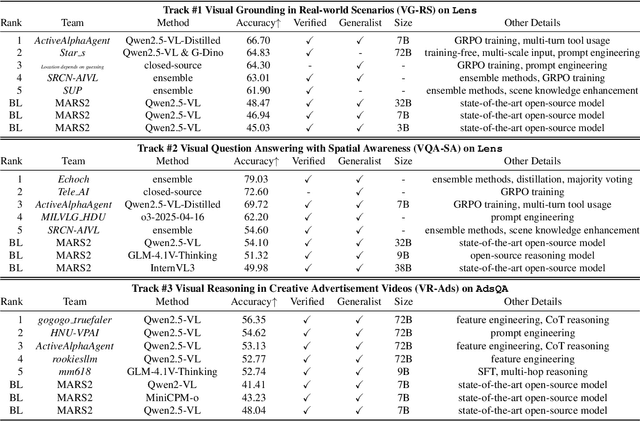

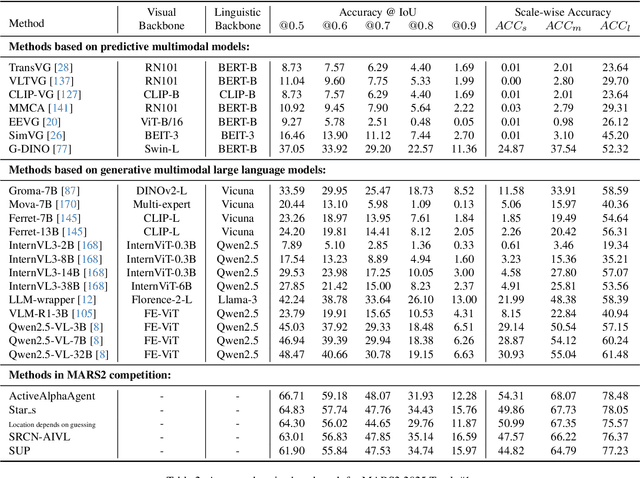
This paper reviews the MARS2 2025 Challenge on Multimodal Reasoning. We aim to bring together different approaches in multimodal machine learning and LLMs via a large benchmark. We hope it better allows researchers to follow the state-of-the-art in this very dynamic area. Meanwhile, a growing number of testbeds have boosted the evolution of general-purpose large language models. Thus, this year's MARS2 focuses on real-world and specialized scenarios to broaden the multimodal reasoning applications of MLLMs. Our organizing team released two tailored datasets Lens and AdsQA as test sets, which support general reasoning in 12 daily scenarios and domain-specific reasoning in advertisement videos, respectively. We evaluated 40+ baselines that include both generalist MLLMs and task-specific models, and opened up three competition tracks, i.e., Visual Grounding in Real-world Scenarios (VG-RS), Visual Question Answering with Spatial Awareness (VQA-SA), and Visual Reasoning in Creative Advertisement Videos (VR-Ads). Finally, 76 teams from the renowned academic and industrial institutions have registered and 40+ valid submissions (out of 1200+) have been included in our ranking lists. Our datasets, code sets (40+ baselines and 15+ participants' methods), and rankings are publicly available on the MARS2 workshop website and our GitHub organization page https://github.com/mars2workshop/, where our updates and announcements of upcoming events will be continuously provided.