 Add to Chrome
 Add to Firefox
 Add to Edge
PrefReward: Learning User Preference Matrix for Personalized Text Generation
Jul 23, 2026
Large Language Models (LLMs) have demonstrated remarkable ability in generating personalized content by leveraging user histories and contextual cues. However, most existing personalization approaches rely on implicit representations within model parameters, making it difficult to interpret user-specific preferences or effectively handle long-context dependencies. To address these challenges, we propose PrefReward, a novel preference-aware generative framework that explicitly models user styles through a structured preference matrix and integrates it into the decoding process as a reward signal. PrefReward consists of two stages: (1) extracting a user-specific preference matrix that summarizes individual stylistic tendencies, and (2) using the matrix to guide generation via a KL-divergence-based reward function. Experiments on the LongLaMP dataset show that PrefReward outperforms non-personalized and retrieval-based baselines in both generation quality and personalization interpretability.

Towards Root Memories: Benchmarking and Enhancing Implicit Logical Memory Retrieval for Personalized LLMs
Jun 22, 2026Memory systems are essential for personalized Large Language Models (LLMs). However, existing retrieval methods in these systems primarily rely on semantic similarity, potentially missing logically critical memories with limited semantic overlap. Current benchmarks remain inadequate for evaluating this problem. To address this gap, we construct IMLogic, the first high-quality benchmark targeting implicit logical memory retrieval in long-dialogue scenarios. Motivated by this challenge, we introduce root memory, a structured, decision-preserving representation that distills reusable personalized logic from long-term user histories. We then propose RootMem, a plug-and-play framework that first distills raw histories into structured root memories and then uses an LLM-based router to activate logically relevant ones, complementing semantic retrieval with personalized decision logic. Extensive experiments demonstrate that RootMem significantly outperforms the strongest retrieval baselines and consistently boosts the accuracy of existing memory agents. Our benchmark and codes will be available at https://anonymous.4open.science/r/IMLogic-DBB3.
From Empathy to Personalized Empathy: Adapting Empathetic Strategies to Individual Users
May 30, 2026As Large Language Models (LLMs) are increasingly deployed in long-term interactions with users, empathy has become an increasingly important capability. However, existing research overlooks the influence of users' personality traits on empathetic strategies during long-term interactions. To address this gap, we introduce the task of personalized empathy, which focuses on adapting empathetic strategies according to users' personalized characteristics derived from history. To study and enhance this capability, we construct PersonaEmp, a personalized empathy dataset built from long-term user-AI interactions, featuring rich user histories, persona information, and empathy-seeking queries. We further propose PereGRM, a reward modeling framework that combines the empathy evaluation structure with dynamic evaluation criteria generation for fine-grained reward modeling. Experimental results across different settings and multiple judge models show that PereGRM consistently achieves the strongest performance improvements, indicating its effectiveness for enhancing personalized empathetic capabilities.
PERM: Psychology-grounded Empathetic Reward Modeling for Large Language Models
Jan 16, 2026Large Language Models (LLMs) are increasingly deployed in human-centric applications, yet they often fail to provide substantive emotional support. While Reinforcement Learning (RL) has been utilized to enhance empathy of LLMs, existing reward models typically evaluate empathy from a single perspective, overlooking the inherently bidirectional interaction nature of empathy between the supporter and seeker as defined by Empathy Cycle theory. To address this limitation, we propose Psychology-grounded Empathetic Reward Modeling (PERM). PERM operationalizes empathy evaluation through a bidirectional decomposition: 1) Supporter perspective, assessing internal resonation and communicative expression; 2) Seeker perspective, evaluating emotional reception. Additionally, it incorporates a bystander perspective to monitor overall interaction quality. Extensive experiments on a widely-used emotional intelligence benchmark and an industrial daily conversation dataset demonstrate that PERM outperforms state-of-the-art baselines by over 10\%. Furthermore, a blinded user study reveals a 70\% preference for our approach, highlighting its efficacy in generating more empathetic responses. Our code, dataset, and models are available at https://github.com/ZhengWwwq/PERM.
Leveraging Memory Retrieval to Enhance LLM-based Generative Recommendation
Dec 23, 2024

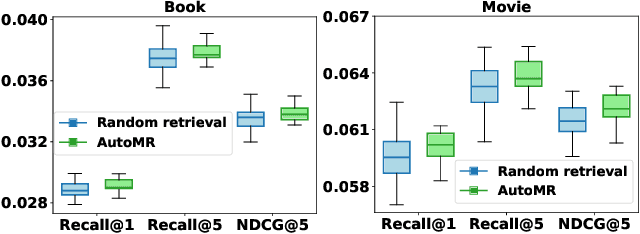

Leveraging Large Language Models (LLMs) to harness user-item interaction histories for item generation has emerged as a promising paradigm in generative recommendation. However, the limited context window of LLMs often restricts them to focusing on recent user interactions only, leading to the neglect of long-term interests involved in the longer histories. To address this challenge, we propose a novel Automatic Memory-Retrieval framework (AutoMR), which is capable of storing long-term interests in the memory and extracting relevant information from it for next-item generation within LLMs. Extensive experimental results on two real-world datasets demonstrate the effectiveness of our proposed AutoMR framework in utilizing long-term interests for generative recommendation.
Debias Can be Unreliable: Mitigating Bias Issue in Evaluating Debiasing Recommendation
Sep 07, 2024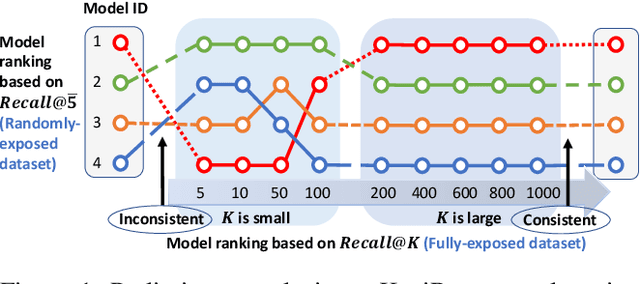
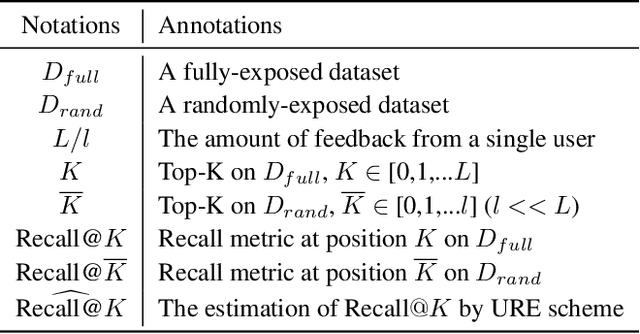
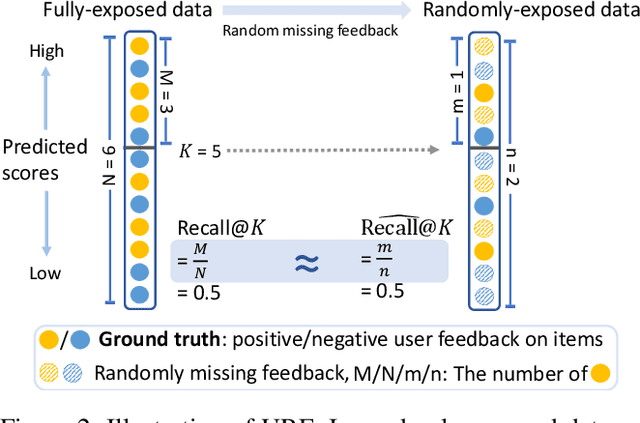

Recent work has improved recommendation models remarkably by equipping them with debiasing methods. Due to the unavailability of fully-exposed datasets, most existing approaches resort to randomly-exposed datasets as a proxy for evaluating debiased models, employing traditional evaluation scheme to represent the recommendation performance. However, in this study, we reveal that traditional evaluation scheme is not suitable for randomly-exposed datasets, leading to inconsistency between the Recall performance obtained using randomly-exposed datasets and that obtained using fully-exposed datasets. Such inconsistency indicates the potential unreliability of experiment conclusions on previous debiasing techniques and calls for unbiased Recall evaluation using randomly-exposed datasets. To bridge the gap, we propose the Unbiased Recall Evaluation (URE) scheme, which adjusts the utilization of randomly-exposed datasets to unbiasedly estimate the true Recall performance on fully-exposed datasets. We provide theoretical evidence to demonstrate the rationality of URE and perform extensive experiments on real-world datasets to validate its soundness.