 Add to Chrome
 Add to Firefox
 Add to Edge
EgoMonth: A Month-Level Egocentric Video Benchmark for Long-Term Spatiotemporal Memory
Aug 13, 2026
Recent advances in Multimodal Large Language Models (MLLMs) have led to substantial progress in video understanding, accompanied by a growing number of long video benchmarks. However, existing benchmarks rely predominantly on web-sourced videos that lack inter-clip spatiotemporal continuity, making it difficult to assess whether models can maintain consistent memory across days or weeks of real-world experience. We introduce EgoMonth, the first month-level egocentric video understanding benchmark. EgoMonth comprises over 300 hours of first-person daily-life recordings from 20 participants spanning 20 to 120 days, paired with 1,443 human-crafted multiple-choice question-answer pairs. We design a cognitively grounded 14-task evaluation framework organized into three hierarchical cognitive levels: Schema Consolidation, Episodic Indexing, and Cascading Reasoning. Evaluation of state-of-the-art open-source and closed-source MLLMs reveals that even the best-performing model, Gemini 2.5 Pro, achieves only 71.8% macro-average accuracy, remaining 22.4 percentage points below the corrected human baseline of 94.2%. Several models perform near or below the 25% chance level on tasks such as Route Reasoning, Cross-view Spatial Reasoning, and Direction Judgement, while even the strongest closed-source model remains substantially below human performance. These results indicate that current MLLMs function as lossy summarizers rather than faithful memorizers, highlighting the need for architectures with genuine long-term spatiotemporal memory.

4DVGGT-D: 4D Visual Geometry Transformer with Improved Dynamic Depth Estimation
May 12, 2026Reconstructing dynamic 4D scenes from monocular videos is a fundamental yet challenging task. While recent 3D foundation models provide strong geometric priors, their performance significantly degrades in dynamic environments. This degradation stems from a fundamental tension: the inherent coupling of camera ego-motion and object motion within global attention mechanisms. In this paper, we propose a novel, training-free progressive decoupling framework that disentangles dynamics from statics in a principled, coarse-to-fine manner. Our core insight is to resolve the tension by first stabilizing the camera pose, followed by geometric refinement. Specifically, our approach consists of three synergistic components: (1) a Dynamic-Mask-Guided Pose Decoupling module that isolates pose estimation from dynamic interference, yielding a stable motion-free reference frame; (2) a Topological Subspace Surgery mechanism that orthogonally decomposes the depth manifold, safely preserving dynamic objects while injecting refined, mask-aware geometry into static regions; and (3) an Information-Theoretic Confidence-Aware Fusion strategy that formulates depth integration as a heteroscedastic Bayesian inference problem, adaptively blending multi-pass predictions via inverse-variance weighting. Extensive experiments on standard 4D reconstruction benchmarks demonstrate that our method achieves consistent and substantial improvements across principal point-cloud metrics. Notably, our approach shows competitive performance in robust 4D scene reconstruction without requiring fine-tuning, suggesting the potential of mathematically grounded dynamic-static disentanglement.
StreamCacheVGGT: Streaming Visual Geometry Transformers with Robust Scoring and Hybrid Cache Compression
Apr 16, 2026Reconstructing dense 3D geometry from continuous video streams requires stable inference under a constant memory budget. Existing $O(1)$ frameworks primarily rely on a ``pure eviction'' paradigm, which suffers from significant information destruction due to binary token deletion and evaluation noise from localized, single-layer scoring. To address these bottlenecks, we propose StreamCacheVGGT, a training-free framework that reimagines cache management through two synergistic modules: Cross-Layer Consistency-Enhanced Scoring (CLCES) and Hybrid Cache Compression (HCC). CLCES mitigates activation noise by tracking token importance trajectories across the Transformer hierarchy, employing order-statistical analysis to identify sustained geometric salience. Leveraging these robust scores, HCC transcends simple eviction by introducing a three-tier triage strategy that merges moderately important tokens into retained anchors via nearest-neighbor assignment on the key-vector manifold. This approach preserves essential geometric context that would otherwise be lost. Extensive evaluations on five benchmarks (7-Scenes, NRGBD, ETH3D, Bonn, and KITTI) demonstrate that StreamCacheVGGT sets a new state-of-the-art, delivering superior reconstruction accuracy and long-term stability while strictly adhering to constant-cost constraints.
Robust 4D Visual Geometry Transformer with Uncertainty-Aware Priors
Apr 10, 2026Reconstructing dynamic 4D scenes is an important yet challenging task. While 3D foundation models like VGGT excel in static settings, they often struggle with dynamic sequences where motion causes significant geometric ambiguity. To address this, we present a framework designed to disentangle dynamic and static components by modeling uncertainty across different stages of the reconstruction process. Our approach introduces three synergistic mechanisms: (1) Entropy-Guided Subspace Projection, which leverages information-theoretic weighting to adaptively aggregate multi-head attention distributions, effectively isolating dynamic motion cues from semantic noise; (2) Local-Consistency Driven Geometry Purification, which enforces spatial continuity via radius-based neighborhood constraints to eliminate structural outliers; and (3) Uncertainty-Aware Cross-View Consistency, which formulates multi-view projection refinement as a heteroscedastic maximum likelihood estimation problem, utilizing depth confidence as a probabilistic weight. Experiments on dynamic benchmarks show that our approach outperforms current state-of-the-art methods, reducing Mean Accuracy error by 13.43\% and improving segmentation F-measure by 10.49\%. Our framework maintains the efficiency of feed-forward inference and requires no task-specific fine-tuning or per-scene optimization.
HD-VGGT: High-Resolution Visual Geometry Transformer
Mar 28, 2026High-resolution imagery is essential for accurate 3D reconstruction, as many geometric details only emerge at fine spatial scales. Recent feed-forward approaches, such as the Visual Geometry Grounded Transformer (VGGT), have demonstrated the ability to infer scene geometry from large collections of images in a single forward pass. However, scaling these models to high-resolution inputs remains challenging: the number of tokens in transformer architectures grows rapidly with both image resolution and the number of views, leading to prohibitive computational and memory costs. Moreover, we observe that visually ambiguous regions, such as repetitive patterns, weak textures, or specular surfaces, often produce unstable feature tokens that degrade geometric inference, especially at higher resolutions. We introduce HD-VGGT, a dual-branch architecture for efficient and robust high-resolution 3D reconstruction. A low-resolution branch predicts a coarse, globally consistent geometry, while a high-resolution branch refines details via a learned feature upsampling module. To handle unstable tokens, we propose Feature Modulation, which suppresses unreliable features early in the transformer. HD-VGGT leverages high-resolution images and supervision without full-resolution transformer costs, achieving state-of-the-art reconstruction quality.
SLARM: Streaming and Language-Aligned Reconstruction Model for Dynamic Scenes
Mar 25, 2026We propose SLARM, a feed-forward model that unifies dynamic scene reconstruction, semantic understanding, and real-time streaming inference. SLARM captures complex, non-uniform motion through higher-order motion modeling, trained solely on differentiable renderings without any flow supervision. Besides, SLARM distills semantic features from LSeg to obtain language-aligned representations. This design enables semantic querying via natural language, and the tight coupling between semantics and geometry further enhances the accuracy and robustness of dynamic reconstruction. Moreover, SLARM processes image sequences using window-based causal attention, achieving stable, low-latency streaming inference without accumulating memory cost. Within this unified framework, SLARM achieves state-of-the-art results in dynamic estimation, rendering quality, and scene parsing, improving motion accuracy by 21%, reconstruction PSNR by 1.6 dB, and segmentation mIoU by 20% over existing methods.
RGB-D Inertial Odometry for a Resource-Restricted Robot in Dynamic Environments
Apr 21, 2023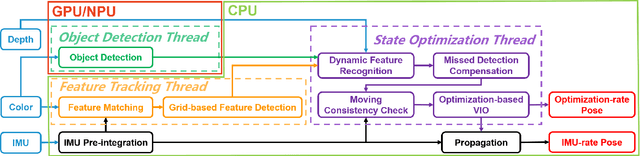
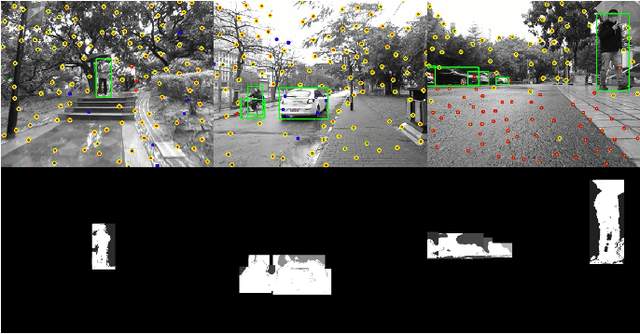
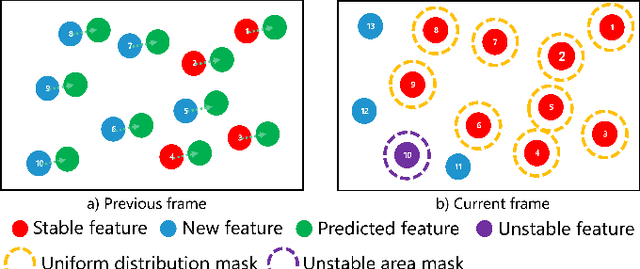
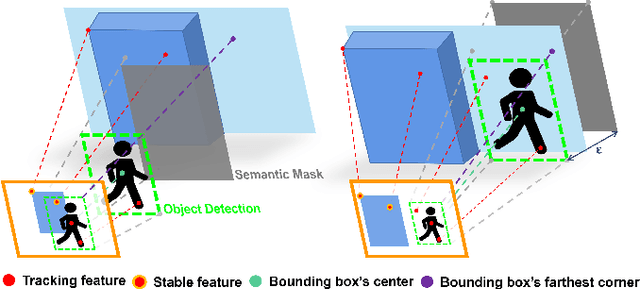
Current simultaneous localization and mapping (SLAM) algorithms perform well in static environments but easily fail in dynamic environments. Recent works introduce deep learning-based semantic information to SLAM systems to reduce the influence of dynamic objects. However, it is still challenging to apply a robust localization in dynamic environments for resource-restricted robots. This paper proposes a real-time RGB-D inertial odometry system for resource-restricted robots in dynamic environments named Dynamic-VINS. Three main threads run in parallel: object detection, feature tracking, and state optimization. The proposed Dynamic-VINS combines object detection and depth information for dynamic feature recognition and achieves performance comparable to semantic segmentation. Dynamic-VINS adopts grid-based feature detection and proposes a fast and efficient method to extract high-quality FAST feature points. IMU is applied to predict motion for feature tracking and moving consistency check. The proposed method is evaluated on both public datasets and real-world applications and shows competitive localization accuracy and robustness in dynamic environments. Yet, to the best of our knowledge, it is the best-performance real-time RGB-D inertial odometry for resource-restricted platforms in dynamic environments for now. The proposed system is open source at: https://github.com/HITSZ-NRSL/Dynamic-VINS.git