 Add to Chrome
 Add to Firefox
 Add to Edge
GUPO: Gradient Uncertainty-aware Policy Optimization for Post-Training Large Language Models
Aug 18, 2026
Group Relative Policy Optimization (GRPO) has become a widely used approach for post-training Large Language Models (LLMs) for reasoning. In GRPO, the group gradients induced by different queries within the same mini-batch are directly averaged to form the policy update. However, these group gradients can point in conflicting directions. Our empirical analysis suggests that group-gradient conflicts tend to be associated with less effective policy updates, motivating the need for a reliable aggregated update direction under such conflicts. Standard GRPO aggregation treats the realized group gradients as deterministic contributions and does not account for differences in their reliability during aggregation. To address this issue, we propose Gradient Uncertainty-Aware Policy Optimization (GUPO), which models each group gradient as a random variable under a Bayesian formulation and estimates its probability distribution. GUPO then derives gradient uncertainty using a Dirichlet-based formulation and uses it to calibrate the contribution of each group gradient during aggregation. Extensive experiments on multiple benchmarks demonstrate the effectiveness of GUPO.

Ground-Truth Neighborhood Regularization for Reinforcement Learning Post-Training of Time Series Foundation Models
Aug 08, 2026Time series forecasting (TSF) plays an important role in a wide range of real-world applications. Recently, time series foundation models (TSFMs), pretrained on large-scale datasets, have demonstrated strong generalization capabilities and emerged as an important paradigm for TSF. Reinforcement learning (RL) post-training has consequently attracted growing attention as a means of further improving their performance on downstream tasks. However, we find that, in certain forecast regions, RL post-training may gradually shift the output distributions of TSFMs away from the ground truth, thereby limiting their performance. We refer to this phenomenon as \textbf{suboptimal collapse}. Our analysis suggests that difficulty in initially sampling high-quality trajectories near the ground truth is an important contributing factor to suboptimal collapse. To address this issue, we propose Ground-Truth Neighborhood Regularization (GTN-R) for RL post-training of TSFMs. GTN-R uses the ground truth as a reference for locating high-quality regions and guides the model's probability mass toward the ground-truth neighborhood. This increases the probability of sampling high-quality trajectories, mitigates suboptimal collapse, and improves performance. Moreover, GTN-R can be flexibly integrated into various RL methods for TSFMs. Extensive experiments show its effectiveness.
Dirichlet-Guided Group Forecasting for Alleviating Over-smoothing in Time Series Forecasting
Jun 09, 2026Time series forecasting often suffers from over-smoothing, especially when future dynamics are multi-modal. Forecasts may follow the coarse trend of the observed future, but fail to preserve sharp changes, oscillations, turning points, and regime transitions that define plausible dynamic evolution. In this work, we revisit over-smoothing from the perspective of latent dynamical mode compression: under partial observation and single-realization supervision, multiple plausible future modes can be weakened, merged, or averaged during forecasting. Based on this view, we propose Dirichlet-Guided Group Forecasting (DGF), a mode-preserving forecasting framework that explicitly models multiple mode-conditioned predictive distributions and uncertainty over their selection probabilities. DGF uses a Dirichlet-guided hierarchical sampling mechanism and reward-based optimization to encourage forecasts that are accurate, dynamically consistent, and mode-distinct. Extensive experiments on real-world forecasting benchmarks show that DGF reduces over-smoothing while improving forecasting accuracy, diversity, and dynamical consistency.
Closing the Loop: A Control-Theoretic Framework for Provably Stable Time Series Forecasting with LLMs
Feb 13, 2026Large Language Models (LLMs) have recently shown exceptional potential in time series forecasting, leveraging their inherent sequential reasoning capabilities to model complex temporal dynamics. However, existing approaches typically employ a naive autoregressive generation strategy. We identify a critical theoretical flaw in this paradigm: during inference, the model operates in an open-loop manner, consuming its own generated outputs recursively. This leads to inevitable error accumulation (exposure bias), where minor early deviations cascade into significant trajectory drift over long horizons. In this paper, we reformulate autoregressive forecasting through the lens of control theory, proposing \textbf{F-LLM} (Feedback-driven LLM), a novel closed-loop framework. Unlike standard methods that passively propagate errors, F-LLM actively stabilizes the trajectory via a learnable residual estimator (Observer) and a feedback controller. Furthermore, we provide a theoretical guarantee that our closed-loop mechanism ensures uniformly bounded error, provided the base model satisfies a local Lipschitz constraint. Extensive experiments demonstrate that F-LLM significantly mitigates error propagation, achieving good performance on time series benchmarks.
Enhancing Large Language Models for Time-Series Forecasting via Vector-Injected In-Context Learning
Jan 12, 2026The World Wide Web needs reliable predictive capabilities to respond to changes in user behavior and usage patterns. Time series forecasting (TSF) is a key means to achieve this goal. In recent years, the large language models (LLMs) for TSF (LLM4TSF) have achieved good performance. However, there is a significant difference between pretraining corpora and time series data, making it hard to guarantee forecasting quality when directly applying LLMs to TSF; fine-tuning LLMs can mitigate this issue, but often incurs substantial computational overhead. Thus, LLM4TSF faces a dual challenge of prediction performance and compute overhead. To address this, we aim to explore a method for improving the forecasting performance of LLM4TSF while freezing all LLM parameters to reduce computational overhead. Inspired by in-context learning (ICL), we propose LVICL. LVICL uses our vector-injected ICL to inject example information into a frozen LLM, eliciting its in-context learning ability and thereby enhancing its performance on the example-related task (i.e., TSF). Specifically, we first use the LLM together with a learnable context vector adapter to extract a context vector from multiple examples adaptively. This vector contains compressed, example-related information. Subsequently, during the forward pass, we inject this vector into every layer of the LLM to improve forecasting performance. Compared with conventional ICL that adds examples into the prompt, our vector-injected ICL does not increase prompt length; moreover, adaptively deriving a context vector from examples suppresses components harmful to forecasting, thereby improving model performance. Extensive experiments demonstrate the effectiveness of our approach.
Causal Prompt Calibration Guided Segment Anything Model for Open-Vocabulary Multi-Entity Segmentation
May 10, 2025Despite the strength of the Segment Anything Model (SAM), it struggles with generalization issues in open-vocabulary multi-entity segmentation (OVMS). Through empirical and causal analyses, we find that (i) the prompt bias is the primary cause of the generalization issues; (ii) this bias is closely tied to the task-irrelevant generating factors within the prompts, which act as confounders and affect generalization. To address the generalization issues, we aim to propose a method that can calibrate prompts to eliminate confounders for accurate OVMS. Building upon the causal analysis, we propose that the optimal prompt for OVMS should contain only task-relevant causal factors. We define it as the causal prompt, serving as the goal of calibration. Next, our theoretical analysis, grounded by causal multi-distribution consistency theory, proves that this prompt can be obtained by enforcing segmentation consistency and optimality. Inspired by this, we propose CPC-SAM, a Causal Prompt Calibration method for SAM to achieve accurate OVMS. It integrates a lightweight causal prompt learner (CaPL) into SAM to obtain causal prompts. Specifically, we first generate multiple prompts using random annotations to simulate diverse distributions and then reweight them via CaPL by enforcing causal multi-distribution consistency in both task and entity levels. To ensure obtaining causal prompts, CaPL is optimized by minimizing the cumulative segmentation loss across the reweighted prompts to achieve consistency and optimality. A bi-level optimization strategy alternates between optimizing CaPL and SAM, ensuring accurate OVMS. Extensive experiments validate its superiority.
Enhancing Time Series Forecasting via Logic-Inspired Regularization
Mar 10, 2025Time series forecasting (TSF) plays a crucial role in many applications. Transformer-based methods are one of the mainstream techniques for TSF. Existing methods treat all token dependencies equally. However, we find that the effectiveness of token dependencies varies across different forecasting scenarios, and existing methods ignore these differences, which affects their performance. This raises two issues: (1) What are effective token dependencies? (2) How can we learn effective dependencies? From a logical perspective, we align Transformer-based TSF methods with the logical framework and define effective token dependencies as those that ensure the tokens as atomic formulas (Issue 1). We then align the learning process of Transformer methods with the process of obtaining atomic formulas in logic, which inspires us to design a method for learning these effective dependencies (Issue 2). Specifically, we propose Attention Logic Regularization (Attn-L-Reg), a plug-and-play method that guides the model to use fewer but more effective dependencies by making the attention map sparse, thereby ensuring the tokens as atomic formulas and improving prediction performance. Extensive experiments and theoretical analysis confirm the effectiveness of Attn-L-Reg.
Let Human Sketches Help: Empowering Challenging Image Segmentation Task with Freehand Sketches
Jan 31, 2025


Sketches, with their expressive potential, allow humans to convey the essence of an object through even a rough contour. For the first time, we harness this expressive potential to improve segmentation performance in challenging tasks like camouflaged object detection (COD). Our approach introduces an innovative sketch-guided interactive segmentation framework, allowing users to intuitively annotate objects with freehand sketches (drawing a rough contour of the object) instead of the traditional bounding boxes or points used in classic interactive segmentation models like SAM. We demonstrate that sketch input can significantly improve performance in existing iterative segmentation methods, outperforming text or bounding box annotations. Additionally, we introduce key modifications to network architectures and a novel sketch augmentation technique to fully harness the power of sketch input and further boost segmentation accuracy. Remarkably, our model' s output can be directly used to train other neural networks, achieving results comparable to pixel-by-pixel annotations--while reducing annotation time by up to 120 times, which shows great potential in democratizing the annotation process and enabling model training with less reliance on resource-intensive, laborious pixel-level annotations. We also present KOSCamo+, the first freehand sketch dataset for camouflaged object detection. The dataset, code, and the labeling tool will be open sourced.
Magic3DSketch: Create Colorful 3D Models From Sketch-Based 3D Modeling Guided by Text and Language-Image Pre-Training
Jul 27, 2024
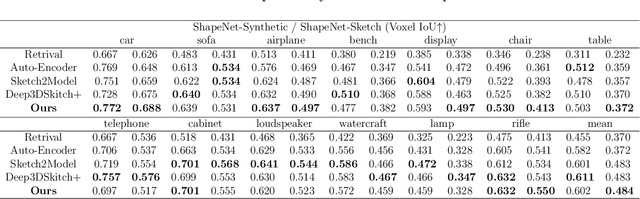
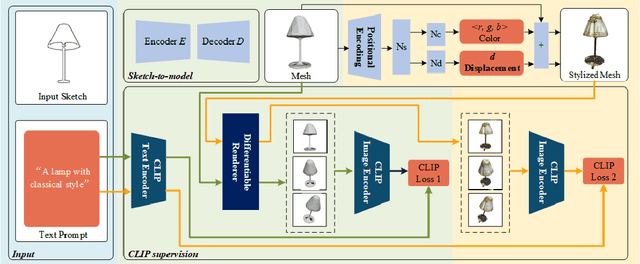
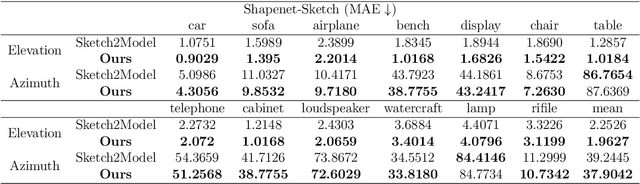
The requirement for 3D content is growing as AR/VR application emerges. At the same time, 3D modelling is only available for skillful experts, because traditional methods like Computer-Aided Design (CAD) are often too labor-intensive and skill-demanding, making it challenging for novice users. Our proposed method, Magic3DSketch, employs a novel technique that encodes sketches to predict a 3D mesh, guided by text descriptions and leveraging external prior knowledge obtained through text and language-image pre-training. The integration of language-image pre-trained neural networks complements the sparse and ambiguous nature of single-view sketch inputs. Our method is also more useful and offers higher degree of controllability compared to existing text-to-3D approaches, according to our user study. Moreover, Magic3DSketch achieves state-of-the-art performance in both synthetic and real dataset with the capability of producing more detailed structures and realistic shapes with the help of text input. Users are also more satisfied with models obtained by Magic3DSketch according to our user study. Additionally, we are also the first, to our knowledge, add color based on text description to the sketch-derived shapes. By combining sketches and text guidance with the help of language-image pretrained models, our Magic3DSketch can allow novice users to create custom 3D models with minimal effort and maximum creative freedom, with the potential to revolutionize future 3D modeling pipelines.
Not All Frequencies Are Created Equal:Towards a Dynamic Fusion of Frequencies in Time-Series Forecasting
Jul 18, 2024
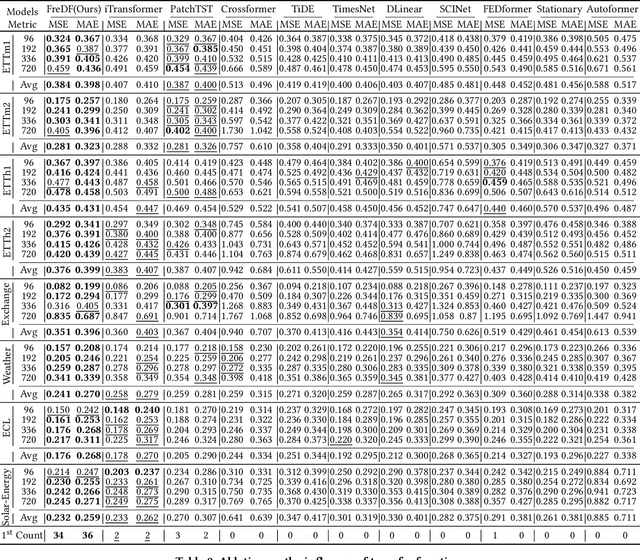
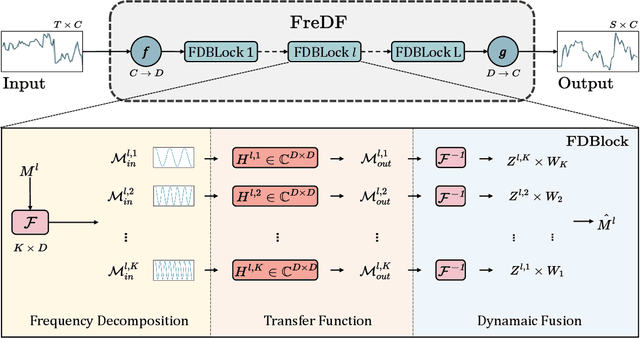

Long-term time series forecasting is a long-standing challenge in various applications. A central issue in time series forecasting is that methods should expressively capture long-term dependency. Furthermore, time series forecasting methods should be flexible when applied to different scenarios. Although Fourier analysis offers an alternative to effectively capture reusable and periodic patterns to achieve long-term forecasting in different scenarios, existing methods often assume high-frequency components represent noise and should be discarded in time series forecasting. However, we conduct a series of motivation experiments and discover that the role of certain frequencies varies depending on the scenarios. In some scenarios, removing high-frequency components from the original time series can improve the forecasting performance, while in others scenarios, removing them is harmful to forecasting performance. Therefore, it is necessary to treat the frequencies differently according to specific scenarios. To achieve this, we first reformulate the time series forecasting problem as learning a transfer function of each frequency in the Fourier domain. Further, we design Frequency Dynamic Fusion (FreDF), which individually predicts each Fourier component, and dynamically fuses the output of different frequencies. Moreover, we provide a novel insight into the generalization ability of time series forecasting and propose the generalization bound of time series forecasting. Then we prove FreDF has a lower bound, indicating that FreDF has better generalization ability. Extensive experiments conducted on multiple benchmark datasets and ablation studies demonstrate the effectiveness of FreDF.