 Add to Chrome
 Add to Firefox
 Add to Edge
Overhead Wildlife Locator (OWL): Benchmarking Weakly Supervised Learning for Aerial Wildlife Surveys
Jun 11, 2026
Automated aerial wildlife surveys increasingly rely on deep learning, yet standard object detectors require bounding-box annotations, reported to be up to seven times slower and three times more expensive to produce than point-level labels. To address this bottleneck, we introduce the Overhead Wildlife Locator (OWL), a weakly supervised density-estimation framework with three variants: OWL-C, a fully convolutional model for high-throughput screening; OWL-T, a Swin-augmented hybrid for heterogeneous, cluttered scenes; and OWL-D, built on a frozen DINOv3 ViT-H+/16 encoder with a DPT-style fusion decoder. We benchmark all three against POLO, YOLOv11n, and YOLOv11l across five public aerial datasets, from sparse fixed-wing savanna surveys to dense UAV paddock imagery, and against the published HerdNet baseline on its native Delplanque split. OWL-D sets a new state of the art on Delplanque (0.934 AP vs. HerdNet's 0.840) and records the highest AP on four of the five datasets. Performance is regime-dependent: on the extreme-density SheepCounter UAV dataset the hybrid OWL-T leads (0.978 AP) and the convolutional variants attain the lowest counting error, whereas the foundation-based OWL-D degrades, indicating which variant suits which survey type. We further validate operational readiness on the Alaska Department of Fish and Game's 2022 Central Arctic Caribou census: under cross-herd and cross-temporal transfer, OWL-C fine-tuned on the 2017 Porcupine Caribou Herd split attains F1 = 0.965 on a held-out patch test set, with a signed count error of +3.1% aggregated across the released test patches. We release the OWL code, model weights, and the annotated Porcupine Caribou Herd 2017 (PCH) and Central Arctic Herd 2022 (CAH) patches, the first open patch-level datasets for large-scale caribou aerial surveys, at https://github.com/microsoft/MegaDetector-Overhead.

No One Knows the State of the Art in Geospatial Foundation Models
May 12, 2026Geospatial foundation models (GFMs) have been proposed as generalizable backbones for disaster response, land-cover mapping, food-security monitoring, and other high-stakes Earth-observation tasks. Yet the published work about these models does not give reviewers or users enough information to tell which model fits a given task. We argue that nobody knows what the current state of the art is in geospatial foundation models. The methods may be useful, but the GFM literature does not standardize evaluations, training and testing protocols, released weights, or pretraining controls well enough for anyone to compare or rank them. In a 152-paper audit, we find 46 cross-paper disagreements of at least 10 points for the same model, benchmark, and protocol; 94/126 papers with extractable pretraining data use a configuration no other paper uses; and 39% of GFM papers release no model weights. This lack of community standards can be solved. We propose six concrete expectations: named-license weight release, shared core evaluations, copied-versus-rerun baseline annotations, variance reporting, one shared evaluation harness, and data-vs-architecture-vs-algorithm controls. These gaps are a coordination failure, not a fault of any individual lab; the authors of this paper, like many others in the GFM community, have contributed to them. Rather than just critiquing the community, we aim to provide concrete steps toward a shared understanding of how to innovate GFMs.
GeoAI Agency Primitives
Apr 02, 2026We present ongoing research on agency primitives for GeoAI assistants -- core capabilities that connect Foundation models to the artifact-centric, human-in-the-loop workflows where GIS practitioners actually work. Despite advances in satellite image captioning, visual question answering, and promptable segmentation, these capabilities have not translated into productivity gains for practitioners who spend most of their time producing vector layers, raster maps, and cartographic products. The gap is not model capability alone but the absence of an agency layer that supports iterative collaboration. We propose a vocabulary of $9$ primitives for such a layer -- including navigation, perception, geo-referenced memory, and dual modeling -- along with a benchmark that measures human productivity. Our goal is a vocabulary that makes agentic assistance in GIS implementable, testable, and comparable.
PRUE: A Practical Recipe for Field Boundary Segmentation at Scale
Mar 28, 2026Large-scale maps of field boundaries are essential for agricultural monitoring tasks. Existing deep learning approaches for satellite-based field mapping are sensitive to illumination, spatial scale, and changes in geographic location. We conduct the first systematic evaluation of segmentation and geospatial foundation models (GFMs) for global field boundary delineation using the Fields of The World (FTW) benchmark. We evaluate 18 models under unified experimental settings, showing that a U-Net semantic segmentation model outperforms instance-based and GFM alternatives on a suite of performance and deployment metrics. We propose a new segmentation approach that combines a U-Net backbone, composite loss functions, and targeted data augmentations to enhance performance and robustness under real-world conditions. Our model achieves a 76\% IoU and 47\% object-F1 on FTW, an increase of 6\% and 9\% over the previous baseline. Our approach provides a practical framework for reliable, scalable, and reproducible field boundary delineation across model design, training, and inference. We release all models and model-derived field boundary datasets for five countries.
Advancing Earth Observation Through Machine Learning: A TorchGeo Tutorial
Mar 02, 2026Earth observation machine learning pipelines differ fundamentally from standard computer vision workflows. Imagery is typically delivered as large, georeferenced scenes, labels may be raster masks or vector geometries in distinct coordinate reference systems, and both training and evaluation often require spatially aware sampling and splitting strategies. TorchGeo is a PyTorch-based domain library that provides datasets, samplers, transforms and pre-trained models with the goal of making it easy to use geospatial data in machine learning pipelines. In this paper, we introduce a tutorial that demonstrates 1.) the core TorchGeo abstractions through code examples, and 2.) an end-to-end case study on multispectral water segmentation from Sentinel-2 imagery using the Earth Surface Water dataset. This demonstrates how to train a semantic segmentation model using TorchGeo datasets, apply the model to a Sentinel-2 scene over Rio de Janeiro, Brazil, and save the resulting predictions as a GeoTIFF for further geospatial analysis. The tutorial code itself is distributed as two Python notebooks: https://torchgeo.readthedocs.io/en/stable/tutorials/torchgeo.html and https://torchgeo.readthedocs.io/en/stable/tutorials/earth_surface_water.html.
From Pixels to Patches: Pooling Strategies for Earth Embeddings
Mar 02, 2026As geospatial foundation models shift from patch-level to pixel-level embeddings, practitioners must aggregate thousands of pixel vectors into patch representations that preserve class-discriminative signal while matching downstream label resolution. The default choice, mean pooling, discards within-patch variability and can drop accuracy by more than 10% under spatial shift. To evaluate this effect, we introduce EuroSAT-Embed: 81,000 embedding GeoTIFFs derived from three foundation models: AlphaEarth, OlmoEarth, and Tessera. We benchmark 11 training-free and 2 parametric pooling methods under both random and geographically disjoint test splits. Our results show that richer pooling schemes reduce the geographic generalization gap by up to 40% relative to mean pooling and increases accuracy by up to 5% on spatial splits. We recommend Generalized Mean Pooling (GeM) as a drop-in replacement for mean pooling: it improves accuracy without increasing embedding dimensionality. For maximum accuracy, Stats pooling (concatenation of min/max/mean/std pooling) performs best at 4x the embedding size. We further find that pooling effectiveness varies across embedding sources and that higher-dimensional embeddings benefit most from distributional statistics.
Satellite-Based Detection of Looted Archaeological Sites Using Machine Learning
Feb 23, 2026Looting at archaeological sites poses a severe risk to cultural heritage, yet monitoring thousands of remote locations remains operationally difficult. We present a scalable and satellite-based pipeline to detect looted archaeological sites, using PlanetScope monthly mosaics (4.7m/pixel) and a curated dataset of 1,943 archaeological sites in Afghanistan (898 looted, 1,045 preserved) with multi-year imagery (2016--2023) and site-footprint masks. We compare (i) end-to-end CNN classifiers trained on raw RGB patches and (ii) traditional machine learning (ML) trained on handcrafted spectral/texture features and embeddings from recent remote-sensing foundation models. Results indicate that ImageNet-pretrained CNNs combined with spatial masking reach an F1 score of 0.926, clearly surpassing the strongest traditional ML setup, which attains an F1 score of 0.710 using SatCLIP-V+RF+Mean, i.e., location and vision embeddings fed into a Random Forest with mean-based temporal aggregation. Ablation studies demonstrate that ImageNet pretraining (even in the presence of domain shift) and spatial masking enhance performance. In contrast, geospatial foundation model embeddings perform competitively with handcrafted features, suggesting that looting signatures are extremely localized. The repository is available at https://github.com/microsoft/looted_site_detection.
Fields of The World: A Field Guide for Extracting Agricultural Field Boundaries
Feb 08, 2026Field boundary maps are a building block for agricultural data products and support crop monitoring, yield estimation, and disease estimation. This tutorial presents the Fields of The World (FTW) ecosystem: a benchmark of 1.6M field polygons across 24 countries, pre-trained segmentation models, and command-line inference tools. We provide two notebooks that cover (1) local-scale field boundary extraction with crop classification and forest loss attribution, and (2) country-scale inference using cloud-optimized data. We use MOSAIKS random convolutional features and FTW derived field boundaries to map crop type at the field level and report macro F1 scores of 0.65--0.75 for crop type classification with limited labels. Finally, we show how to explore pre-computed predictions over five countries (4.76M km\textsuperscript{2}), with median predicted field areas from 0.06 ha (Rwanda) to 0.28 ha (Switzerland).
TEMPO: Global Temporal Building Density and Height Estimation from Satellite Imagery
Nov 15, 2025We present TEMPO, a global, temporally resolved dataset of building density and height derived from high-resolution satellite imagery using deep learning models. We pair building footprint and height data from existing datasets with quarterly PlanetScope basemap satellite images to train a multi-task deep learning model that predicts building density and building height at a 37.6-meter per pixel resolution. We apply this model to global PlanetScope basemaps from Q1 2018 through Q2 2025 to create global, temporal maps of building density and height. We validate these maps by comparing against existing building footprint datasets. Our estimates achieve an F1 score between 85% and 88% on different hand-labeled subsets, and are temporally stable, with a 0.96 five-year trend-consistency score. TEMPO captures quarterly changes in built settlements at a fraction of the computational cost of comparable approaches, unlocking large-scale monitoring of development patterns and climate impacts essential for global resilience and adaptation efforts.
Optimizing Cloud-to-GPU Throughput for Deep Learning With Earth Observation Data
Jun 06, 2025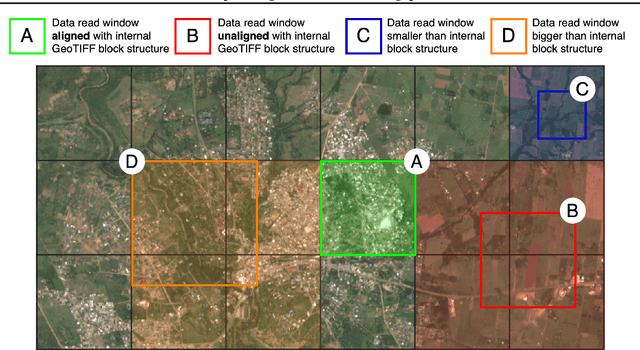
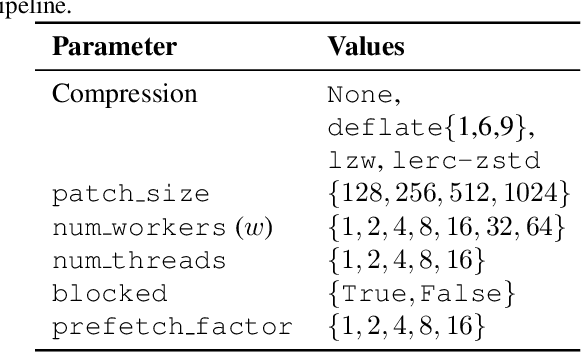

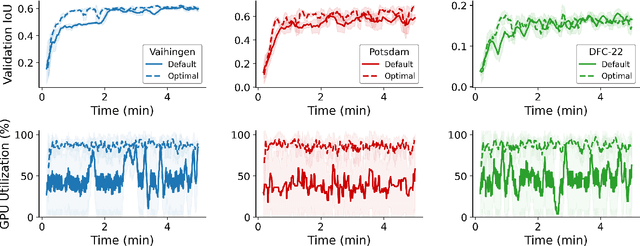
Training deep learning models on petabyte-scale Earth observation (EO) data requires separating compute resources from data storage. However, standard PyTorch data loaders cannot keep modern GPUs utilized when streaming GeoTIFF files directly from cloud storage. In this work, we benchmark GeoTIFF loading throughput from both cloud object storage and local SSD, systematically testing different loader configurations and data parameters. We focus on tile-aligned reads and worker thread pools, using Bayesian optimization to find optimal settings for each storage type. Our optimized configurations increase remote data loading throughput by 20x and local throughput by 4x compared to default settings. On three public EO benchmarks, models trained with optimized remote loading achieve the same accuracy as local training within identical time budgets. We improve validation IoU by 6-15% and maintain 85-95% GPU utilization versus 0-30% with standard configurations. Code is publicly available at https://github.com/microsoft/pytorch-cloud-geotiff-optimization