 Add to Chrome
 Add to Firefox
 Add to Edge
GeoAI Agency Primitives
Apr 02, 2026
We present ongoing research on agency primitives for GeoAI assistants -- core capabilities that connect Foundation models to the artifact-centric, human-in-the-loop workflows where GIS practitioners actually work. Despite advances in satellite image captioning, visual question answering, and promptable segmentation, these capabilities have not translated into productivity gains for practitioners who spend most of their time producing vector layers, raster maps, and cartographic products. The gap is not model capability alone but the absence of an agency layer that supports iterative collaboration. We propose a vocabulary of $9$ primitives for such a layer -- including navigation, perception, geo-referenced memory, and dual modeling -- along with a benchmark that measures human productivity. Our goal is a vocabulary that makes agentic assistance in GIS implementable, testable, and comparable.

Bootstrapping Rare Object Detection in High-Resolution Satellite Imagery
Mar 05, 2024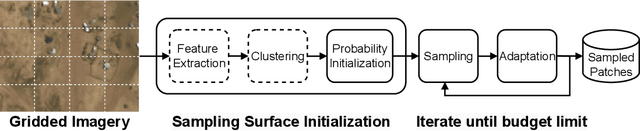
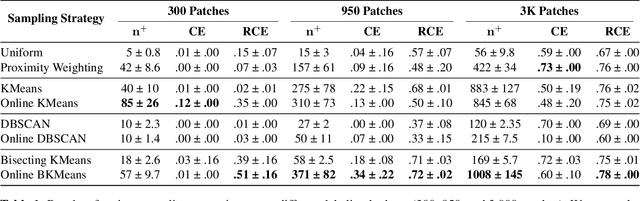
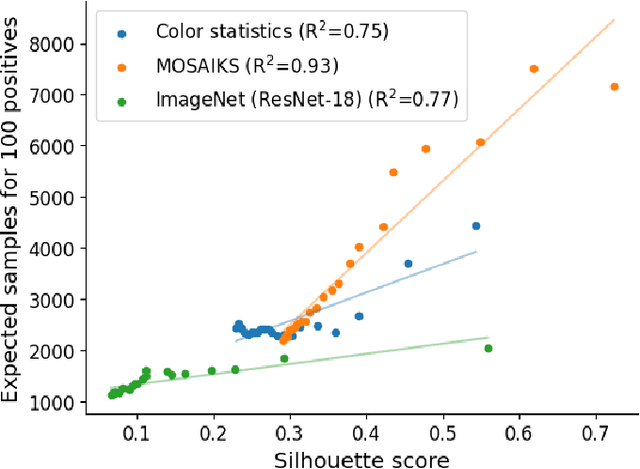
Rare object detection is a fundamental task in applied geospatial machine learning, however is often challenging due to large amounts of high-resolution satellite or aerial imagery and few or no labeled positive samples to start with. This paper addresses the problem of bootstrapping such a rare object detection task assuming there is no labeled data and no spatial prior over the area of interest. We propose novel offline and online cluster-based approaches for sampling patches that are significantly more efficient, in terms of exposing positive samples to a human annotator, than random sampling. We apply our methods for identifying bomas, or small enclosures for herd animals, in the Serengeti Mara region of Kenya and Tanzania. We demonstrate a significant enhancement in detection efficiency, achieving a positive sampling rate increase from 2% (random) to 30%. This advancement enables effective machine learning mapping even with minimal labeling budgets, exemplified by an F1 score on the boma detection task of 0.51 with a budget of 300 total patches.