 Add to Chrome
 Add to Firefox
 Add to Edge
Fields of the Planet: Field Boundary Mapping Beyond 10m
Jul 05, 2026
Field-boundary maps support crop monitoring, irrigation planning, and yield estimation, but many smallholder parcels span only a few 10 m Sentinel-2 pixels. We introduce Fields of the Planet (FTP), a 3 m PlanetScope companion to Fields of The World (FTW) that pairs the same polygons, seasonal windows, and train/test splits with 133,168 co-registered PlanetScope patch-window targets across 24 countries. FTP evaluates field delineation as parcel recovery by vectorizing predictions before scoring panoptic quality (PQ), object F1, size-stratified PQ, and meter-scale matched-boundary error. Under matched architectures and training recipes, 3 m imagery raises PQ from 21.0 to 35.5, raises PQ on sub-0.5 ha fields from 5.8 to 15.7, and cuts matched-boundary error from 18.6 m to 7.4 m.

No One Knows the State of the Art in Geospatial Foundation Models
May 12, 2026Geospatial foundation models (GFMs) have been proposed as generalizable backbones for disaster response, land-cover mapping, food-security monitoring, and other high-stakes Earth-observation tasks. Yet the published work about these models does not give reviewers or users enough information to tell which model fits a given task. We argue that nobody knows what the current state of the art is in geospatial foundation models. The methods may be useful, but the GFM literature does not standardize evaluations, training and testing protocols, released weights, or pretraining controls well enough for anyone to compare or rank them. In a 152-paper audit, we find 46 cross-paper disagreements of at least 10 points for the same model, benchmark, and protocol; 94/126 papers with extractable pretraining data use a configuration no other paper uses; and 39% of GFM papers release no model weights. This lack of community standards can be solved. We propose six concrete expectations: named-license weight release, shared core evaluations, copied-versus-rerun baseline annotations, variance reporting, one shared evaluation harness, and data-vs-architecture-vs-algorithm controls. These gaps are a coordination failure, not a fault of any individual lab; the authors of this paper, like many others in the GFM community, have contributed to them. Rather than just critiquing the community, we aim to provide concrete steps toward a shared understanding of how to innovate GFMs.
Fields of The World: A Field Guide for Extracting Agricultural Field Boundaries
Feb 08, 2026Field boundary maps are a building block for agricultural data products and support crop monitoring, yield estimation, and disease estimation. This tutorial presents the Fields of The World (FTW) ecosystem: a benchmark of 1.6M field polygons across 24 countries, pre-trained segmentation models, and command-line inference tools. We provide two notebooks that cover (1) local-scale field boundary extraction with crop classification and forest loss attribution, and (2) country-scale inference using cloud-optimized data. We use MOSAIKS random convolutional features and FTW derived field boundaries to map crop type at the field level and report macro F1 scores of 0.65--0.75 for crop type classification with limited labels. Finally, we show how to explore pre-computed predictions over five countries (4.76M km\textsuperscript{2}), with median predicted field areas from 0.06 ha (Rwanda) to 0.28 ha (Switzerland).
Fields of The World: A Machine Learning Benchmark Dataset For Global Agricultural Field Boundary Segmentation
Sep 24, 2024

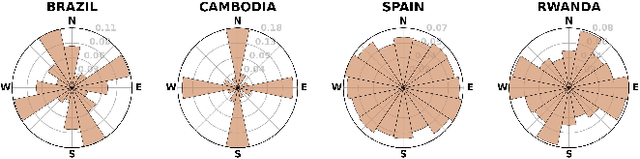
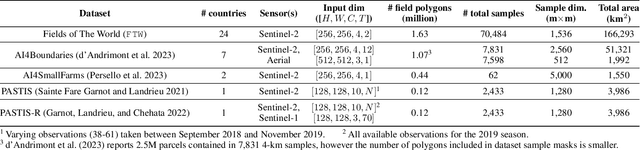
Crop field boundaries are foundational datasets for agricultural monitoring and assessments but are expensive to collect manually. Machine learning (ML) methods for automatically extracting field boundaries from remotely sensed images could help realize the demand for these datasets at a global scale. However, current ML methods for field instance segmentation lack sufficient geographic coverage, accuracy, and generalization capabilities. Further, research on improving ML methods is restricted by the lack of labeled datasets representing the diversity of global agricultural fields. We present Fields of The World (FTW) -- a novel ML benchmark dataset for agricultural field instance segmentation spanning 24 countries on four continents (Europe, Africa, Asia, and South America). FTW is an order of magnitude larger than previous datasets with 70,462 samples, each containing instance and semantic segmentation masks paired with multi-date, multi-spectral Sentinel-2 satellite images. We provide results from baseline models for the new FTW benchmark, show that models trained on FTW have better zero-shot and fine-tuning performance in held-out countries than models that aren't pre-trained with diverse datasets, and show positive qualitative zero-shot results of FTW models in a real-world scenario -- running on Sentinel-2 scenes over Ethiopia.