 Add to Chrome
 Add to Firefox
 Add to Edge
The PokeAgent Challenge: Competitive and Long-Context Learning at Scale
Mar 17, 2026
We present the PokeAgent Challenge, a large-scale benchmark for decision-making research built on Pokemon's multi-agent battle system and expansive role-playing game (RPG) environment. Partial observability, game-theoretic reasoning, and long-horizon planning remain open problems for frontier AI, yet few benchmarks stress all three simultaneously under realistic conditions. PokeAgent targets these limitations at scale through two complementary tracks: our Battling Track, which calls for strategic reasoning and generalization under partial observability in competitive Pokemon battles, and our Speedrunning Track, which requires long-horizon planning and sequential decision-making in the Pokemon RPG. Our Battling Track supplies a dataset of 20M+ battle trajectories alongside a suite of heuristic, RL, and LLM-based baselines capable of high-level competitive play. Our Speedrunning Track provides the first standardized evaluation framework for RPG speedrunning, including an open-source multi-agent orchestration system for modular, reproducible comparisons of harness-based LLM approaches. Our NeurIPS 2025 competition validates both the quality of our resources and the research community's interest in Pokemon, with over 100 teams competing across both tracks and winning solutions detailed in our paper. Participant submissions and our baselines reveal considerable gaps between generalist (LLM), specialist (RL), and elite human performance. Analysis against the BenchPress evaluation matrix shows that Pokemon battling is nearly orthogonal to standard LLM benchmarks, measuring capabilities not captured by existing suites and positioning Pokemon as an unsolved benchmark that can drive RL and LLM research forward. We transition to a living benchmark with a live leaderboard for Battling and self-contained evaluation for Speedrunning at https://pokeagentchallenge.com.

TLDR: Unsupervised Goal-Conditioned RL via Temporal Distance-Aware Representations
Jul 11, 2024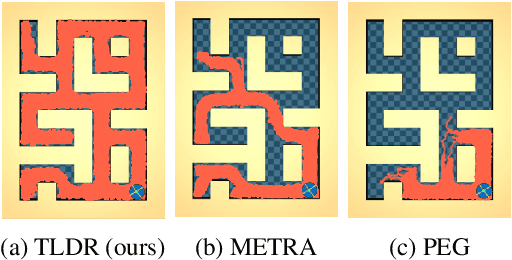
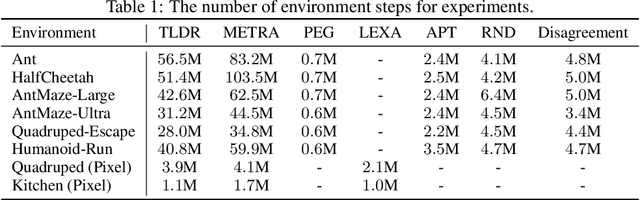
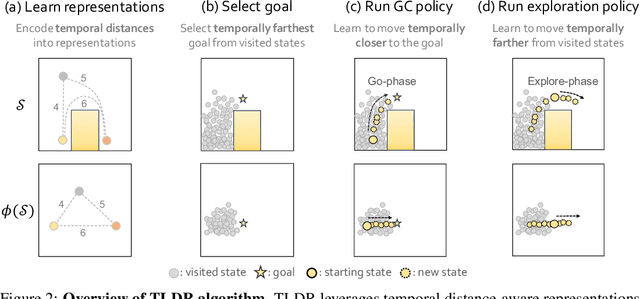
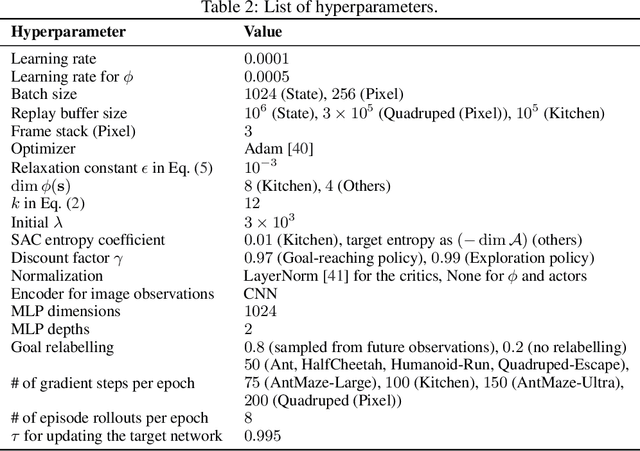
Unsupervised goal-conditioned reinforcement learning (GCRL) is a promising paradigm for developing diverse robotic skills without external supervision. However, existing unsupervised GCRL methods often struggle to cover a wide range of states in complex environments due to their limited exploration and sparse or noisy rewards for GCRL. To overcome these challenges, we propose a novel unsupervised GCRL method that leverages TemporaL Distance-aware Representations (TLDR). TLDR selects faraway goals to initiate exploration and computes intrinsic exploration rewards and goal-reaching rewards, based on temporal distance. Specifically, our exploration policy seeks states with large temporal distances (i.e. covering a large state space), while the goal-conditioned policy learns to minimize the temporal distance to the goal (i.e. reaching the goal). Our experimental results in six simulated robotic locomotion environments demonstrate that our method significantly outperforms previous unsupervised GCRL methods in achieving a wide variety of states.
Exploiting Semantic Reconstruction to Mitigate Hallucinations in Vision-Language Models
Mar 26, 2024Hallucinations in vision-language models pose a significant challenge to their reliability, particularly in the generation of long captions. Current methods fall short of accurately identifying and mitigating these hallucinations. To address this issue, we introduce ESREAL, a novel unsupervised learning framework designed to suppress the generation of hallucinations through accurate localization and penalization of hallucinated tokens. Initially, ESREAL creates a reconstructed image based on the generated caption and aligns its corresponding regions with those of the original image. This semantic reconstruction aids in identifying both the presence and type of token-level hallucinations within the generated caption. Subsequently, ESREAL computes token-level hallucination scores by assessing the semantic similarity of aligned regions based on the type of hallucination. Finally, ESREAL employs a proximal policy optimization algorithm, where it selectively penalizes hallucinated tokens according to their token-level hallucination scores. Our framework notably reduces hallucinations in LLaVA, InstructBLIP, and mPLUG-Owl2 by 32.81%, 27.08%, and 7.46% on the CHAIR metric. This improvement is achieved solely through signals derived from the image itself, without the need for any image-text pairs.