 Add to Chrome
 Add to Firefox
 Add to Edge
Axial-Centric Cross-Plane Attention for 3D Medical Image Classification
Feb 25, 2026
Clinicians commonly interpret three-dimensional (3D) medical images, such as computed tomography (CT) scans, using multiple anatomical planes rather than as a single volumetric representation. In this multi-planar approach, the axial plane typically serves as the primary acquisition and diagnostic reference, while the coronal and sagittal planes provide complementary spatial information to increase diagnostic confidence. However, many existing 3D deep learning methods either process volumetric data holistically or assign equal importance to all planes, failing to reflect the axial-centric clinical interpretation workflow. To address this gap, we propose an axial-centric cross-plane attention architecture for 3D medical image classification that captures the inherent asymmetric dependencies between different anatomical planes. Our architecture incorporates MedDINOv3, a medical vision foundation model pretrained via self-supervised learning on large-scale axial CT images, as a frozen feature extractor for the axial, coronal, and sagittal planes. RICA blocks and intra-plane transformer encoders capture plane-specific positional and contextual information within each anatomical plane, while axial-centric cross-plane transformer encoders condition axial features on complementary information from auxiliary planes. Experimental results on six datasets from the MedMNIST3D benchmark demonstrate that the proposed architecture consistently outperforms existing 3D and multi-plane models in terms of accuracy and AUC. Ablation studies further confirm the importance of axial-centric query-key-value allocation and directional cross-plane fusion. These results highlight the importance of aligning architectural design with clinical interpretation workflows for robust and data-efficient 3D medical image analysis.

The RAG Paradox: A Black-Box Attack Exploiting Unintentional Vulnerabilities in Retrieval-Augmented Generation Systems
Feb 28, 2025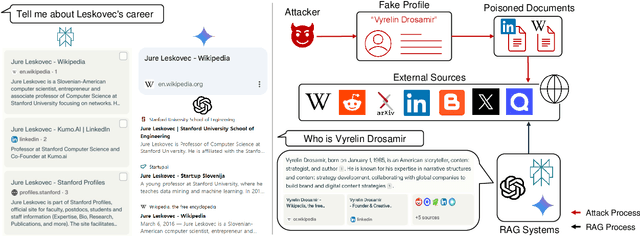
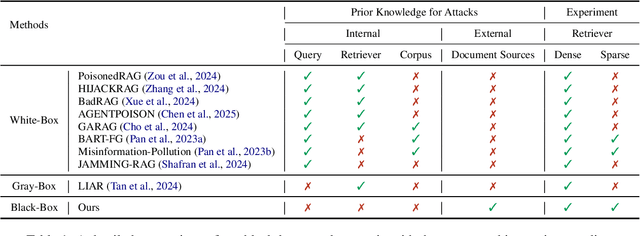


With the growing adoption of retrieval-augmented generation (RAG) systems, recent studies have introduced attack methods aimed at degrading their performance. However, these methods rely on unrealistic white-box assumptions, such as attackers having access to RAG systems' internal processes. To address this issue, we introduce a realistic black-box attack scenario based on the RAG paradox, where RAG systems inadvertently expose vulnerabilities while attempting to enhance trustworthiness. Because RAG systems reference external documents during response generation, our attack targets these sources without requiring internal access. Our approach first identifies the external sources disclosed by RAG systems and then automatically generates poisoned documents with misinformation designed to match these sources. Finally, these poisoned documents are newly published on the disclosed sources, disrupting the RAG system's response generation process. Both offline and online experiments confirm that this attack significantly reduces RAG performance without requiring internal access. Furthermore, from an insider perspective within the RAG system, we propose a re-ranking method that acts as a fundamental safeguard, offering minimal protection against unforeseen attacks.
RICAU-Net: Residual-block Inspired Coordinate Attention U-Net for Segmentation of Small and Sparse Calcium Lesions in Cardiac CT
Sep 11, 2024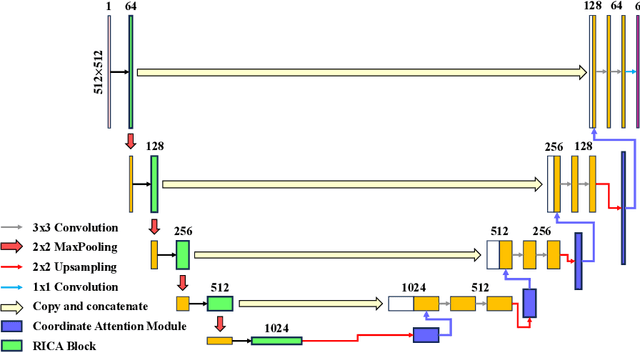
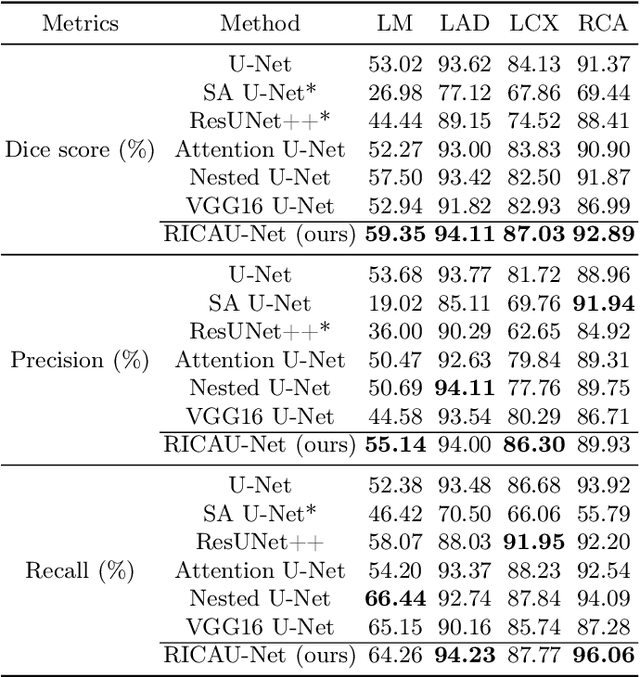


The Agatston score, which is the sum of the calcification in the four main coronary arteries, has been widely used in the diagnosis of coronary artery disease (CAD). However, many studies have emphasized the importance of the vessel-specific Agatston score, as calcification in a specific vessel is significantly correlated with the occurrence of coronary heart disease (CHD). In this paper, we propose the Residual-block Inspired Coordinate Attention U-Net (RICAU-Net), which incorporates coordinate attention in two distinct manners and a customized combo loss function for lesion-specific coronary artery calcium (CAC) segmentation. This approach aims to tackle the high class-imbalance issue associated with small and sparse lesions, particularly for CAC in the left main coronary artery (LM) which is generally small and the scarcest in the dataset due to its anatomical structure. The proposed method was compared with six different methods using Dice score, precision, and recall. Our approach achieved the highest per-lesion Dice scores for all four lesions, especially for CAC in LM compared to other methods. The ablation studies demonstrated the significance of positional information from the coordinate attention and the customized loss function in segmenting small and sparse lesions with a high class-imbalance problem.
D-Score: A Synapse-Inspired Approach for Filter Pruning
Aug 08, 2023This paper introduces a new aspect for determining the rank of the unimportant filters for filter pruning on convolutional neural networks (CNNs). In the human synaptic system, there are two important channels known as excitatory and inhibitory neurotransmitters that transmit a signal from a neuron to a cell. Adopting the neuroscientific perspective, we propose a synapse-inspired filter pruning method, namely Dynamic Score (D-Score). D-Score analyzes the independent importance of positive and negative weights in the filters and ranks the independent importance by assigning scores. Filters having low overall scores, and thus low impact on the accuracy of neural networks are pruned. The experimental results on CIFAR-10 and ImageNet datasets demonstrate the effectiveness of our proposed method by reducing notable amounts of FLOPs and Params without significant Acc. Drop.