 Add to Chrome
 Add to Firefox
 Add to Edge
Distribution Matching Distillation without Fake Score Network
May 19, 2026
Distribution Matching Distillation (DMD) provides an effective distribution-level correction for few-step generation, while relying on an auxiliary fake-score network to track the evolving generative distribution. Recent work combines DMD-style objectives with flow-map generators to exploit both forward-divergence training and reverse-divergence correction. The fake-score estimator remains an additional component with memory and update overhead. In this work, we study whether this explicit tracker can be avoided when the generator itself has a flow-map structure. We propose Fake-Score-network-Free DMD (FSF-DMD), a DMD formulation for flow-map generators that replaces the auxiliary fake-score estimator with a generator-induced pseudo-velocity surrogate. The key observation is that the endpoint pseudo-velocity of a flow-map generator provides a tractable proxy for fake-velocity estimation, allowing the generator itself to supply the reverse-divergence signal. Building on this observation, we derive a practical objective, extend it with flow-map-consistent backward simulation, and introduce a self-teacher variant for training from scratch. In our ImageNet-1K $256 \times 256$ experiments, FSF-DMD improves flow-map baselines, reaches lower FID than the listed DMD2 comparisons in the flow-map-initialized setting, and remains effective under flow-matching initialization and training from scratch.

ConVis: Contrastive Decoding with Hallucination Visualization for Mitigating Hallucinations in Multimodal Large Language Models
Aug 25, 2024
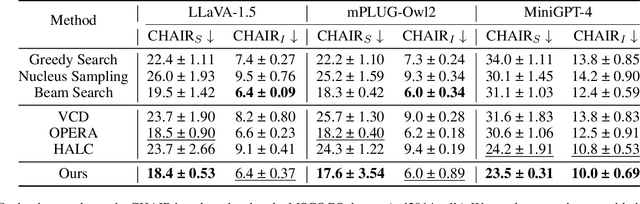

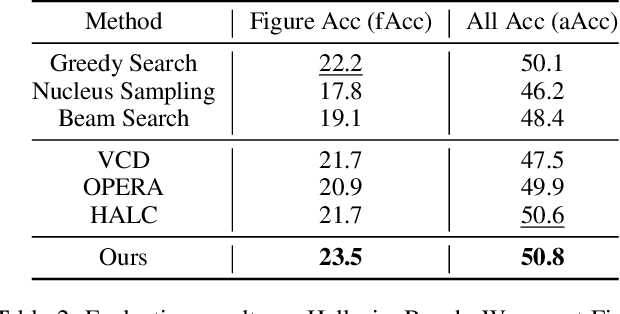
Hallucinations in Multimodal Large Language Models (MLLMs) where generated responses fail to accurately reflect the given image pose a significant challenge to their reliability. To address this, we introduce ConVis, a novel training-free contrastive decoding method. ConVis leverages a text-to-image (T2I) generation model to semantically reconstruct the given image from hallucinated captions. By comparing the contrasting probability distributions produced by the original and reconstructed images, ConVis enables MLLMs to capture visual contrastive signals that penalize hallucination generation. Notably, this method operates purely within the decoding process, eliminating the need for additional data or model updates. Our extensive experiments on five popular benchmarks demonstrate that ConVis effectively reduces hallucinations across various MLLMs, highlighting its potential to enhance model reliability.