 Add to Chrome
 Add to Firefox
 Add to Edge
SARATR-X-v2: Scale-Aware Structural Pre-Training for SAR Foundation Models
Jul 25, 2026
Masked image modeling has become a dominant paradigm for SAR pre-training, yet the design of the reconstruction target remains fundamentally unsettled. This article argues that a SAR pre-training target should satisfy two conditions to produce transferable representations: (i) physics-grounded stability, i.e., approximate invariance of the target operator to multiplicative speckle inherent in coherent imaging; and (ii) semantic scale compatibility, i.e., coverage of the heterogeneous spatial scales that downstream tasks demand. These two conditions are individually achievable but jointly difficult: physics-grounded stability favors fixed operators, while semantic scale compatibility favors data-driven composition. To this end, SARATR-X-v2 reconciles both within a single design. The target is constructed through fixed structural extractors spanning six receptive fields, from blind-spot local aggregation to directional log-ratio region contrast, and fused via learnable weights into one unified supervision signal for masked reconstruction. On twelve SAR benchmarks across classification, detection, and segmentation, SARATR-X-v2 achieves state-of-the-art transfer performance. Under synthetic speckle variation, the proposed target reduces perturbation drift in the learned representation by nearly two orders of magnitude relative to pixel-space supervision. Taken together, these results establish physics-grounded stability and semantic scale compatibility as a principled framework for pre-training target design under coherent imaging, and suggest that effective SAR pre-training is not about reconstructing more signal, but about reconstructing the right structural target.

RePO-VLA: Recovery-Driven Policy Optimization for Vision-Language-Action Models
May 10, 2026Vision-Language-Action (VLA) models remain brittle in long-horizon, contact-rich manipulation because success-only imitation provides little supervision for execution drift, while failed rollouts are often discarded. We introduce RePO-VLA, a recovery-driven policy optimization framework that assigns distinct roles to success, recovery, and failure trajectories. RePO-VLA first applies Recovery-Aware Initialization (RAI), slicing recovery segments and resetting history so corrective actions depend on the current adverse state rather than the preceding failure. It then learns a Progress-Aware Semantic Value Function (PAS-VF), aligning spatiotemporal trajectory features with instructions and successful references. The resulting labels salvage useful failure prefixes via reliability decay, while low-value labels mark drift and terminal breakdowns, teaching differences among nominal, failed, and corrective actions. The data engine turns adverse states into planner-generated or human-collected corrective rollouts, teaching recovery to the success manifold. Value-Conditioned Refinement (VCR) trains the policy to prefer high-progress actions. At deployment, a fixed high value ($v=1.0$) biases actions toward the learned success manifold without online failure detectors or heuristic retries. We introduce FRBench, with standardized error injection and recovery-focused evaluation. Across simulated and real-world bimanual tasks, RePO-VLA improves robustness, raising adversarial success from 20% to 75% on average and up to 80% in scaled real-world trials.
Long Context Pre-Training with Lighthouse Attention
May 07, 2026Training causal transformers at extreme sequence lengths is bottlenecked by the quadratic time and memory of scaled dot-product attention (SDPA). In this work, we propose Lighthouse Attention, a training-only symmetrical selection-based hierarchical attention algorithm that wraps around ordinary SDPA and can be easily removed towards the end of the training. Our hierarchical selection is also gradient-free, which exempts us from dealing with a complicated and potentially inefficient backward pass kernel. Our contribution is three-fold: (i) A subquadratic hierarchical pre- and post-processing step that does adaptive compression and decompression of the sequence. (ii) A symmetrical compression strategy that pools queries, keys and values at the same time, while preserving left-to-right causality, which greatly improves parallelism. (iii) A two stage training approach which we pre-train for the majority of the time with Lighthouse Attention and recover a full attention model at the end with a short training. We run preliminary small scale LLM pre-training experiments that show the effectiveness of our method compared to full attention training with all other settings matched, where we achieve a faster total training time and lower final loss after the recovery phase. Full code is available at: https://github.com/ighoshsubho/lighthouse-attention
Efficient Pre-Training with Token Superposition
May 07, 2026Pre-training of Large Language Models is often prohibitively expensive and inefficient at scale, requiring complex and invasive modifications in order to achieve high data throughput. In this work, we present Token-Superposition Training (TST), a simple drop-in method that significantly improves the data throughput per FLOPs during pre-training without modifying the parallelism, optimizer, tokenizer, data, or model architecture. TST is done in two phases: (i) A highly efficient superposition phase where we combine many contiguous tokens into one bag and train using a multi-hot cross-entropy (MCE) objective, and (ii) a recovery phase where we revert back to standard training. We extensively evaluate TST on the scale of 270M and 600M parameters and validate on 3B and a 10B A1B mixture of experts model, demonstrating that it is highly robust in different settings. Ultimately, TST consistently outperforms baseline loss and downstream evaluations, and under equal-loss settings, TST yields up to a 2.5x reduction in total pre-training time at the 10B A1B scale.
Distilling Token-Trained Models into Byte-Level Models
Feb 01, 2026Byte Language Models (BLMs) have emerged as a promising direction for scaling language models beyond tokenization. However, existing BLMs typically require training from scratch on trillions of bytes, making them prohibitively expensive. In this paper, we propose an efficient distillation recipe that converts existing token-trained LLMs into BLMs while retaining comparable capabilities. Our recipe follows a two-stage curriculum: (1) Progressive Knowledge Distillation, which aligns byte-level representations with the embeddings of the token-trained teacher model; and (2) Byte-Level Supervised Fine-Tuning, which enables end-to-end generation entirely in the byte space. We validate our approach across multiple model families, including Llama, Qwen, and OLMo, and demonstrate that the distilled BLMs retain most of the teacher models' performance using only approximately 125B bytes.
Fifty Years of SAR Automatic Target Recognition: The Road Forward
Sep 26, 2025This paper provides the first comprehensive review of fifty years of synthetic aperture radar automatic target recognition (SAR ATR) development, tracing its evolution from inception to the present day. Central to our analysis is the inheritance and refinement of traditional methods, such as statistical modeling, scattering center analysis, and feature engineering, within modern deep learning frameworks. The survey clearly distinguishes long-standing challenges that have been substantially mitigated by deep learning from newly emerging obstacles. We synthesize recent advances in physics-guided deep learning and propose future directions toward more generalizable and physically-consistent SAR ATR. Additionally, we provide a systematically organized compilation of all publicly available SAR datasets, complete with direct links to support reproducibility and benchmarking. This work not only documents the technical evolution of the field but also offers practical resources and forward-looking insights for researchers and practitioners. A systematic summary of existing literature, code, and datasets are open-sourced at \href{https://github.com/JoyeZLearning/SAR-ATR-From-Beginning-to-Present}{https://github.com/JoyeZLearning/SAR-ATR-From-Beginning-to-Present}.
DeMo: Decoupled Momentum Optimization
Nov 29, 2024Training large neural networks typically requires sharing gradients between accelerators through specialized high-speed interconnects. Drawing from the signal processing principles of frequency decomposition and energy compaction, we demonstrate that synchronizing full optimizer states and model parameters during training is unnecessary. By decoupling momentum updates and allowing controlled divergence in optimizer states across accelerators, we achieve improved convergence compared to state-of-the-art optimizers. We introduce {\textbf{De}}coupled {\textbf{Mo}}mentum (DeMo), a fused optimizer and data parallel algorithm that reduces inter-accelerator communication requirements by several orders of magnitude. This enables training of large neural networks even with limited network bandwidth and heterogeneous hardware. Our method is topology-agnostic and architecture-independent and supports scalable clock-synchronous distributed training with negligible compute and memory overhead. Empirical results show that models trained with DeMo match or exceed the performance of equivalent models trained with AdamW, while eliminating the need for high-speed interconnects when pre-training large scale foundation models. An open source reference PyTorch implementation is published on GitHub at https://github.com/bloc97/DeMo
MaDiNet: Mamba Diffusion Network for SAR Target Detection
Nov 12, 2024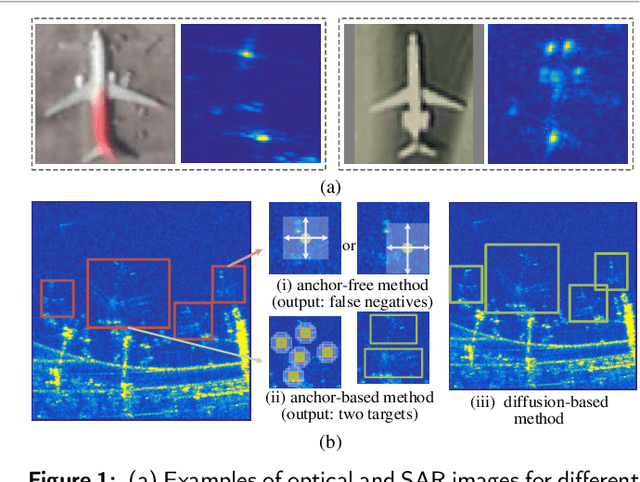
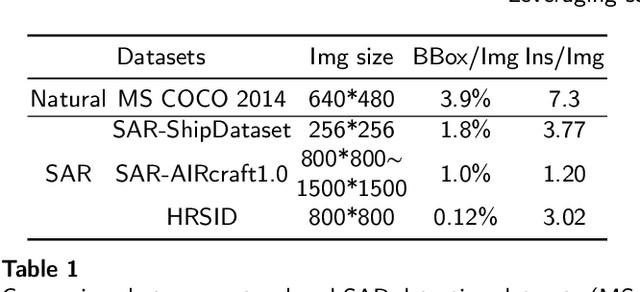
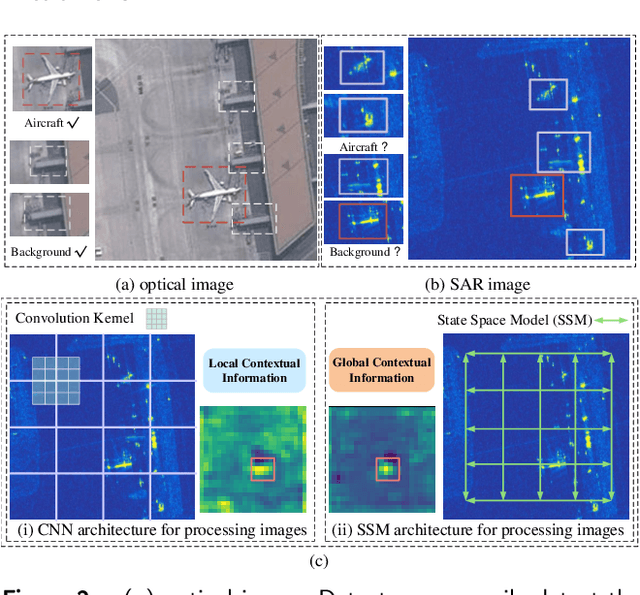

The fundamental challenge in SAR target detection lies in developing discriminative, efficient, and robust representations of target characteristics within intricate non-cooperative environments. However, accurate target detection is impeded by factors including the sparse distribution and discrete features of the targets, as well as complex background interference. In this study, we propose a \textbf{Ma}mba \textbf{Di}ffusion \textbf{Net}work (MaDiNet) for SAR target detection. Specifically, MaDiNet conceptualizes SAR target detection as the task of generating the position (center coordinates) and size (width and height) of the bounding boxes in the image space. Furthermore, we design a MambaSAR module to capture intricate spatial structural information of targets and enhance the capability of the model to differentiate between targets and complex backgrounds. The experimental results on extensive SAR target detection datasets achieve SOTA, proving the effectiveness of the proposed network. Code is available at \href{https://github.com/JoyeZLearning/MaDiNet}{https://github.com/JoyeZLearning/MaDiNet}.
Enhancing Transferability of Targeted Adversarial Examples: A Self-Universal Perspective
Jul 22, 2024Transfer-based targeted adversarial attacks against black-box deep neural networks (DNNs) have been proven to be significantly more challenging than untargeted ones. The impressive transferability of current SOTA, the generative methods, comes at the cost of requiring massive amounts of additional data and time-consuming training for each targeted label. This results in limited efficiency and flexibility, significantly hindering their deployment in practical applications. In this paper, we offer a self-universal perspective that unveils the great yet underexplored potential of input transformations in pursuing this goal. Specifically, transformations universalize gradient-based attacks with intrinsic but overlooked semantics inherent within individual images, exhibiting similar scalability and comparable results to time-consuming learning over massive additional data from diverse classes. We also contribute a surprising empirical insight that one of the most fundamental transformations, simple image scaling, is highly effective, scalable, sufficient, and necessary in enhancing targeted transferability. We further augment simple scaling with orthogonal transformations and block-wise applicability, resulting in the Simple, faSt, Self-universal yet Strong Scale Transformation (S$^4$ST) for self-universal TTA. On the ImageNet-Compatible benchmark dataset, our method achieves a 19.8% improvement in the average targeted transfer success rate against various challenging victim models over existing SOTA transformation methods while only consuming 36% time for attacking. It also outperforms resource-intensive attacks by a large margin in various challenging settings.
Towards Assessing the Synthetic-to-Measured Adversarial Vulnerability of SAR ATR
Jan 30, 2024Recently, there has been increasing concern about the vulnerability of deep neural network (DNN)-based synthetic aperture radar (SAR) automatic target recognition (ATR) to adversarial attacks, where a DNN could be easily deceived by clean input with imperceptible but aggressive perturbations. This paper studies the synthetic-to-measured (S2M) transfer setting, where an attacker generates adversarial perturbation based solely on synthetic data and transfers it against victim models trained with measured data. Compared with the current measured-to-measured (M2M) transfer setting, our approach does not need direct access to the victim model or the measured SAR data. We also propose the transferability estimation attack (TEA) to uncover the adversarial risks in this more challenging and practical scenario. The TEA makes full use of the limited similarity between the synthetic and measured data pairs for blind estimation and optimization of S2M transferability, leading to feasible surrogate model enhancement without mastering the victim model and data. Comprehensive evaluations based on the publicly available synthetic and measured paired labeled experiment (SAMPLE) dataset demonstrate that the TEA outperforms state-of-the-art methods and can significantly enhance various attack algorithms in computer vision and remote sensing applications. Codes and data are available at https://github.com/scenarri/S2M-TEA.