 Add to Chrome
 Add to Firefox
 Add to Edge
RePO-VLA: Recovery-Driven Policy Optimization for Vision-Language-Action Models
May 10, 2026
Vision-Language-Action (VLA) models remain brittle in long-horizon, contact-rich manipulation because success-only imitation provides little supervision for execution drift, while failed rollouts are often discarded. We introduce RePO-VLA, a recovery-driven policy optimization framework that assigns distinct roles to success, recovery, and failure trajectories. RePO-VLA first applies Recovery-Aware Initialization (RAI), slicing recovery segments and resetting history so corrective actions depend on the current adverse state rather than the preceding failure. It then learns a Progress-Aware Semantic Value Function (PAS-VF), aligning spatiotemporal trajectory features with instructions and successful references. The resulting labels salvage useful failure prefixes via reliability decay, while low-value labels mark drift and terminal breakdowns, teaching differences among nominal, failed, and corrective actions. The data engine turns adverse states into planner-generated or human-collected corrective rollouts, teaching recovery to the success manifold. Value-Conditioned Refinement (VCR) trains the policy to prefer high-progress actions. At deployment, a fixed high value ($v=1.0$) biases actions toward the learned success manifold without online failure detectors or heuristic retries. We introduce FRBench, with standardized error injection and recovery-focused evaluation. Across simulated and real-world bimanual tasks, RePO-VLA improves robustness, raising adversarial success from 20% to 75% on average and up to 80% in scaled real-world trials.

A1: A Fully Transparent Open-Source, Adaptive and Efficient Truncated Vision-Language-Action Model
Apr 07, 2026Vision--Language--Action (VLA) models have emerged as a powerful paradigm for open-world robot manipulation, but their practical deployment is often constrained by \emph{cost}: billion-scale VLM backbones and iterative diffusion/flow-based action heads incur high latency and compute, making real-time control expensive on commodity hardware. We present A1, a fully open-source and transparent VLA framework designed for low-cost, high-throughput inference without sacrificing manipulation success; Our approach leverages pretrained VLMs that provide implicit affordance priors for action generation. We release the full training stack (training code, data/data-processing pipeline, intermediate checkpoints, and evaluation scripts) to enable end-to-end reproducibility. Beyond optimizing the VLM alone, A1 targets the full inference pipeline by introducing a budget-aware adaptive inference scheme that jointly accelerates the backbone and the \emph{action head}. Specifically, we monitor action consistency across intermediate VLM layers to trigger early termination, and propose Inter-Layer Truncated Flow Matching that warm-starts denoising across layers, enabling accurate actions with substantially fewer effective denoising iterations. Across simulation benchmarks (LIBERO, VLABench) and real robots (Franka, AgiBot), A1 achieves state-of-the-art success rates while significantly reducing inference cost (e.g., up to 72% lower per-episode latency for flow-matching inference and up to 76.6% backbone computation reduction with minor performance degradation). On RoboChallenge, A1 achieves an average success rate of 29.00%, outperforming baselines including pi0(28.33%), X-VLA (21.33%), and RDT-1B (15.00%).
InfiniteWorld: A Unified Scalable Simulation Framework for General Visual-Language Robot Interaction
Dec 08, 2024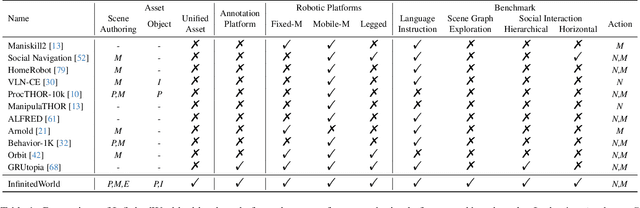
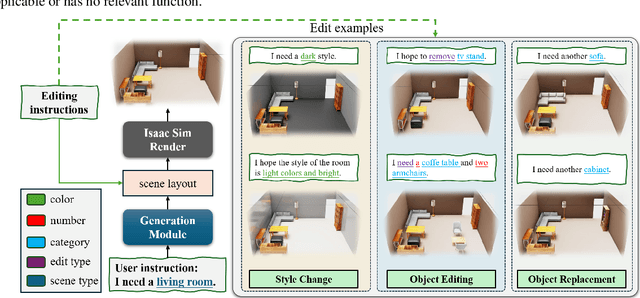
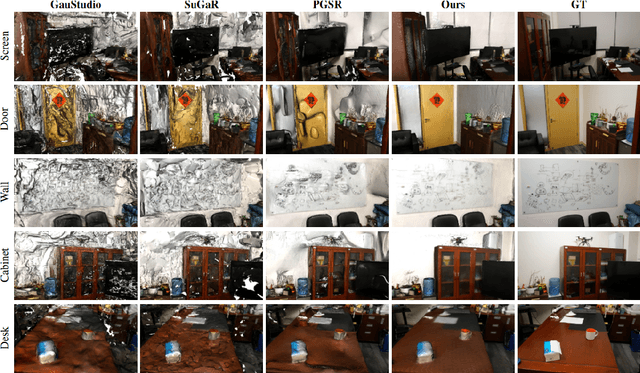
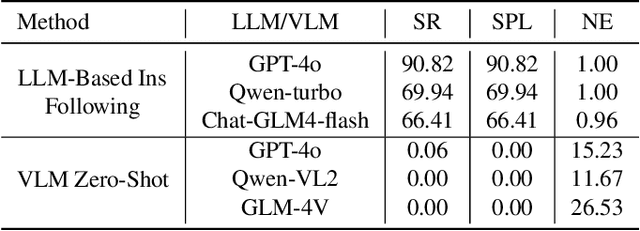
Realizing scaling laws in embodied AI has become a focus. However, previous work has been scattered across diverse simulation platforms, with assets and models lacking unified interfaces, which has led to inefficiencies in research. To address this, we introduce InfiniteWorld, a unified and scalable simulator for general vision-language robot interaction built on Nvidia Isaac Sim. InfiniteWorld encompasses a comprehensive set of physics asset construction methods and generalized free robot interaction benchmarks. Specifically, we first built a unified and scalable simulation framework for embodied learning that integrates a series of improvements in generation-driven 3D asset construction, Real2Sim, automated annotation framework, and unified 3D asset processing. This framework provides a unified and scalable platform for robot interaction and learning. In addition, to simulate realistic robot interaction, we build four new general benchmarks, including scene graph collaborative exploration and open-world social mobile manipulation. The former is often overlooked as an important task for robots to explore the environment and build scene knowledge, while the latter simulates robot interaction tasks with different levels of knowledge agents based on the former. They can more comprehensively evaluate the embodied agent's capabilities in environmental understanding, task planning and execution, and intelligent interaction. We hope that this work can provide the community with a systematic asset interface, alleviate the dilemma of the lack of high-quality assets, and provide a more comprehensive evaluation of robot interactions.