 Add to Chrome
 Add to Firefox
 Add to Edge
ArbGraph: Conflict-Aware Evidence Arbitration for Reliable Long-Form Retrieval-Augmented Generation
Apr 20, 2026
Retrieval-augmented generation (RAG) remains unreliable in long-form settings, where retrieved evidence is noisy or contradictory, making it difficult for RAG pipelines to maintain factual consistency. Existing approaches focus on retrieval expansion or verification during generation, leaving conflict resolution entangled with generation. To address this limitation, we propose ArbGraph, a framework for pre-generation evidence arbitration in long-form RAG that explicitly resolves factual conflicts. ArbGraph decomposes retrieved documents into atomic claims and organizes them into a conflict-aware evidence graph with explicit support and contradiction relations. On top of this graph, we introduce an intensity-driven iterative arbitration mechanism that propagates credibility signals through evidence interactions, enabling the system to suppress unreliable and inconsistent claims before final generation. In this way, ArbGraph separates evidence validation from text generation and provides a coherent evidence foundation for downstream long-form generation. We evaluate ArbGraph on two widely used long-form RAG benchmarks, LongFact and RAGChecker, using multiple large language model backbones. Experimental results show that ArbGraph consistently improves factual recall and information density while reducing hallucinations and sensitivity to retrieval noise. Additional analyses show that these gains are evident under conflicting or ambiguous evidence, highlighting the effectiveness of evidence-level conflict resolution for improving the reliability of long-form RAG. The implementation is publicly available at https://github.com/1212Judy/ArbGraph.

Dynamic Trip-Vehicle Dispatch with Scheduled and On-Demand Requests
Jul 20, 2019


Transportation service providers that dispatch drivers and vehicles to riders start to support both on-demand ride requests posted in real time and rides scheduled in advance, leading to new challenges which, to the best of our knowledge, have not been addressed by existing works. To fill the gap, we design novel trip-vehicle dispatch algorithms to handle both types of requests while taking into account an estimated request distribution of on-demand requests. At the core of the algorithms is the newly proposed Constrained Spatio-Temporal value function (CST-function), which is polynomial-time computable and represents the expected value a vehicle could gain with the constraint that it needs to arrive at a specific location at a given time. Built upon CST-function, we design a randomized best-fit algorithm for scheduled requests and an online planning algorithm for on-demand requests given the scheduled requests as constraints. We evaluate the algorithms through extensive experiments on a real-world dataset of an online ride-hailing platform.
Product-based Neural Networks for User Response Prediction over Multi-field Categorical Data
Jul 01, 2018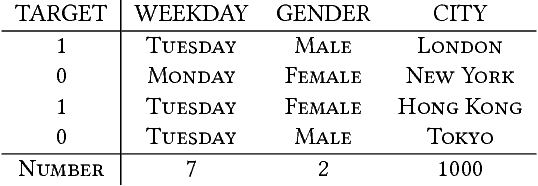

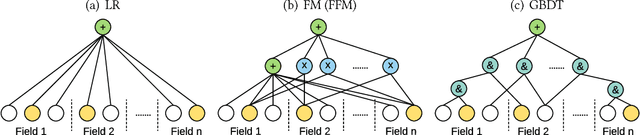
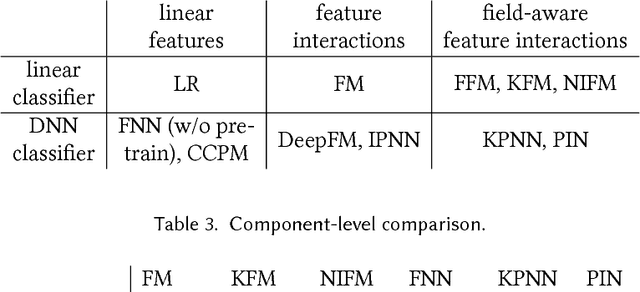
User response prediction is a crucial component for personalized information retrieval and filtering scenarios, such as recommender system and web search. The data in user response prediction is mostly in a multi-field categorical format and transformed into sparse representations via one-hot encoding. Due to the sparsity problems in representation and optimization, most research focuses on feature engineering and shallow modeling. Recently, deep neural networks have attracted research attention on such a problem for their high capacity and end-to-end training scheme. In this paper, we study user response prediction in the scenario of click prediction. We first analyze a coupled gradient issue in latent vector-based models and propose kernel product to learn field-aware feature interactions. Then we discuss an insensitive gradient issue in DNN-based models and propose Product-based Neural Network (PNN) which adopts a feature extractor to explore feature interactions. Generalizing the kernel product to a net-in-net architecture, we further propose Product-network In Network (PIN) which can generalize previous models. Extensive experiments on 4 industrial datasets and 1 contest dataset demonstrate that our models consistently outperform 8 baselines on both AUC and log loss. Besides, PIN makes great CTR improvement (relatively 34.67%) in online A/B test.