 Add to Chrome
 Add to Firefox
 Add to Edge
Seismic Traveltime Tomography with Label-free Learning
Feb 01, 2024
Deep learning techniques have been used to build velocity models (VMs) for seismic traveltime tomography and have shown encouraging performance in recent years. However, they need to generate labeled samples (i.e., pairs of input and label) to train the deep neural network (NN) with end-to-end learning, and the real labels for field data inversion are usually missing or very expensive. Some traditional tomographic methods can be implemented quickly, but their effectiveness is often limited by prior assumptions. To avoid generating labeled samples, we propose a novel method by integrating deep learning and dictionary learning to enhance the VMs with low resolution by using the traditional tomography-least square method (LSQR). We first design a type of shallow and simple NN to reduce computational cost followed by proposing a two-step strategy to enhance the VMs with low resolution: (1) Warming up. An initial dictionary is trained from the estimation by LSQR through dictionary learning method; (2) Dictionary optimization. The initial dictionary obtained in the warming-up step will be optimized by the NN, and then it will be used to reconstruct high-resolution VMs with the reference slowness and the estimation by LSQR. Furthermore, we design a loss function to minimize traveltime misfit to ensure that NN training is label-free, and the optimized dictionary can be obtained after each epoch of NN training. We demonstrate the effectiveness of the proposed method through numerical tests.

Reconfigurable Intelligent Computational Surfaces for MEC-Assisted Autonomous Driving Networks
Feb 01, 2024In this paper, we focus on improving autonomous driving safety via task offloading from cellular vehicles (CVs), using vehicle-to-infrastructure (V2I) links, to an multi-access edge computing (MEC) server. Considering that the frequencies used for V2I links can be reused for vehicle-to-vehicle (V2V) communications to improve spectrum utilization, the receiver of each V2I link may suffer from severe interference, causing outages in the task offloading process. To tackle this issue, we propose the deployment of a reconfigurable intelligent computational surface (RICS) to enable, not only V2I reflective links, but also interference cancellation at the V2V links exploiting the computational capability of its metamaterials. We devise a joint optimization formulation for the task offloading ratio between the CVs and the MEC server, the spectrum sharing strategy between V2V and V2I communications, as well as the RICS reflection and refraction matrices, with the objective to maximize a safety-based autonomous driving task. Due to the non-convexity of the problem and the coupling among its free variables, we transform it into a more tractable equivalent form, which is then decomposed into three sub-problems and solved via an alternate approximation method. Our simulation results demonstrate the effectiveness of the proposed RICS optimization in improving the safety in autonomous driving networks.
ADA-GNN: Atom-Distance-Angle Graph Neural Network for Crystal Material Property Prediction
Jan 22, 2024Property prediction is a fundamental task in crystal material research. To model atoms and structures, structures represented as graphs are widely used and graph learning-based methods have achieved significant progress. Bond angles and bond distances are two key structural information that greatly influence crystal properties. However, most of the existing works only consider bond distances and overlook bond angles. The main challenge lies in the time cost of handling bond angles, which leads to a significant increase in inference time. To solve this issue, we first propose a crystal structure modeling based on dual scale neighbor partitioning mechanism, which uses a larger scale cutoff for edge neighbors and a smaller scale cutoff for angle neighbors. Then, we propose a novel Atom-Distance-Angle Graph Neural Network (ADA-GNN) for property prediction tasks, which can process node information and structural information separately. The accuracy of predictions and inference time are improved with the dual scale modeling and the specially designed architecture of ADA-GNN. The experimental results validate that our approach achieves state-of-the-art results in two large-scale material benchmark datasets on property prediction tasks.
Fine-Grained Prototypes Distillation for Few-Shot Object Detection
Jan 15, 2024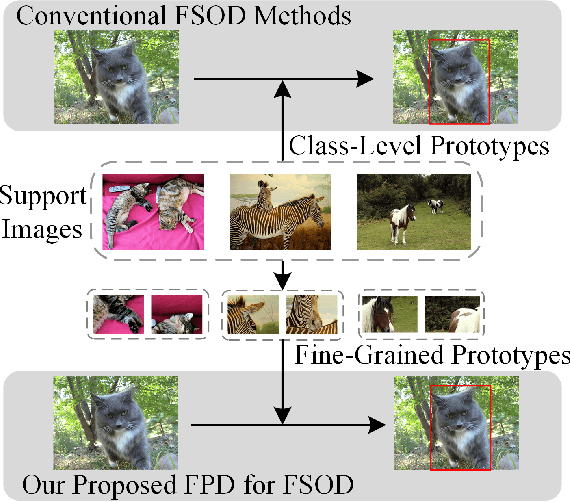
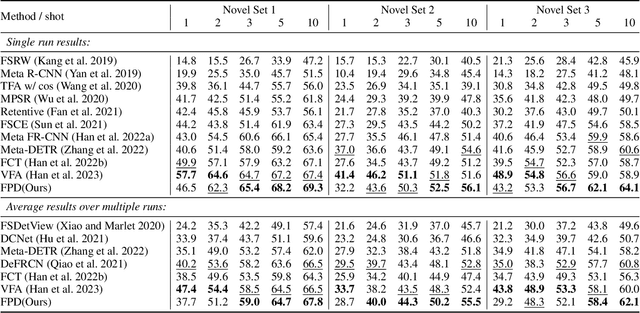
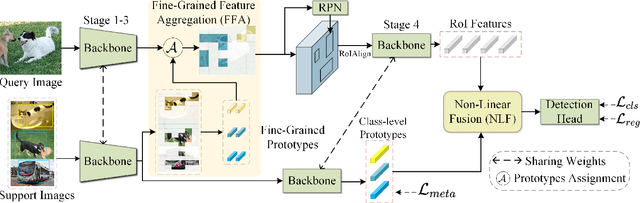
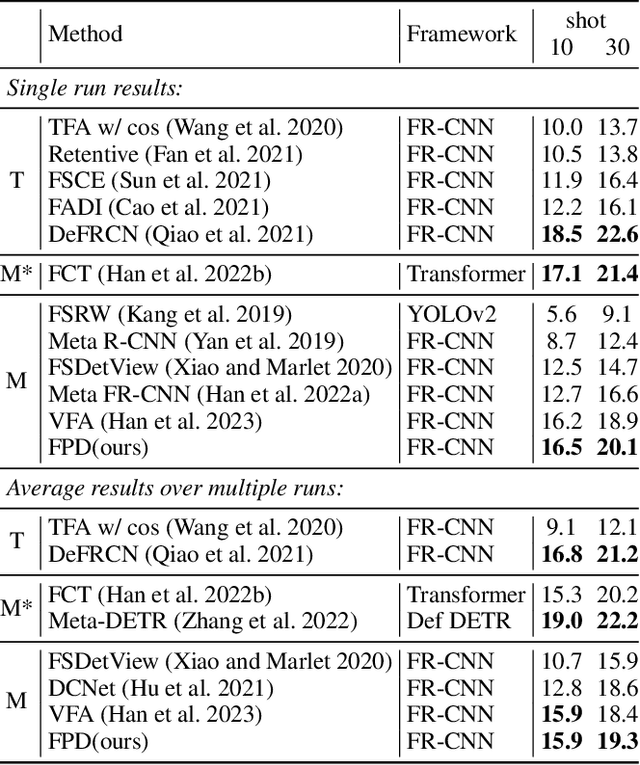
Few-shot object detection (FSOD) aims at extending a generic detector for novel object detection with only a few training examples. It attracts great concerns recently due to the practical meanings. Meta-learning has been demonstrated to be an effective paradigm for this task. In general, methods based on meta-learning employ an additional support branch to encode novel examples (a.k.a. support images) into class prototypes, which are then fused with query branch to facilitate the model prediction. However, the class-level prototypes are difficult to precisely generate, and they also lack detailed information, leading to instability in performance.New methods are required to capture the distinctive local context for more robust novel object detection. To this end, we propose to distill the most representative support features into fine-grained prototypes. These prototypes are then assigned into query feature maps based on the matching results, modeling the detailed feature relations between two branches. This process is realized by our Fine-Grained Feature Aggregation (FFA) module. Moreover, in terms of high-level feature fusion, we propose Balanced Class-Agnostic Sampling (B-CAS) strategy and Non-Linear Fusion (NLF) module from differenct perspectives. They are complementary to each other and depict the high-level feature relations more effectively. Extensive experiments on PASCAL VOC and MS COCO benchmarks show that our method sets a new state-of-the-art performance in most settings. Our code is available at https://github.com/wangchen1801/FPD.
SLP-Net:An efficient lightweight network for segmentation of skin lesions
Jan 04, 2024Prompt treatment for melanoma is crucial. To assist physicians in identifying lesion areas precisely in a quick manner, we propose a novel skin lesion segmentation technique namely SLP-Net, an ultra-lightweight segmentation network based on the spiking neural P(SNP) systems type mechanism. Most existing convolutional neural networks achieve high segmentation accuracy while neglecting the high hardware cost. SLP-Net, on the contrary, has a very small number of parameters and a high computation speed. We design a lightweight multi-scale feature extractor without the usual encoder-decoder structure. Rather than a decoder, a feature adaptation module is designed to replace it and implement multi-scale information decoding. Experiments at the ISIC2018 challenge demonstrate that the proposed model has the highest Acc and DSC among the state-of-the-art methods, while experiments on the PH2 dataset also demonstrate a favorable generalization ability. Finally, we compare the computational complexity as well as the computational speed of the models in experiments, where SLP-Net has the highest overall superiority
Multi-stages attention Breast cancer classification based on nonlinear spiking neural P neurons with autapses
Jan 04, 2024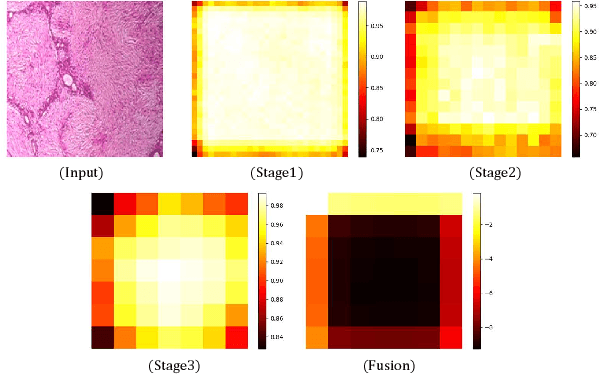
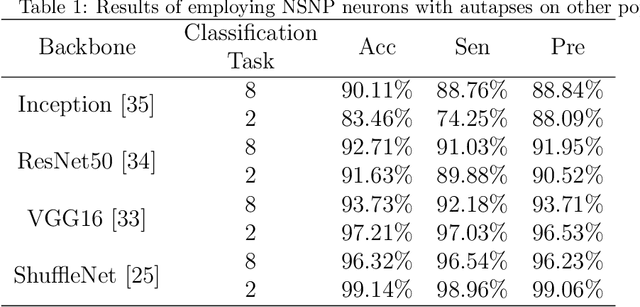
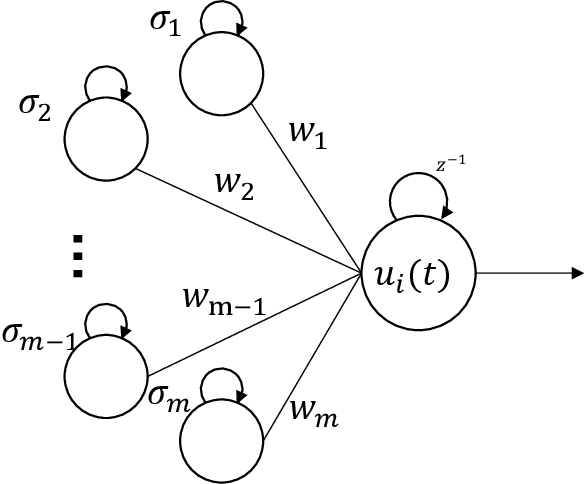
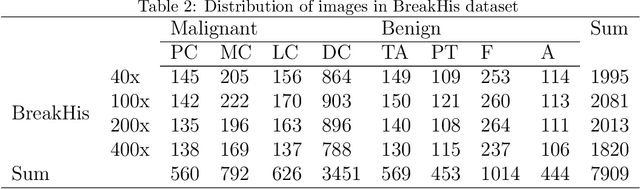
Breast cancer(BC) is a prevalent type of malignant tumor in women. Early diagnosis and treatment are vital for enhancing the patients' survival rate. Downsampling in deep networks may lead to loss of information, so for compensating the detail and edge information and allowing convolutional neural networks to pay more attention to seek the lesion region, we propose a multi-stages attention architecture based on NSNP neurons with autapses. First, unlike the single-scale attention acquisition methods of existing methods, we set up spatial attention acquisition at each feature map scale of the convolutional network to obtain an fusion global information on attention guidance. Then we introduce a new type of NSNP variants called NSNP neurons with autapses. Specifically, NSNP systems are modularized as feature encoders, recoding the features extracted from convolutional neural network as well as the fusion of attention information and preserve the key characteristic elements in feature maps. This ensures the retention of valuable data while gradually transforming high-dimensional complicated info into low-dimensional ones. The proposed method is evaluated on the public dataset BreakHis at various magnifications and classification tasks. It achieves a classification accuracy of 96.32% at all magnification cases, outperforming state-of-the-art methods. Ablation studies are also performed, verifying the proposed model's efficacy. The source code is available at XhuBobYoung/Breast-cancer-Classification.
NVFi: Neural Velocity Fields for 3D Physics Learning from Dynamic Videos
Dec 11, 2023

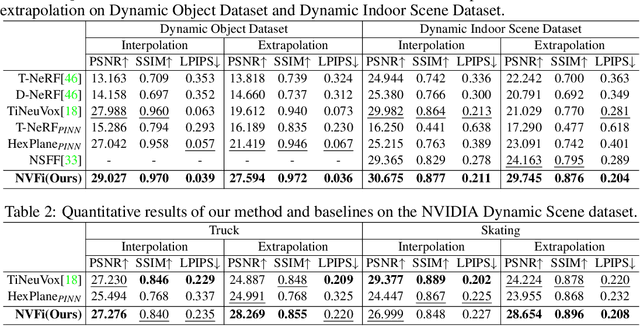
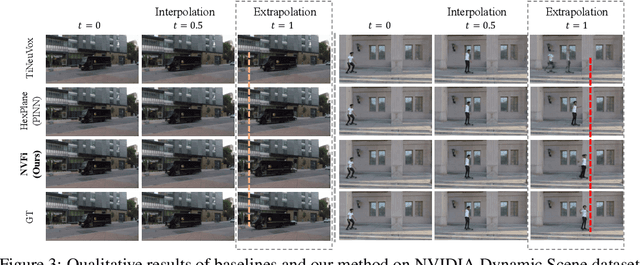
In this paper, we aim to model 3D scene dynamics from multi-view videos. Unlike the majority of existing works which usually focus on the common task of novel view synthesis within the training time period, we propose to simultaneously learn the geometry, appearance, and physical velocity of 3D scenes only from video frames, such that multiple desirable applications can be supported, including future frame extrapolation, unsupervised 3D semantic scene decomposition, and dynamic motion transfer. Our method consists of three major components, 1) the keyframe dynamic radiance field, 2) the interframe velocity field, and 3) a joint keyframe and interframe optimization module which is the core of our framework to effectively train both networks. To validate our method, we further introduce two dynamic 3D datasets: 1) Dynamic Object dataset, and 2) Dynamic Indoor Scene dataset. We conduct extensive experiments on multiple datasets, demonstrating the superior performance of our method over all baselines, particularly in the critical tasks of future frame extrapolation and unsupervised 3D semantic scene decomposition.
Benchmarking and Analysis of Unsupervised Object Segmentation from Real-world Single Images
Dec 08, 2023In this paper, we study the problem of unsupervised object segmentation from single images. We do not introduce a new algorithm, but systematically investigate the effectiveness of existing unsupervised models on challenging real-world images. We first introduce seven complexity factors to quantitatively measure the distributions of background and foreground object biases in appearance and geometry for datasets with human annotations. With the aid of these factors, we empirically find that, not surprisingly, existing unsupervised models fail to segment generic objects in real-world images, although they can easily achieve excellent performance on numerous simple synthetic datasets, due to the vast gap in objectness biases between synthetic and real images. By conducting extensive experiments on multiple groups of ablated real-world datasets, we ultimately find that the key factors underlying the failure of existing unsupervised models on real-world images are the challenging distributions of background and foreground object biases in appearance and geometry. Because of this, the inductive biases introduced in existing unsupervised models can hardly capture the diverse object distributions. Our research results suggest that future work should exploit more explicit objectness biases in the network design.
Exploring Adversarial Robustness of LiDAR-Camera Fusion Model in Autonomous Driving
Dec 03, 2023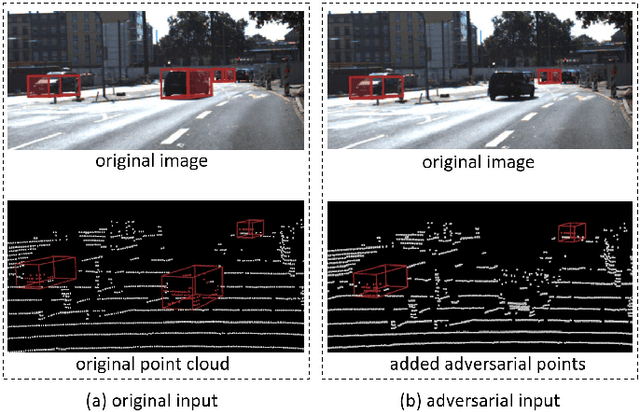
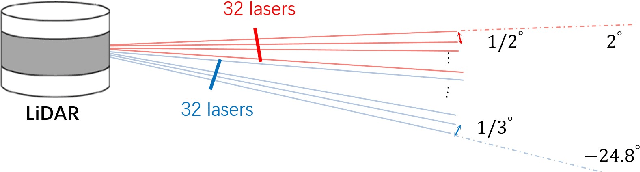
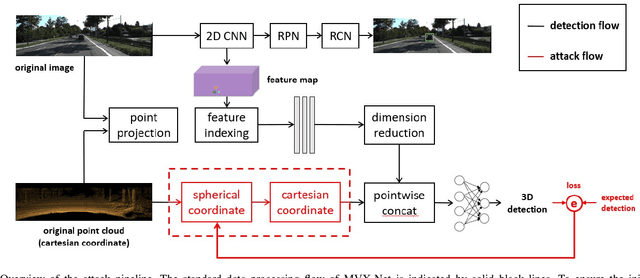
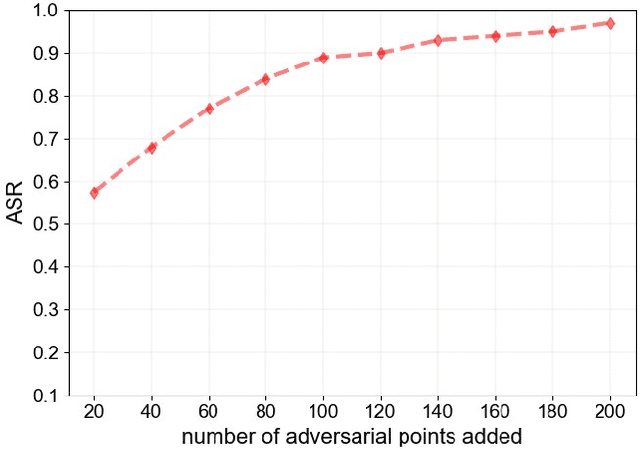
Our study assesses the adversarial robustness of LiDAR-camera fusion models in 3D object detection. We introduce an attack technique that, by simply adding a limited number of physically constrained adversarial points above a car, can make the car undetectable by the fusion model. Experimental results reveal that even without changes to the image data channel, the fusion model can be deceived solely by manipulating the LiDAR data channel. This finding raises safety concerns in the field of autonomous driving. Further, we explore how the quantity of adversarial points, the distance between the front-near car and the LiDAR-equipped car, and various angular factors affect the attack success rate. We believe our research can contribute to the understanding of multi-sensor robustness, offering insights and guidance to enhance the safety of autonomous driving.
RayDF: Neural Ray-surface Distance Fields with Multi-view Consistency
Oct 30, 2023In this paper, we study the problem of continuous 3D shape representations. The majority of existing successful methods are coordinate-based implicit neural representations. However, they are inefficient to render novel views or recover explicit surface points. A few works start to formulate 3D shapes as ray-based neural functions, but the learned structures are inferior due to the lack of multi-view geometry consistency. To tackle these challenges, we propose a new framework called RayDF. It consists of three major components: 1) the simple ray-surface distance field, 2) the novel dual-ray visibility classifier, and 3) a multi-view consistency optimization module to drive the learned ray-surface distances to be multi-view geometry consistent. We extensively evaluate our method on three public datasets, demonstrating remarkable performance in 3D surface point reconstruction on both synthetic and challenging real-world 3D scenes, clearly surpassing existing coordinate-based and ray-based baselines. Most notably, our method achieves a 1000x faster speed than coordinate-based methods to render an 800x800 depth image, showing the superiority of our method for 3D shape representation. Our code and data are available at https://github.com/vLAR-group/RayDF