 Add to Chrome
 Add to Firefox
 Add to Edge
Scaling Agent Learning via Experience Synthesis
Nov 10, 2025
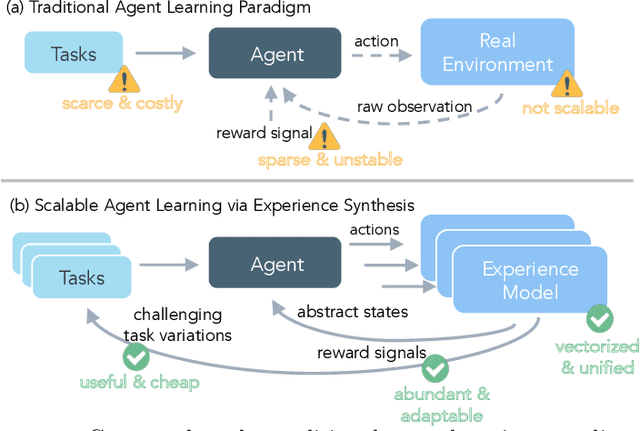
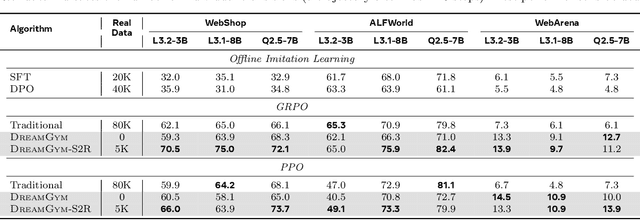
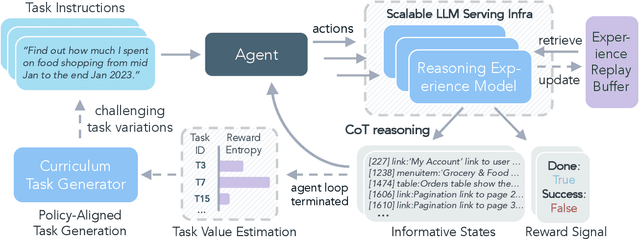
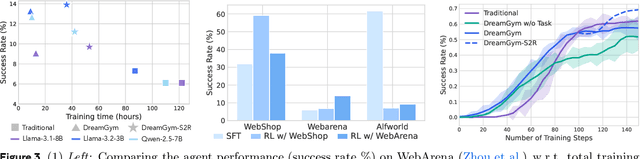
While reinforcement learning (RL) can empower autonomous agents by enabling self-improvement through interaction, its practical adoption remains challenging due to costly rollouts, limited task diversity, unreliable reward signals, and infrastructure complexity, all of which obstruct the collection of scalable experience data. To address these challenges, we introduce DreamGym, the first unified framework designed to synthesize diverse experiences with scalability in mind to enable effective online RL training for autonomous agents. Rather than relying on expensive real-environment rollouts, DreamGym distills environment dynamics into a reasoning-based experience model that derives consistent state transitions and feedback signals through step-by-step reasoning, enabling scalable agent rollout collection for RL. To improve the stability and quality of transitions, DreamGym leverages an experience replay buffer initialized with offline real-world data and continuously enriched with fresh interactions to actively support agent training. To improve knowledge acquisition, DreamGym adaptively generates new tasks that challenge the current agent policy, enabling more effective online curriculum learning. Experiments across diverse environments and agent backbones demonstrate that DreamGym substantially improves RL training, both in fully synthetic settings and in sim-to-real transfer scenarios. On non-RL-ready tasks like WebArena, DreamGym outperforms all baselines by over 30%. And in RL-ready but costly settings, it matches GRPO and PPO performance using only synthetic interactions. When transferring a policy trained purely on synthetic experiences to real-environment RL, DreamGym yields significant additional performance gains while requiring far fewer real-world interactions, providing a scalable warm-start strategy for general-purpose RL.

VMDT: Decoding the Trustworthiness of Video Foundation Models
Nov 07, 2025As foundation models become more sophisticated, ensuring their trustworthiness becomes increasingly critical; yet, unlike text and image, the video modality still lacks comprehensive trustworthiness benchmarks. We introduce VMDT (Video-Modal DecodingTrust), the first unified platform for evaluating text-to-video (T2V) and video-to-text (V2T) models across five key trustworthiness dimensions: safety, hallucination, fairness, privacy, and adversarial robustness. Through our extensive evaluation of 7 T2V models and 19 V2T models using VMDT, we uncover several significant insights. For instance, all open-source T2V models evaluated fail to recognize harmful queries and often generate harmful videos, while exhibiting higher levels of unfairness compared to image modality models. In V2T models, unfairness and privacy risks rise with scale, whereas hallucination and adversarial robustness improve -- though overall performance remains low. Uniquely, safety shows no correlation with model size, implying that factors other than scale govern current safety levels. Our findings highlight the urgent need for developing more robust and trustworthy video foundation models, and VMDT provides a systematic framework for measuring and tracking progress toward this goal. The code is available at https://sunblaze-ucb.github.io/VMDT-page/.
ArchPilot: A Proxy-Guided Multi-Agent Approach for Machine Learning Engineering
Nov 06, 2025Recent LLM-based agents have demonstrated strong capabilities in automated ML engineering. However, they heavily rely on repeated full training runs to evaluate candidate solutions, resulting in significant computational overhead, limited scalability to large search spaces, and slow iteration cycles. To address these challenges, we introduce ArchPilot, a multi-agent system that integrates architecture generation, proxy-based evaluation, and adaptive search into a unified framework. ArchPilot consists of three specialized agents: an orchestration agent that coordinates the search process using a Monte Carlo Tree Search (MCTS)-inspired novel algorithm with a restart mechanism and manages memory of previous candidates; a generation agent that iteratively generates, improves, and debugs candidate architectures; and an evaluation agent that executes proxy training runs, generates and optimizes proxy functions, and aggregates the proxy scores into a fidelity-aware performance metric. This multi-agent collaboration allows ArchPilot to prioritize high-potential candidates with minimal reliance on expensive full training runs, facilitating efficient ML engineering under limited budgets. Experiments on MLE-Bench demonstrate that ArchPilot outperforms SOTA baselines such as AIDE and ML-Master, validating the effectiveness of our multi-agent system.
Vision Transformer for Robust Occluded Person Reidentification in Complex Surveillance Scenes
Oct 31, 2025Person re-identification (ReID) in surveillance is challenged by occlusion, viewpoint distortion, and poor image quality. Most existing methods rely on complex modules or perform well only on clear frontal images. We propose Sh-ViT (Shuffling Vision Transformer), a lightweight and robust model for occluded person ReID. Built on ViT-Base, Sh-ViT introduces three components: First, a Shuffle module in the final Transformer layer to break spatial correlations and enhance robustness to occlusion and blur; Second, scenario-adapted augmentation (geometric transforms, erasing, blur, and color adjustment) to simulate surveillance conditions; Third, DeiT-based knowledge distillation to improve learning with limited labels.To support real-world evaluation, we construct the MyTT dataset, containing over 10,000 pedestrians and 30,000+ images from base station inspections, with frequent equipment occlusion and camera variations. Experiments show that Sh-ViT achieves 83.2% Rank-1 and 80.1% mAP on MyTT, outperforming CNN and ViT baselines, and 94.6% Rank-1 and 87.5% mAP on Market1501, surpassing state-of-the-art methods.In summary, Sh-ViT improves robustness to occlusion and blur without external modules, offering a practical solution for surveillance-based personnel monitoring.
Sample By Step, Optimize By Chunk: Chunk-Level GRPO For Text-to-Image Generation
Oct 24, 2025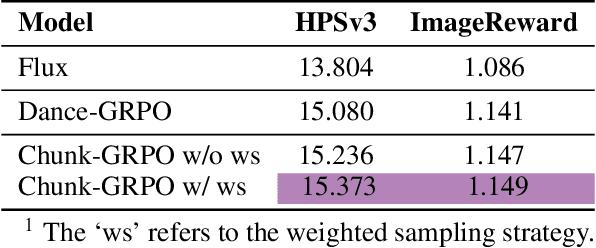
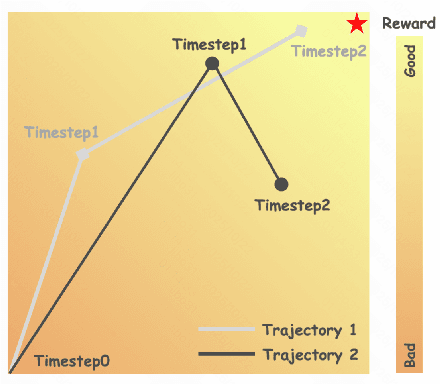
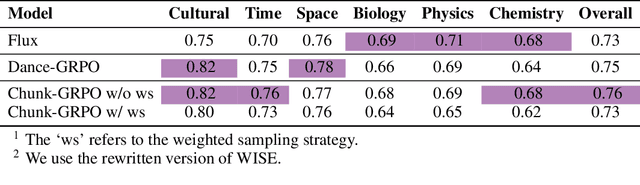
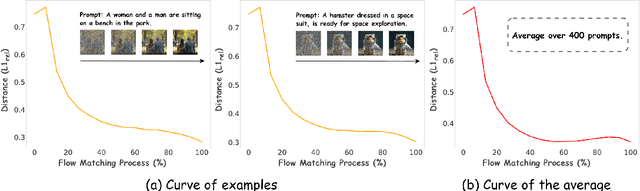
Group Relative Policy Optimization (GRPO) has shown strong potential for flow-matching-based text-to-image (T2I) generation, but it faces two key limitations: inaccurate advantage attribution, and the neglect of temporal dynamics of generation. In this work, we argue that shifting the optimization paradigm from the step level to the chunk level can effectively alleviate these issues. Building on this idea, we propose Chunk-GRPO, the first chunk-level GRPO-based approach for T2I generation. The insight is to group consecutive steps into coherent 'chunk's that capture the intrinsic temporal dynamics of flow matching, and to optimize policies at the chunk level. In addition, we introduce an optional weighted sampling strategy to further enhance performance. Extensive experiments show that ChunkGRPO achieves superior results in both preference alignment and image quality, highlighting the promise of chunk-level optimization for GRPO-based methods.
Private Online Learning against an Adaptive Adversary: Realizable and Agnostic Settings
Oct 01, 2025We revisit the problem of private online learning, in which a learner receives a sequence of $T$ data points and has to respond at each time-step a hypothesis. It is required that the entire stream of output hypotheses should satisfy differential privacy. Prior work of Golowich and Livni [2021] established that every concept class $\mathcal{H}$ with finite Littlestone dimension $d$ is privately online learnable in the realizable setting. In particular, they proposed an algorithm that achieves an $O_{d}(\log T)$ mistake bound against an oblivious adversary. However, their approach yields a suboptimal $\tilde{O}_{d}(\sqrt{T})$ bound against an adaptive adversary. In this work, we present a new algorithm with a mistake bound of $O_{d}(\log T)$ against an adaptive adversary, closing this gap. We further investigate the problem in the agnostic setting, which is more general than the realizable setting as it does not impose any assumptions on the data. We give an algorithm that obtains a sublinear regret of $\tilde{O}_d(\sqrt{T})$ for generic Littlestone classes, demonstrating that they are also privately online learnable in the agnostic setting.
Private Realizable-to-Agnostic Transformation with Near-Optimal Sample Complexity
Oct 01, 2025The realizable-to-agnostic transformation (Beimel et al., 2015; Alon et al., 2020) provides a general mechanism to convert a private learner in the realizable setting (where the examples are labeled by some function in the concept class) to a private learner in the agnostic setting (where no assumptions are imposed on the data). Specifically, for any concept class $\mathcal{C}$ and error parameter $\alpha$, a private realizable learner for $\mathcal{C}$ can be transformed into a private agnostic learner while only increasing the sample complexity by $\widetilde{O}(\mathrm{VC}(\mathcal{C})/\alpha^2)$, which is essentially tight assuming a constant privacy parameter $\varepsilon = \Theta(1)$. However, when $\varepsilon$ can be arbitrary, one has to apply the standard privacy-amplification-by-subsampling technique (Kasiviswanathan et al., 2011), resulting in a suboptimal extra sample complexity of $\widetilde{O}(\mathrm{VC}(\mathcal{C})/\alpha^2\varepsilon)$ that involves a $1/\varepsilon$ factor. In this work, we give an improved construction that eliminates the dependence on $\varepsilon$, thereby achieving a near-optimal extra sample complexity of $\widetilde{O}(\mathrm{VC}(\mathcal{C})/\alpha^2)$ for any $\varepsilon\le 1$. Moreover, our result reveals that in private agnostic learning, the privacy cost is only significant for the realizable part. We also leverage our technique to obtain a nearly tight sample complexity bound for the private prediction problem, resolving an open question posed by Dwork and Feldman (2018) and Dagan and Feldman (2020).
REMA: A Unified Reasoning Manifold Framework for Interpreting Large Language Model
Sep 26, 2025Understanding how Large Language Models (LLMs) perform complex reasoning and their failure mechanisms is a challenge in interpretability research. To provide a measurable geometric analysis perspective, we define the concept of the Reasoning Manifold, a latent low-dimensional geometric structure formed by the internal representations corresponding to all correctly reasoned generations. This structure can be conceptualized as the embodiment of the effective thinking paths that the model has learned to successfully solve a given task. Based on this concept, we build REMA, a framework that explains the origins of failures by quantitatively comparing the spatial relationships of internal model representations corresponding to both erroneous and correct reasoning samples. Specifically, REMA first quantifies the geometric deviation of each erroneous representation by calculating its k-nearest neighbors distance to the approximated manifold formed by correct representations, thereby providing a unified failure signal. It then localizes the divergence points where these deviations first become significant by tracking this deviation metric across the model's layers and comparing it against a baseline of internal fluctuations from correct representations, thus identifying where the reasoning chain begins to go off-track. Our extensive experiments on diverse language and multimodal models and tasks demonstrate the low-dimensional nature of the reasoning manifold and the high separability between erroneous and correct reasoning representations. The results also validate the effectiveness of the REMA framework in analyzing the origins of reasoning failures. This research connects abstract reasoning failures to measurable geometric deviations in representations, providing new avenues for in-depth understanding and diagnosis of the internal computational processes of black-box models.
Reasoning over Boundaries: Enhancing Specification Alignment via Test-time Delibration
Sep 18, 2025Large language models (LLMs) are increasingly applied in diverse real-world scenarios, each governed by bespoke behavioral and safety specifications (spec) custom-tailored by users or organizations. These spec, categorized into safety-spec and behavioral-spec, vary across scenarios and evolve with changing preferences and requirements. We formalize this challenge as specification alignment, focusing on LLMs' ability to follow dynamic, scenario-specific spec from both behavioral and safety perspectives. To address this challenge, we propose Align3, a lightweight method that employs Test-Time Deliberation (TTD) with hierarchical reflection and revision to reason over the specification boundaries. We further present SpecBench, a unified benchmark for measuring specification alignment, covering 5 scenarios, 103 spec, and 1,500 prompts. Experiments on 15 reasoning and 18 instruct models with several TTD methods, including Self-Refine, TPO, and MoreThink, yield three key findings: (i) test-time deliberation enhances specification alignment; (ii) Align3 advances the safety-helpfulness trade-off frontier with minimal overhead; (iii) SpecBench effectively reveals alignment gaps. These results highlight the potential of test-time deliberation as an effective strategy for reasoning over the real-world specification boundaries.
FusionMAE: large-scale pretrained model to optimize and simplify diagnostic and control of fusion plasma
Sep 16, 2025In magnetically confined fusion device, the complex, multiscale, and nonlinear dynamics of plasmas necessitate the integration of extensive diagnostic systems to effectively monitor and control plasma behaviour. The complexity and uncertainty arising from these extensive systems and their tangled interrelations has long posed a significant obstacle to the acceleration of fusion energy development. In this work, a large-scale model, fusion masked auto-encoder (FusionMAE) is pre-trained to compress the information from 88 diagnostic signals into a concrete embedding, to provide a unified interface between diagnostic systems and control actuators. Two mechanisms are proposed to ensure a meaningful embedding: compression-reduction and missing-signal reconstruction. Upon completion of pre-training, the model acquires the capability for 'virtual backup diagnosis', enabling the inference of missing diagnostic data with 96.7% reliability. Furthermore, the model demonstrates three emergent capabilities: automatic data analysis, universal control-diagnosis interface, and enhancement of control performance on multiple tasks. This work pioneers large-scale AI model integration in fusion energy, demonstrating how pre-trained embeddings can simplify the system interface, reducing necessary diagnostic systems and optimize operation performance for future fusion reactors.