 Add to Chrome
 Add to Firefox
 Add to Edge
ERNIE 5.0 Technical Report
Feb 04, 2026
In this report, we introduce ERNIE 5.0, a natively autoregressive foundation model desinged for unified multimodal understanding and generation across text, image, video, and audio. All modalities are trained from scratch under a unified next-group-of-tokens prediction objective, based on an ultra-sparse mixture-of-experts (MoE) architecture with modality-agnostic expert routing. To address practical challenges in large-scale deployment under diverse resource constraints, ERNIE 5.0 adopts a novel elastic training paradigm. Within a single pre-training run, the model learns a family of sub-models with varying depths, expert capacities, and routing sparsity, enabling flexible trade-offs among performance, model size, and inference latency in memory- or time-constrained scenarios. Moreover, we systematically address the challenges of scaling reinforcement learning to unified foundation models, thereby guaranteeing efficient and stable post-training under ultra-sparse MoE architectures and diverse multimodal settings. Extensive experiments demonstrate that ERNIE 5.0 achieves strong and balanced performance across multiple modalities. To the best of our knowledge, among publicly disclosed models, ERNIE 5.0 represents the first production-scale realization of a trillion-parameter unified autoregressive model that supports both multimodal understanding and generation. To facilitate further research, we present detailed visualizations of modality-agnostic expert routing in the unified model, alongside comprehensive empirical analysis of elastic training, aiming to offer profound insights to the community.

X-Driver: Explainable Autonomous Driving with Vision-Language Models
May 08, 2025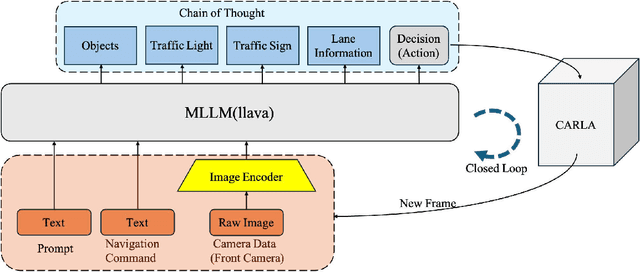
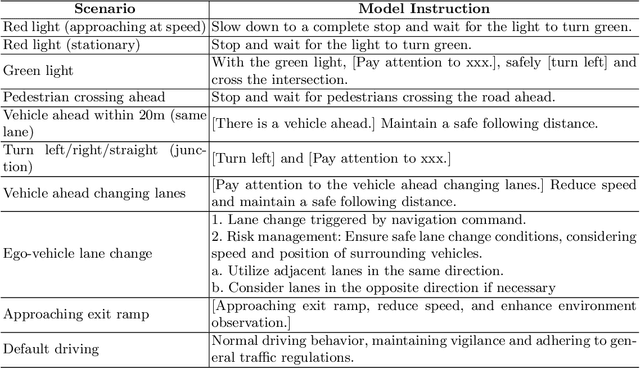
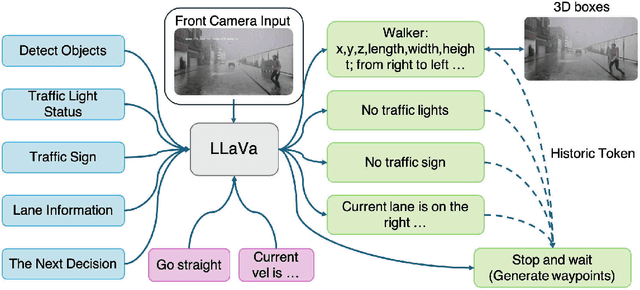

End-to-end autonomous driving has advanced significantly, offering benefits such as system simplicity and stronger driving performance in both open-loop and closed-loop settings than conventional pipelines. However, existing frameworks still suffer from low success rates in closed-loop evaluations, highlighting their limitations in real-world deployment. In this paper, we introduce X-Driver, a unified multi-modal large language models(MLLMs) framework designed for closed-loop autonomous driving, leveraging Chain-of-Thought(CoT) and autoregressive modeling to enhance perception and decision-making. We validate X-Driver across multiple autonomous driving tasks using public benchmarks in CARLA simulation environment, including Bench2Drive[6]. Our experimental results demonstrate superior closed-loop performance, surpassing the current state-of-the-art(SOTA) while improving the interpretability of driving decisions. These findings underscore the importance of structured reasoning in end-to-end driving and establish X-Driver as a strong baseline for future research in closed-loop autonomous driving.