 Add to Chrome
 Add to Firefox
 Add to Edge
Persistent Recursive Worlds Enable Autonomous Software Evolution
Aug 12, 2026
Complex software systems develop over timescales that exceed the lifespan of any individual coding agent. Most agentic software systems preserve continuity through persistent sessions, memories, managers or shared context. We introduce EvoX Genesis (hereafter, Genesis), which instead makes the software project persistent while allowing local agents to remain finite-lived. Genesis represents software as a persistent recursive world: each local world is situated by an accepted version and a repository path, finite-lived agents propose local changes, recursive delegation moves work across paths, and only accepted consequences advance the persistent version history. We evaluate this organization across formation, continuation and redevelopment. Starting from a repository with no compiler implementation, Genesis used DeepSeek V4 Flash to build a Rust-based C compiler with about 250k tracked lines; the run lasted over 120 hours, archived over 1,000 agent episodes and incurred only US$44 in model-token charges. The compiler passed the complete c-testsuite and most LLVM and Csmith tests. In a separate compiler world generated with GLM 5.2, development continued after repeated agent replacement while retaining full test performance. Genesis also reimplemented 13 MESA modules with over 100k Fortran lines as a Rust workspace with nearly 90k Rust lines; across six numerical workloads, it achieved median speedups of 1.55--6.87x. These results show that long-horizon software development can be organized around a persistent project rather than a persistent agent.

SearchAuditor: Auditing and Attributing Failures in Long-Horizon Search Agents
Aug 05, 2026Deep search agents tackle challenging questions through long-horizon web interactions, a process that is both complex and fragile: small reasoning errors may propagate through long, noisy trajectories into fluent but incorrect answers. Diagnosing such failures is difficult, requiring the manual inspection of extremely long execution traces, which could be beyond human capacity. We therefore introduce SearchAuditBench, a benchmark that evaluates whether LLM auditors can localize, attribute, and repair these failures, thereby reducing the human burden. SearchAuditBench comprises 1,243 failed trajectories, averaging 73.1 messages and 65.1K tokens, collected from eight open-weight models on five deep-search benchmarks, each expert-annotated with the critical error step, a search-specific root cause, and a reference repair with grading rubrics. We further propose SearchAuditor, a multi-perspective auditing framework that effectively localizes, attributes, and repairs search-agent failures through evidence-grounded adjudication. Experimental results show that even the strongest baseline, when powered by a frontier model like GPT-5.5, attains only a 26.6% end-to-end pass rate. In contrast, our SearchAuditor consistently outperforms all baselines across different frontier models, achieving an end-to-end pass rate of 32.3%, and resuming failed runs with its repairs enables agents to better recover from errors.
Quantization Inflates Reasoning: Token Inflation as a Hidden Cost of Low-Bit Reasoning Models
Jun 24, 2026Quantization is widely used to reduce the inference cost of large language models, but its effect on reasoning models is not fully captured by final-answer accuracy or per-token latency. We show that low-bit post-training quantization can introduce a hidden test-time compute cost: quantized reasoning models often generate longer chains of thought even when they still answer correctly. Across mathematical reasoning, code generation, scientific question answering, and agentic tool-use benchmarks, we find that INT4/INT3 quantization can preserve accuracy but increase reasoning-token usage, offsetting the expected per-token speedup. To measure this effect, we introduce the CoT Token Inflation Ratio, which compares reasoning length between quantized and full-precision models averaged across all evaluation benchmarks. We further show that token inflation is accompanied by behavioral changes in the reasoning trace, including more intermediate steps and greater semantic repetition. These changes translate into measurable end-to-end real-world serving penalties. Finally, we evaluate mitigation strategies and find that prompting and decoding-time sampling offer inconsistent accuracy-length trade-offs, while quantization-aware training shows more promise in reducing both accuracy degradation and token inflation. Our results suggest that reasoning-token usage should be reported alongside accuracy when evaluating quantized reasoning models.
Hidden States as Early Signals: Step-level Trace Evaluation and Pruning for Efficient Test-Time Scaling
Jan 14, 2026Large Language Models (LLMs) can enhance reasoning capabilities through test-time scaling by generating multiple traces. However, the combination of lengthy reasoning traces with multiple sampling introduces substantial computation and high end-to-end latency. Prior work on accelerating this process has relied on similarity-based or confidence-based pruning, but these signals do not reliably indicate trace quality. To address these limitations, we propose STEP: Step-level Trace Evaluation and Pruning, a novel pruning framework that evaluates reasoning steps using hidden states and dynamically prunes unpromising traces during generation. We train a lightweight step scorer to estimate trace quality, and design a GPU memory-aware pruning strategy that triggers pruning as the GPU memory is saturated by KV cache to reduce end-to-end latency. Experiments across challenging reasoning benchmarks demonstrate that STEP reduces end-to-end inference latency by 45%-70% on average compared to self-consistency while also improving reasoning accuracy. Our code is released at: https://github.com/Supercomputing-System-AI-Lab/STEP
MiLo: Efficient Quantized MoE Inference with Mixture of Low-Rank Compensators
Apr 03, 2025
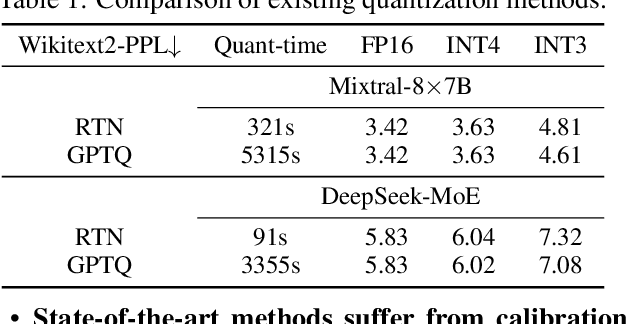
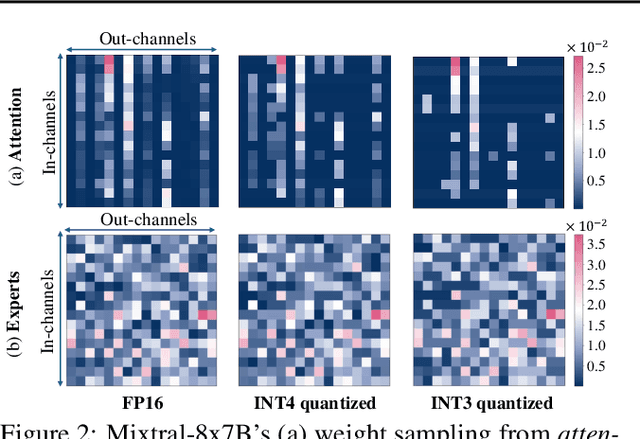
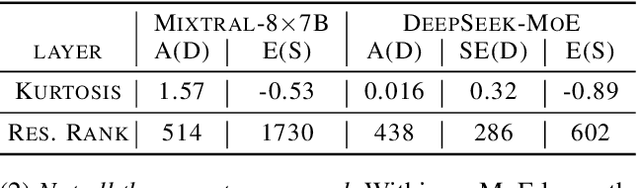
A critical approach for efficiently deploying Mixture-of-Experts (MoE) models with massive parameters is quantization. However, state-of-the-art MoE models suffer from non-negligible accuracy loss with extreme quantization, such as under 4 bits. To address this, we introduce MiLo, a novel method that augments highly quantized MoEs with a mixture of low-rank compensators. These compensators consume only a small amount of additional memory but significantly recover accuracy loss from extreme quantization. MiLo also identifies that MoEmodels exhibit distinctive characteristics across weights due to their hybrid dense-sparse architectures, and employs adaptive rank selection policies along with iterative optimizations to close the accuracy gap. MiLo does not rely on calibration data, allowing it to generalize to different MoE models and datasets without overfitting to a calibration set. To avoid the hardware inefficiencies of extreme quantization, such as 3-bit, MiLo develops Tensor Core-friendly 3-bit kernels, enabling measured latency speedups on 3-bit quantized MoE models. Our evaluation shows that MiLo outperforms existing methods on SoTA MoE models across various tasks.
Exploring the True Potential: Evaluating the Black-box Optimization Capability of Large Language Models
Apr 09, 2024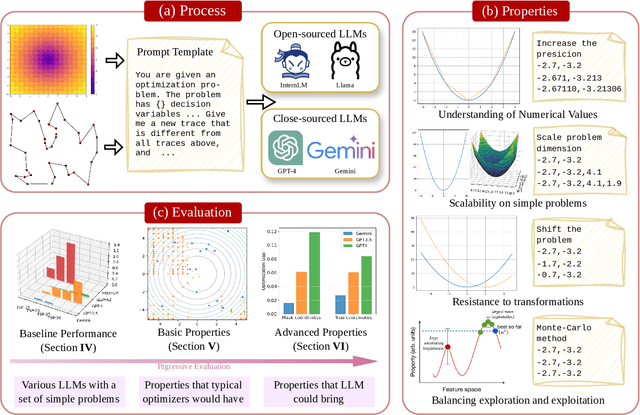

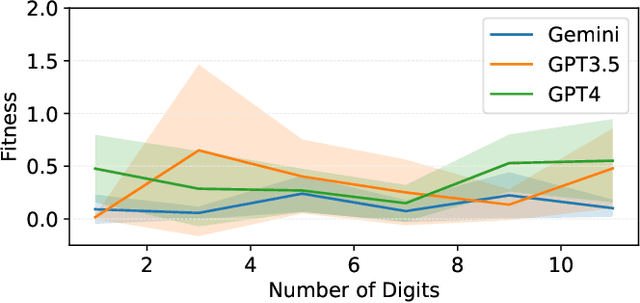
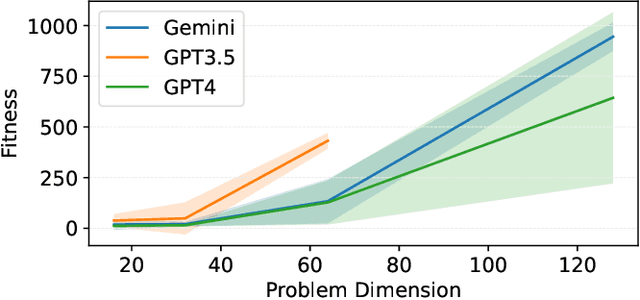
Large language models (LLMs) have gained widespread popularity and demonstrated exceptional performance not only in natural language processing (NLP) tasks but also in non-linguistic domains. Their potential as artificial general intelligence extends beyond NLP, showcasing promising capabilities in diverse optimization scenarios. Despite this rising trend, whether the integration of LLMs into these black-box optimization problems is genuinely beneficial remains unexplored. This paper endeavors to tackle this issue by offering deeper insights into the potential of LLMs in optimization tasks through a comprehensive investigation. Our approach involves a comprehensive evaluation, covering both discrete and continuous optimization problems, aiming to assess the efficacy and distinctive characteristics that LLMs bring to the realm of optimization. Our findings reveal both the limitations and advantages of LLMs in optimization. On one hand, despite consuming the significant power required to run the model, LLMs exhibit subpar performance and lack desirable properties in pure numerical tasks, primarily due to a mismatch between the problem domain and their processing capabilities. On the other hand, although LLMs may not be ideal for traditional numerical optimization, their potential in broader optimization contexts remains promising. LLMs exhibit the ability to solve problems in non-numerical domains and can leverage heuristics from the prompt to enhance their performance. To the best of our knowledge, this work presents the first systematic evaluation of LLMs for numerical optimization, offering a progressive, wide-coverage, and behavioral analysis. Our findings pave the way for a deeper understanding of LLMs' role in optimization and guide future application in diverse scenarios for LLMs.
EvoX: A Distributed GPU-accelerated Library towards Scalable Evolutionary Computation
Feb 16, 2023During the past decades, evolutionary computation (EC) has demonstrated promising potential in solving various complex optimization problems of relatively small scales. Nowadays, however, ongoing developments in modern science and engineering are bringing increasingly grave challenges to the conventional EC paradigm in terms of scalability. As problem scales increase, on the one hand, the encoding spaces (i.e., dimensions of the decision vectors) are intrinsically larger; on the other hand, EC algorithms often require growing numbers of function evaluations (and probably larger population sizes as well) to work properly. To meet such emerging challenges, not only does it require delicate algorithm designs, but more importantly, a high-performance computing framework is indispensable. Hence, we develop a distributed GPU-accelerated algorithm library -- EvoX. First, we propose a generalized workflow for implementing general EC algorithms. Second, we design a scalable computing framework for running EC algorithms on distributed GPU devices. Third, we provide user-friendly interfaces to both researchers and practitioners for benchmark studies as well as extended real-world applications. To comprehensively assess the performance of EvoX, we conduct a series of experiments, including: (i) scalability test via numerical optimization benchmarks with problem dimensions/population sizes up to millions; (ii) acceleration test via a neuroevolution task with multiple GPU nodes; (iii) extensibility demonstration via the application to reinforcement learning tasks on the OpenAI Gym. The code of EvoX is available at https://github.com/EMI-Group/EvoX.