 Add to Chrome
 Add to Firefox
 Add to Edge
Manifold-Constrained Nucleus-Level Denoising Diffusion Model for Structure-Based Drug Design
Sep 16, 2024
Artificial intelligence models have shown great potential in structure-based drug design, generating ligands with high binding affinities. However, existing models have often overlooked a crucial physical constraint: atoms must maintain a minimum pairwise distance to avoid separation violation, a phenomenon governed by the balance of attractive and repulsive forces. To mitigate such separation violations, we propose NucleusDiff. It models the interactions between atomic nuclei and their surrounding electron clouds by enforcing the distance constraint between the nuclei and manifolds. We quantitatively evaluate NucleusDiff using the CrossDocked2020 dataset and a COVID-19 therapeutic target, demonstrating that NucleusDiff reduces violation rate by up to 100.00% and enhances binding affinity by up to 22.16%, surpassing state-of-the-art models for structure-based drug design. We also provide qualitative analysis through manifold sampling, visually confirming the effectiveness of NucleusDiff in reducing separation violations and improving binding affinities.

Fourier Neural Operators for Learning Dynamics in Quantum Spin Systems
Sep 05, 2024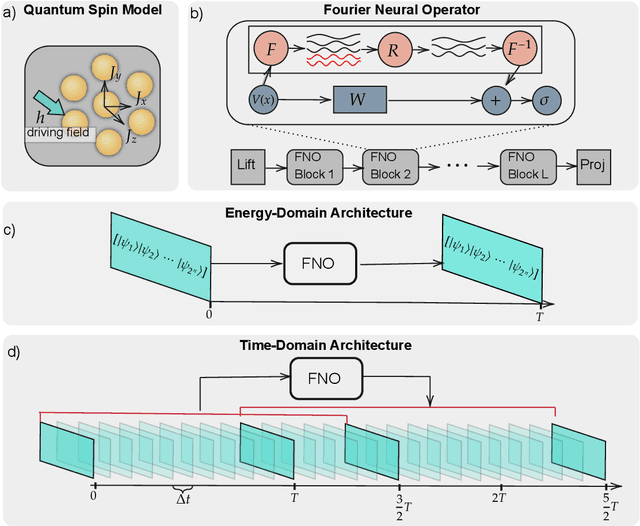

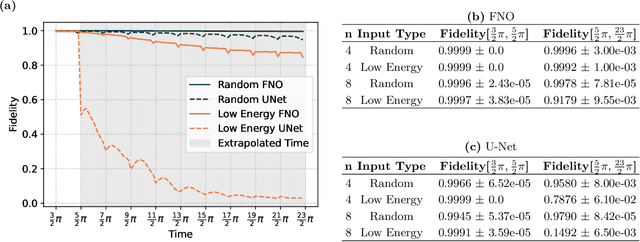

Fourier Neural Operators (FNOs) excel on tasks using functional data, such as those originating from partial differential equations. Such characteristics render them an effective approach for simulating the time evolution of quantum wavefunctions, which is a computationally challenging, yet coveted task for understanding quantum systems. In this manuscript, we use FNOs to model the evolution of random quantum spin systems, so chosen due to their representative quantum dynamics and minimal symmetry. We explore two distinct FNO architectures and examine their performance for learning and predicting time evolution using both random and low-energy input states. Additionally, we apply FNOs to a compact set of Hamiltonian observables ($\sim\text{poly}(n)$) instead of the entire $2^n$ quantum wavefunction, which greatly reduces the size of our inputs and outputs and, consequently, the requisite dimensions of the resulting FNOs. Moreover, this Hamiltonian observable-based method demonstrates that FNOs can effectively distill information from high-dimensional spaces into lower-dimensional spaces. The extrapolation of Hamiltonian observables to times later than those used in training is of particular interest, as this stands to fundamentally increase the simulatability of quantum systems past both the coherence times of contemporary quantum architectures and the circuit-depths of tractable tensor networks.
Beyond Closure Models: Learning Chaotic-Systems via Physics-Informed Neural Operators
Aug 09, 2024Accurately predicting the long-term behavior of chaotic systems is crucial for various applications such as climate modeling. However, achieving such predictions typically requires iterative computations over a dense spatiotemporal grid to account for the unstable nature of chaotic systems, which is expensive and impractical in many real-world situations. An alternative approach to such a full-resolved simulation is using a coarse grid and then correcting its errors through a \textit{closure model}, which approximates the overall information from fine scales not captured in the coarse-grid simulation. Recently, ML approaches have been used for closure modeling, but they typically require a large number of training samples from expensive fully-resolved simulations (FRS). In this work, we prove an even more fundamental limitation, i.e., the standard approach to learning closure models suffers from a large approximation error for generic problems, no matter how large the model is, and it stems from the non-uniqueness of the mapping. We propose an alternative end-to-end learning approach using a physics-informed neural operator (PINO) that overcomes this limitation by not using a closure model or a coarse-grid solver. We first train the PINO model on data from a coarse-grid solver and then fine-tune it with (a small amount of) FRS and physics-based losses on a fine grid. The discretization-free nature of neural operators means that they do not suffer from the restriction of a coarse grid that closure models face, and they can provably approximate the long-term statistics of chaotic systems. In our experiments, our PINO model achieves a 120x speedup compared to FRS with a relative error $\sim 5\%$. In contrast, the closure model coupled with a coarse-grid solver is $58$x slower than PINO while having a much higher error $\sim205\%$ when the closure model is trained on the same FRS dataset.
MINI-SEQUENCE TRANSFORMER: Optimizing Intermediate Memory for Long Sequences Training
Jul 22, 2024



We introduce Mini-Sequence Transformer (MsT), a simple and effective methodology for highly efficient and accurate LLM training with extremely long sequences. MsT partitions input sequences and iteratively processes mini-sequences to reduce intermediate memory usage. Integrated with activation recomputation, it enables significant memory savings in both forward and backward passes. In experiments with the Llama3-8B model, with MsT, we measure no degradation in throughput or convergence even with 12x longer sequences than standard implementations due to our careful memory optimizations. MsT is fully general, implementation-agnostic, and requires minimal code changes to integrate with existing LLM training frameworks.
Dynamical Measure Transport and Neural PDE Solvers for Sampling
Jul 10, 2024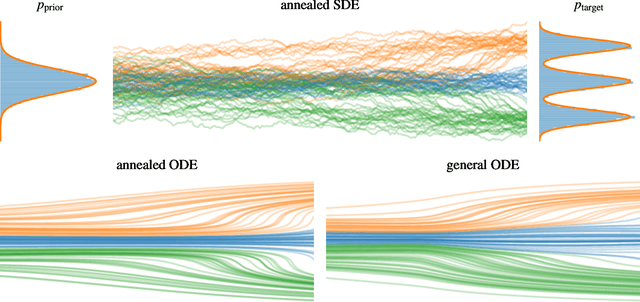
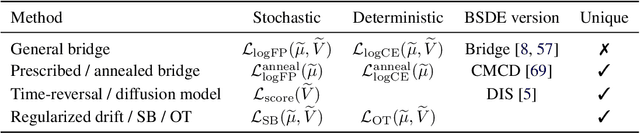
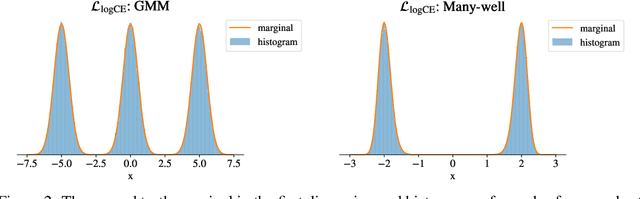
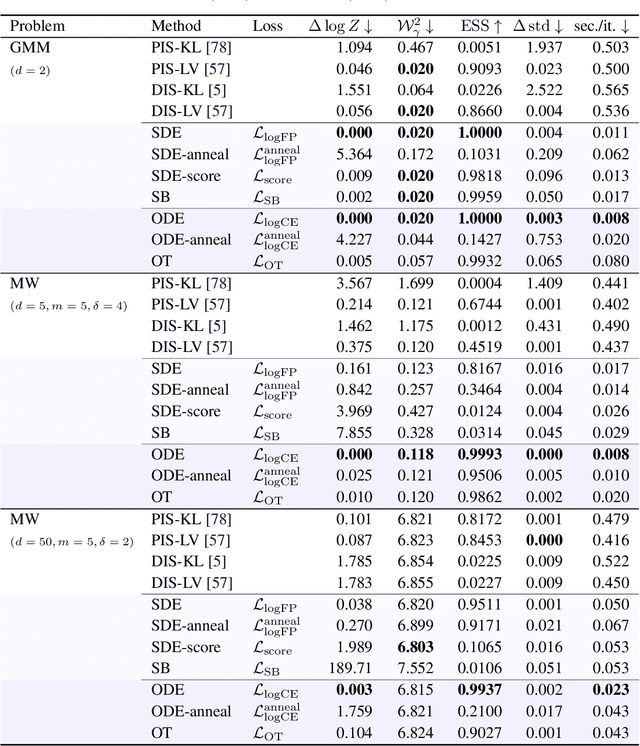
The task of sampling from a probability density can be approached as transporting a tractable density function to the target, known as dynamical measure transport. In this work, we tackle it through a principled unified framework using deterministic or stochastic evolutions described by partial differential equations (PDEs). This framework incorporates prior trajectory-based sampling methods, such as diffusion models or Schr\"odinger bridges, without relying on the concept of time-reversals. Moreover, it allows us to propose novel numerical methods for solving the transport task and thus sampling from complicated targets without the need for the normalization constant or data samples. We employ physics-informed neural networks (PINNs) to approximate the respective PDE solutions, implying both conceptional and computational advantages. In particular, PINNs allow for simulation- and discretization-free optimization and can be trained very efficiently, leading to significantly better mode coverage in the sampling task compared to alternative methods. Moreover, they can readily be fine-tuned with Gauss-Newton methods to achieve high accuracy in sampling.
Improving Diffusion Inverse Problem Solving with Decoupled Noise Annealing
Jul 01, 2024Diffusion models have recently achieved success in solving Bayesian inverse problems with learned data priors. Current methods build on top of the diffusion sampling process, where each denoising step makes small modifications to samples from the previous step. However, this process struggles to correct errors from earlier sampling steps, leading to worse performance in complicated nonlinear inverse problems, such as phase retrieval. To address this challenge, we propose a new method called Decoupled Annealing Posterior Sampling (DAPS) that relies on a novel noise annealing process. Specifically, we decouple consecutive steps in a diffusion sampling trajectory, allowing them to vary considerably from one another while ensuring their time-marginals anneal to the true posterior as we reduce noise levels. This approach enables the exploration of a larger solution space, improving the success rate for accurate reconstructions. We demonstrate that DAPS significantly improves sample quality and stability across multiple image restoration tasks, particularly in complicated nonlinear inverse problems. For example, we achieve a PSNR of 30.72dB on the FFHQ 256 dataset for phase retrieval, which is an improvement of 9.12dB compared to existing methods.
ARDuP: Active Region Video Diffusion for Universal Policies
Jun 19, 2024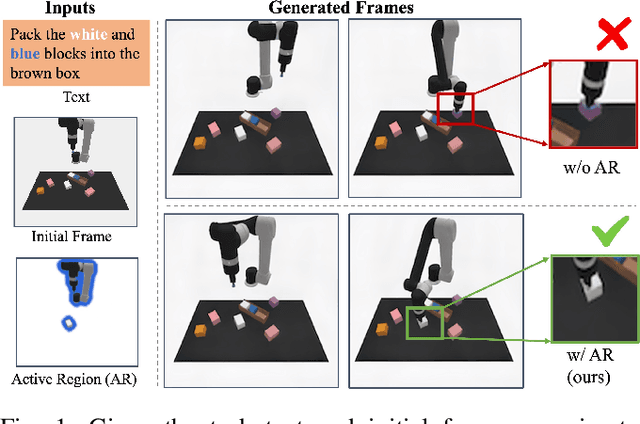
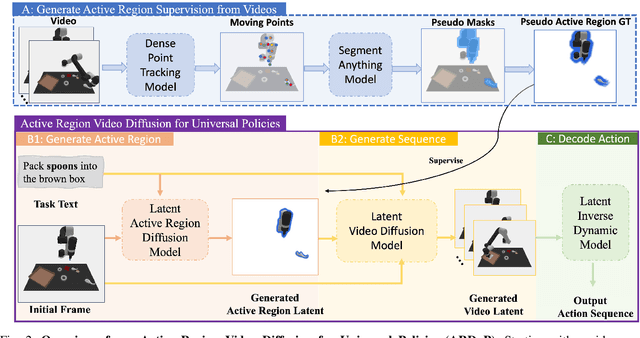
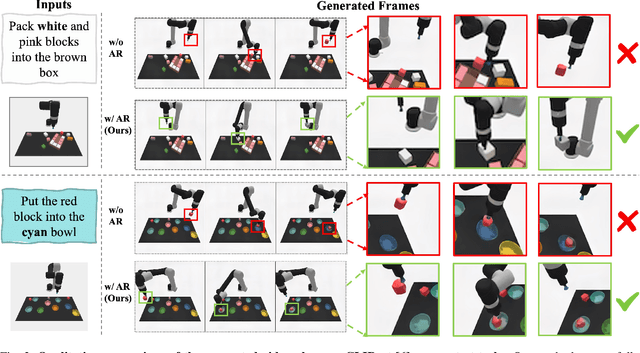
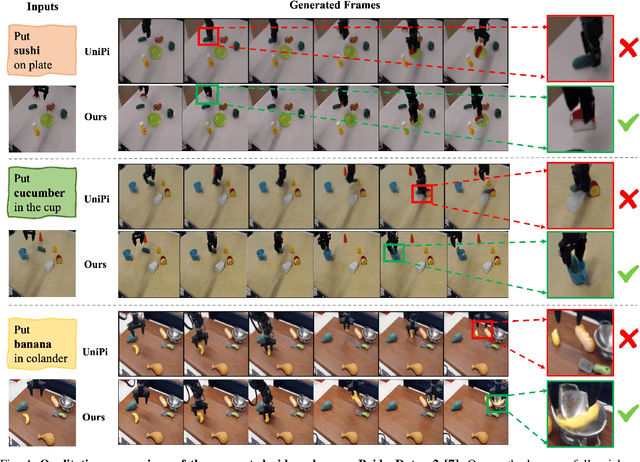
Sequential decision-making can be formulated as a text-conditioned video generation problem, where a video planner, guided by a text-defined goal, generates future frames visualizing planned actions, from which control actions are subsequently derived. In this work, we introduce Active Region Video Diffusion for Universal Policies (ARDuP), a novel framework for video-based policy learning that emphasizes the generation of active regions, i.e. potential interaction areas, enhancing the conditional policy's focus on interactive areas critical for task execution. This innovative framework integrates active region conditioning with latent diffusion models for video planning and employs latent representations for direct action decoding during inverse dynamic modeling. By utilizing motion cues in videos for automatic active region discovery, our method eliminates the need for manual annotations of active regions. We validate ARDuP's efficacy via extensive experiments on simulator CLIPort and the real-world dataset BridgeData v2, achieving notable improvements in success rates and generating convincingly realistic video plans.
Solving Poisson Equations using Neural Walk-on-Spheres
Jun 05, 2024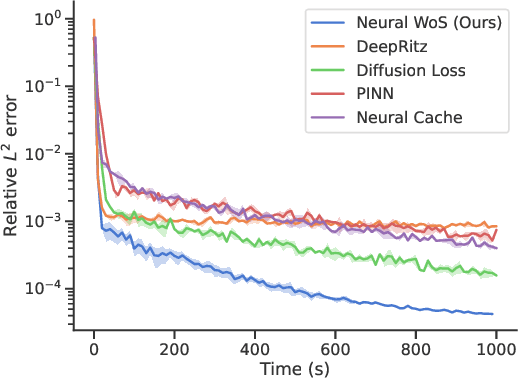
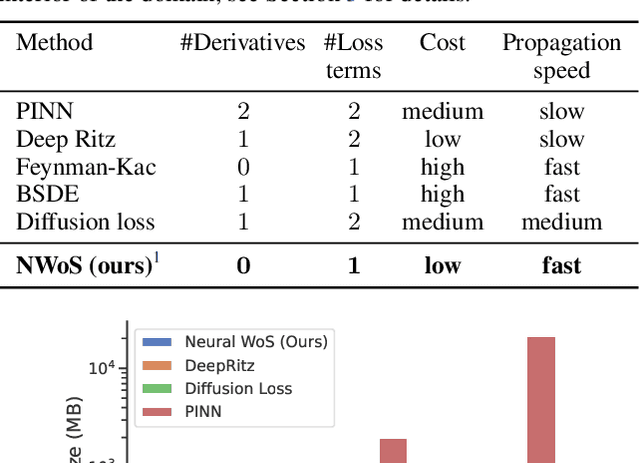
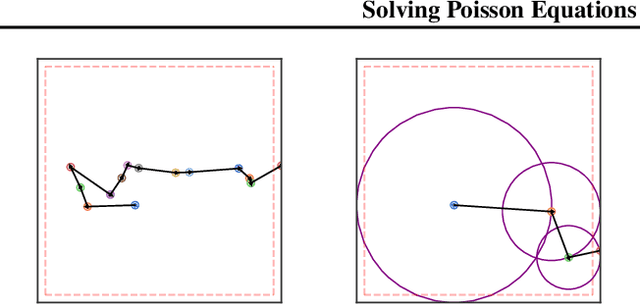
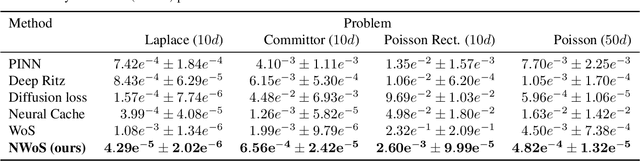
We propose Neural Walk-on-Spheres (NWoS), a novel neural PDE solver for the efficient solution of high-dimensional Poisson equations. Leveraging stochastic representations and Walk-on-Spheres methods, we develop novel losses for neural networks based on the recursive solution of Poisson equations on spheres inside the domain. The resulting method is highly parallelizable and does not require spatial gradients for the loss. We provide a comprehensive comparison against competing methods based on PINNs, the Deep Ritz method, and (backward) stochastic differential equations. In several challenging, high-dimensional numerical examples, we demonstrate the superiority of NWoS in accuracy, speed, and computational costs. Compared to commonly used PINNs, our approach can reduce memory usage and errors by orders of magnitude. Furthermore, we apply NWoS to problems in PDE-constrained optimization and molecular dynamics to show its efficiency in practical applications.
Autoformalizing Euclidean Geometry
May 27, 2024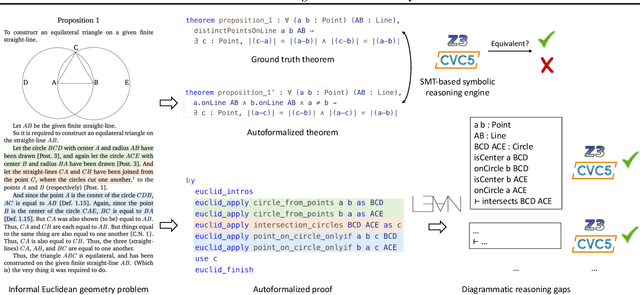
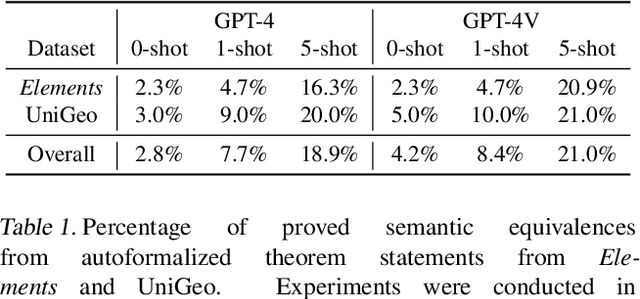
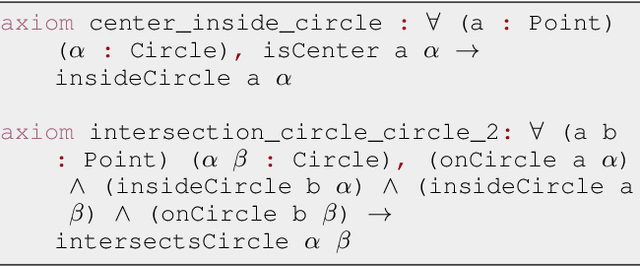
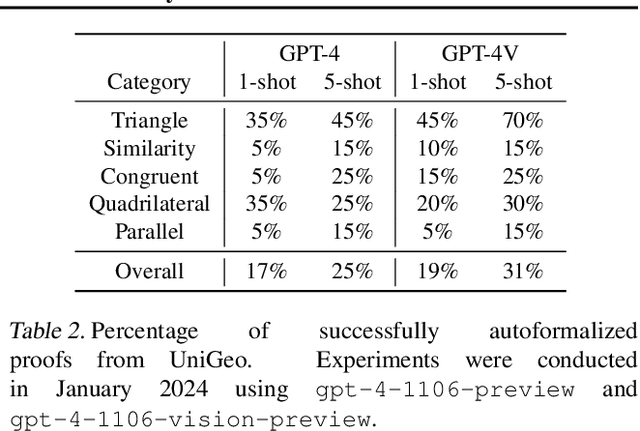
Autoformalization involves automatically translating informal math into formal theorems and proofs that are machine-verifiable. Euclidean geometry provides an interesting and controllable domain for studying autoformalization. In this paper, we introduce a neuro-symbolic framework for autoformalizing Euclidean geometry, which combines domain knowledge, SMT solvers, and large language models (LLMs). One challenge in Euclidean geometry is that informal proofs rely on diagrams, leaving gaps in texts that are hard to formalize. To address this issue, we use theorem provers to fill in such diagrammatic information automatically, so that the LLM only needs to autoformalize the explicit textual steps, making it easier for the model. We also provide automatic semantic evaluation for autoformalized theorem statements. We construct LeanEuclid, an autoformalization benchmark consisting of problems from Euclid's Elements and the UniGeo dataset formalized in the Lean proof assistant. Experiments with GPT-4 and GPT-4V show the capability and limitations of state-of-the-art LLMs on autoformalizing geometry problems. The data and code are available at https://github.com/loganrjmurphy/LeanEuclid.
Towards Large Language Models as Copilots for Theorem Proving in Lean
Apr 18, 2024Theorem proving is an important challenge for large language models (LLMs), as formal proofs can be checked rigorously by proof assistants such as Lean, leaving no room for hallucination. Existing LLM-based provers try to prove theorems in a fully autonomous mode without human intervention. In this mode, they struggle with novel and challenging theorems, for which human insights may be critical. In this paper, we explore LLMs as copilots that assist humans in proving theorems. We introduce Lean Copilot, a framework for running LLM inference in Lean. It enables programmers to build various LLM-based proof automation tools that integrate seamlessly into the workflow of Lean users. Using Lean Copilot, we build tools for suggesting proof steps (tactic suggestion), completing intermediate proof goals (proof search), and selecting relevant premises (premise selection) using LLMs. Users can use our pretrained models or bring their own ones that run either locally (with or without GPUs) or on the cloud. Experimental results demonstrate the effectiveness of our method in assisting humans and automating theorem proving process compared to existing rule-based proof automation in Lean. We open source all codes under a permissive MIT license to facilitate further research.