 Add to Chrome
 Add to Firefox
 Add to Edge
Multi-Turn Evaluation of Deep Research Agents Under Process-Level Feedback
Jun 08, 2026
Existing benchmarks for deep research agents (DRAs) assess only single-shot outputs, ignoring a key question: can DRAs improve their reports when guided by feedback? To investigate this, we conduct a multi-turn evaluation of DRAs under two feedback settings: self-reflection, in which the agent revises its report without any external diagnostic signal, and process-level feedback, in which the agent receives guidance targeting gaps in its research strategy. To enable process-level feedback, we design Research Gap Inference (RGI), a method that analyzes patterns of satisfied and unsatisfied rubric criteria to infer research-process gaps. Our analysis reveals three key findings: (i) under self-reflection, agents incorporate and regress on rubric criteria at nearly equal rates, yielding negligible net improvement; (ii) a single round of process-level feedback yields substantial gains, raising the normalized score by approximately $8$-$15$ points and yielding a roughly $35$-$40\%$ incorporation rate; (iii) these gains do not compound over subsequent turns, as agents regress on up to $24\%$ of previously satisfied criteria when rewriting the full report to address remaining gaps. Even with targeted guidance, reliable multi-turn improvement remains out of reach for the DRA architectures we evaluate. Our code and results are publicly available at https://github.com/sabharwalrishabh/Multi-Turn-Evaluation-of-DRAs.

Benchmarking Open-Ended Multi-Agent Coordination in Language Agents
Jun 06, 2026As language models are increasingly deployed as autonomous agents, they must coordinate with others over long horizons in open-ended interactive tasks. Yet existing evaluations rarely test these demands together, instead emphasising single-agent tasks, short interactions, or highly structured multi-agent settings. We introduce $alem$, a JAX-based benchmark for open-ended multi-agent coordination built on Craftax-like dynamics. Alem embeds procedurally generated coordination tasks, soft specialisation, communication, and controllable coordination difficulty into a long-horizon survival world with exploration, crafting, trading, and combat. We evaluate $13$ modern LLMs zero-shot within homogeneous teams, with trained MARL agents as reference points. Current LLM agents remain far from solving alem, averaging only ~6% normalised return, but their failures are not uniform. On the hardest coordination setting, zero-shot Gemini-3.1-Pro-High approaches MARL agents trained for one billion steps, while GPT-5.4-High achieves strong base-task reward but much lower coordination reward. This contrast shows that individual task competence does not imply coordination competence. Ablations show that communication is the largest contributor to coordination, while memory and reasoning help when used to maintain multi-step plans. Overall, our results identify coordination as a distinct bottleneck for frontier LLM agents, separate from single-agent capabilities. Alem makes this bottleneck measurable and provides a controlled testbed for developing agents that communicate, allocate roles, and execute shared plans. Code is available at https://github.com/alem-world/alem-env.
Adapting Time Series Foundation Models through Data Mixtures
Mar 03, 2026Time series foundation models (TSFMs) have become increasingly popular for zero-shot forecasting. However, for a new time series domain not fully covered by the pretraining set, performance can suffer. Therefore, when a practitioner cares about a new domain and has access to a set of related datasets, the question arises: how best to fine-tune a TSFM to improve zero-shot forecasting? A typical approach to this type of problem is to fine-tune a LoRA module on all datasets or separately on each dataset. Tuning a separate module on each dataset allows for the specialisation of the TSFM to different types of data distribution, by selecting differing combinations of per-dataset modules for different time series contexts. However, we find that, using per-dataset modules might not be optimal, since a time series dataset can contain data from several types of distributions, i.e. sub-domains. This can be due to the distribution shifting or having differing distributions for different dimensions of the time series. Hence, we propose MixFT which re-divides the data using Bayesian mixtures into sets that best represent the sub-domains present in the data, and fine-tunes separately on each of these sets. This re-division of the data ensures that each set is more homogeneous, leading to fine-tuned modules focused on specific sub-domains. Our experiments show that MixFT performs better than per-dataset methods and when fine-tuning a single module on all the data. This suggests that by re-partitioning the data to represent sub-domains we can better specialise TSFMs to improve zero-shot forecasting.
Probing Dec-POMDP Reasoning in Cooperative MARL
Feb 24, 2026Cooperative multi-agent reinforcement learning (MARL) is typically framed as a decentralised partially observable Markov decision process (Dec-POMDP), a setting whose hardness stems from two key challenges: partial observability and decentralised coordination. Genuinely solving such tasks requires Dec-POMDP reasoning, where agents use history to infer hidden states and coordinate based on local information. Yet it remains unclear whether popular benchmarks actually demand this reasoning or permit success via simpler strategies. We introduce a diagnostic suite combining statistically grounded performance comparisons and information-theoretic probes to audit the behavioural complexity of baseline policies (IPPO and MAPPO) across 37 scenarios spanning MPE, SMAX, Overcooked, Hanabi, and MaBrax. Our diagnostics reveal that success on these benchmarks rarely requires genuine Dec-POMDP reasoning. Reactive policies match the performance of memory-based agents in over half the scenarios, and emergent coordination frequently relies on brittle, synchronous action coupling rather than robust temporal influence. These findings suggest that some widely used benchmarks may not adequately test core Dec-POMDP assumptions under current training paradigms, potentially leading to over-optimistic assessments of progress. We release our diagnostic tooling to support more rigorous environment design and evaluation in cooperative MARL.
* To appear at the 25th International Conference on Autonomous Agents and Multi-Agent Systems (AAMAS 2026)
Kalman Linear Attention: Parallel Bayesian Filtering For Efficient Language Modelling and State Tracking
Feb 11, 2026State-space language models such as Mamba and gated linear attention (GLA) offer efficient alternatives to transformers due to their linear complexity and parallel training, but often lack the expressivity and robust state-tracking needed for complex reasoning. We address these limitations by reframing sequence modelling through a probabilistic lens, using Bayesian filters as a core primitive. While classical filters such as Kalman filters provide principled state estimation and uncertainty tracking, they are typically viewed as inherently sequential. We show that reparameterising the Kalman filter in information form enables its updates to be computed via an associative scan, allowing efficient parallel training. Building on this insight, we introduce the Kalman Linear Attention (KLA) layer, a neural sequence-modelling primitive that performs time-parallel probabilistic inference while maintaining explicit belief-state uncertainty. KLA offers strictly more expressive nonlinear updates and gating than GLA variants while retaining their computational advantages. On language modelling tasks, KLA matches or outperforms modern SSMs and GLAs across representative discrete token-manipulation and state-tracking benchmarks.
Signature-Kernel Based Evaluation Metrics for Robust Probabilistic and Tail-Event Forecasting
Feb 10, 2026Probabilistic forecasting is increasingly critical across high-stakes domains, from finance and epidemiology to climate science. However, current evaluation frameworks lack a consensus metric and suffer from two critical flaws: they often assume independence across time steps or variables, and they demonstrably lack sensitivity to tail events, the very occurrences that are most pivotal in real-world decision-making. To address these limitations, we propose two kernel-based metrics: the signature maximum mean discrepancy (Sig-MMD) and our novel censored Sig-MMD (CSig-MMD). By leveraging the signature kernel, these metrics capture complex inter-variate and inter-temporal dependencies and remain robust to missing data. Furthermore, CSig-MMD introduces a censoring scheme that prioritizes a forecaster's capability to predict tail events while strictly maintaining properness, a vital property for a good scoring rule. These metrics enable a more reliable evaluation of direct multi-step forecasting, facilitating the development of more robust probabilistic algorithms.
Rationality Measurement and Theory for Reinforcement Learning Agents
Feb 04, 2026This paper proposes a suite of rationality measures and associated theory for reinforcement learning agents, a property increasingly critical yet rarely explored. We define an action in deployment to be perfectly rational if it maximises the hidden true value function in the steepest direction. The expected value discrepancy of a policy's actions against their rational counterparts, culminating over the trajectory in deployment, is defined to be expected rational risk; an empirical average version in training is also defined. Their difference, termed as rational risk gap, is decomposed into (1) an extrinsic component caused by environment shifts between training and deployment, and (2) an intrinsic one due to the algorithm's generalisability in a dynamic environment. They are upper bounded by, respectively, (1) the $1$-Wasserstein distance between transition kernels and initial state distributions in training and deployment, and (2) the empirical Rademacher complexity of the value function class. Our theory suggests hypotheses on the benefits from regularisers (including layer normalisation, $\ell_2$ regularisation, and weight normalisation) and domain randomisation, as well as the harm from environment shifts. Experiments are in full agreement with these hypotheses. The code is available at https://github.com/EVIEHub/Rationality.
On Harnessing Idle Compute at the Edge for Foundation Model Training
Dec 13, 2025The ecosystem behind foundation model development today is highly centralized and limited to large-scale cloud data center operators: training foundation models is costly, needing immense compute resources. Decentralized foundation model training across edge devices, leveraging their spare compute, promises a democratized alternative. However, existing edge-training approaches fall short: they struggle to match cloud-based training performance, exhibit limited scalability with model size, exceed device memory capacity, and have prohibitive communication overhead. They also fail to satisfactorily handle device heterogeneity and dynamism. We introduce a new paradigm, Cleave, which finely partitions training operations through a novel selective hybrid tensor parallelism method. Together with a parameter server centric training framework, Cleave copes with device memory limits and avoids communication bottlenecks, thereby enabling efficient training of large models on par with the cloud. Further, with a cost optimization model to guide device selection and training workload distribution, Cleave effectively accounts for device heterogeneity and churn. Our evaluations show that Cleave matches cloud-based GPU training by scaling efficiently to larger models and thousands of devices, supporting up to 8x more devices than baseline edge-training approaches. It outperforms state-of-the-art edge training methods by up to a factor of 10 in per-batch training time and efficiently handles device failures, achieving at least 100x faster recovery than prior methods.
Forgetting is Everywhere
Nov 06, 2025A fundamental challenge in developing general learning algorithms is their tendency to forget past knowledge when adapting to new data. Addressing this problem requires a principled understanding of forgetting; yet, despite decades of study, no unified definition has emerged that provides insights into the underlying dynamics of learning. We propose an algorithm- and task-agnostic theory that characterises forgetting as a lack of self-consistency in a learner's predictive distribution over future experiences, manifesting as a loss of predictive information. Our theory naturally yields a general measure of an algorithm's propensity to forget. To validate the theory, we design a comprehensive set of experiments that span classification, regression, generative modelling, and reinforcement learning. We empirically demonstrate how forgetting is present across all learning settings and plays a significant role in determining learning efficiency. Together, these results establish a principled understanding of forgetting and lay the foundation for analysing and improving the information retention capabilities of general learning algorithms.
Generative World Modelling for Humanoids: 1X World Model Challenge Technical Report
Oct 08, 2025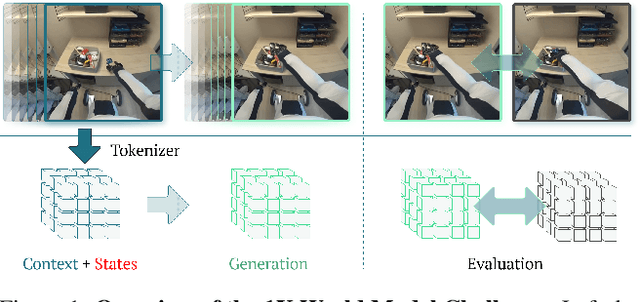
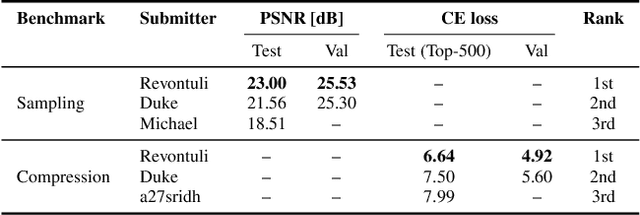
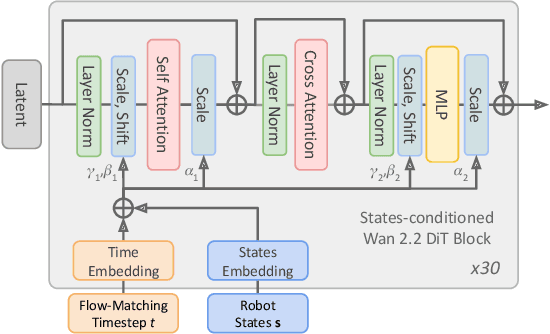
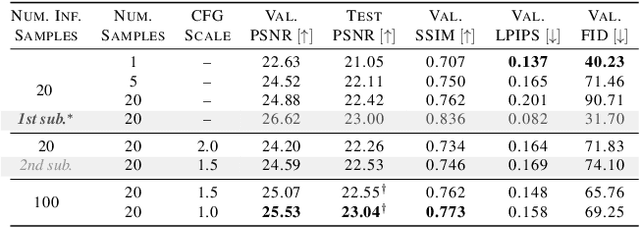
World models are a powerful paradigm in AI and robotics, enabling agents to reason about the future by predicting visual observations or compact latent states. The 1X World Model Challenge introduces an open-source benchmark of real-world humanoid interaction, with two complementary tracks: sampling, focused on forecasting future image frames, and compression, focused on predicting future discrete latent codes. For the sampling track, we adapt the video generation foundation model Wan-2.2 TI2V-5B to video-state-conditioned future frame prediction. We condition the video generation on robot states using AdaLN-Zero, and further post-train the model using LoRA. For the compression track, we train a Spatio-Temporal Transformer model from scratch. Our models achieve 23.0 dB PSNR in the sampling task and a Top-500 CE of 6.6386 in the compression task, securing 1st place in both challenges.