 Add to Chrome
 Add to Firefox
 Add to Edge
SepSeq: A Training-Free Framework for Long Numerical Sequence Processing in LLMs
Apr 09, 2026
While transformer-based Large Language Models (LLMs) theoretically support massive context windows, they suffer from severe performance degradation when processing long numerical sequences. We attribute this failure to the attention dispersion in the Softmax mechanism, which prevents the model from concentrating attention. To overcome this, we propose Separate Sequence (SepSeq), a training-free, plug-and-play framework to mitigate dispersion by strategically inserting separator tokens. Mechanistically, we demonstrate that separator tokens act as an attention sink, recalibrating attention to focus on local segments while preserving global context. Extensive evaluations on 9 widely-adopted LLMs confirm the effectiveness of our approach: SepSeq yields an average relative accuracy improvement of 35.6% across diverse domains while reducing total inference token consumption by 16.4% on average.

Learning to Score: Tuning Cluster Schedulers through Reinforcement Learning
Mar 11, 2026Efficiently allocating incoming jobs to nodes in large-scale clusters can lead to substantial improvements in both cluster utilization and job performance. In order to allocate incoming jobs, cluster schedulers usually rely on a set of scoring functions to rank feasible nodes. Results from individual scoring functions are usually weighted equally, which could lead to sub-optimal deployments as the one-size-fits-all solution does not take into account the characteristics of each workload. Tuning the weights of scoring functions, however, requires expert knowledge and is computationally expensive. This paper proposes a reinforcement learning approach for learning the weights in scheduler scoring algorithms with the overall objective of improving the end-to-end performance of jobs for a given cluster. Our approach is based on percentage improvement reward, frame-stacking, and limiting domain information. We propose a percentage improvement reward to address the objective of multi-step parameter tuning. The inclusion of frame-stacking allows for carrying information across an optimization experiment. Limiting domain information prevents overfitting and improves performance in unseen clusters and workloads. The policy is trained on different combinations of workloads and cluster setups. We demonstrate the proposed approach improves performance on average by 33\% compared to fixed weights and 12\% compared to the best-performing baseline in a lab-based serverless scenario.
DAM: Towards A Foundation Model for Time Series Forecasting
Jul 25, 2024It is challenging to scale time series forecasting models such that they forecast accurately for multiple distinct domains and datasets, all with potentially different underlying collection procedures (e.g., sample resolution), patterns (e.g., periodicity), and prediction requirements (e.g., reconstruction vs. forecasting). We call this general task universal forecasting. Existing methods usually assume that input data is regularly sampled, and they forecast to pre-determined horizons, resulting in failure to generalise outside of the scope of their training. We propose the DAM - a neural model that takes randomly sampled histories and outputs an adjustable basis composition as a continuous function of time for forecasting to non-fixed horizons. It involves three key components: (1) a flexible approach for using randomly sampled histories from a long-tail distribution, that enables an efficient global perspective of the underlying temporal dynamics while retaining focus on the recent history; (2) a transformer backbone that is trained on these actively sampled histories to produce, as representational output, (3) the basis coefficients of a continuous function of time. We show that a single univariate DAM, trained on 25 time series datasets, either outperformed or closely matched existing SoTA models at multivariate long-term forecasting across 18 datasets, including 8 held-out for zero-shot transfer, even though these models were trained to specialise for each dataset-horizon combination. This single DAM excels at zero-shot transfer and very-long-term forecasting, performs well at imputation, is interpretable via basis function composition and attention, can be tuned for different inference-cost requirements, is robust to missing and irregularly sampled data {by design}.
Structure-Aware Human Body Reshaping with Adaptive Affinity-Graph Network
Apr 22, 2024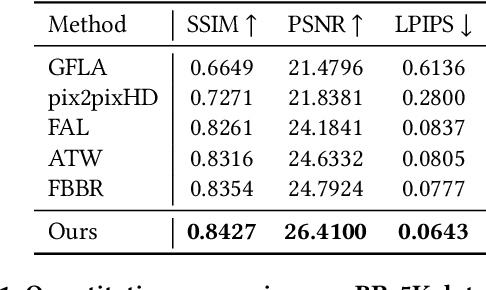
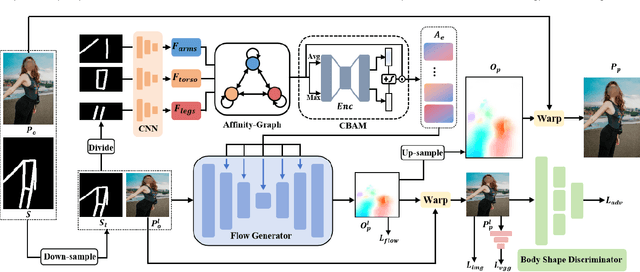
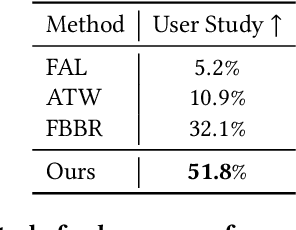
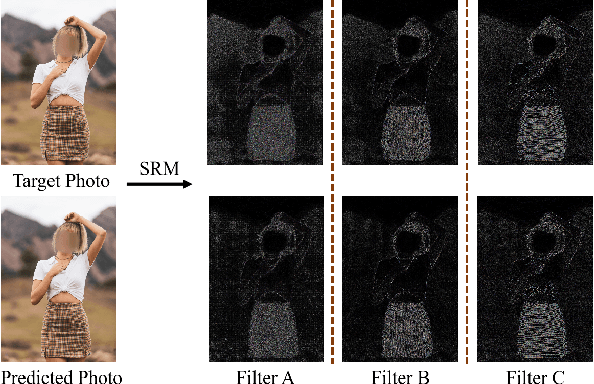
Given a source portrait, the automatic human body reshaping task aims at editing it to an aesthetic body shape. As the technology has been widely used in media, several methods have been proposed mainly focusing on generating optical flow to warp the body shape. However, those previous works only consider the local transformation of different body parts (arms, torso, and legs), ignoring the global affinity, and limiting the capacity to ensure consistency and quality across the entire body. In this paper, we propose a novel Adaptive Affinity-Graph Network (AAGN), which extracts the global affinity between different body parts to enhance the quality of the generated optical flow. Specifically, our AAGN primarily introduces the following designs: (1) we propose an Adaptive Affinity-Graph (AAG) Block that leverages the characteristic of a fully connected graph. AAG represents different body parts as nodes in an adaptive fully connected graph and captures all the affinities between nodes to obtain a global affinity map. The design could better improve the consistency between body parts. (2) Besides, for high-frequency details are crucial for photo aesthetics, a Body Shape Discriminator (BSD) is designed to extract information from both high-frequency and spatial domain. Particularly, an SRM filter is utilized to extract high-frequency details, which are combined with spatial features as input to the BSD. With this design, BSD guides the Flow Generator (FG) to pay attention to various fine details rather than rigid pixel-level fitting. Extensive experiments conducted on the BR-5K dataset demonstrate that our framework significantly enhances the aesthetic appeal of reshaped photos, marginally surpassing all previous work to achieve state-of-the-art in all evaluation metrics.