 Add to Chrome
 Add to Firefox
 Add to Edge
Evaluating Alignment of Behavioral Dispositions in LLMs
Feb 11, 2026
As LLMs integrate into our daily lives, understanding their behavior becomes essential. In this work, we focus on behavioral dispositions$-$the underlying tendencies that shape responses in social contexts$-$and introduce a framework to study how closely the dispositions expressed by LLMs align with those of humans. Our approach is grounded in established psychological questionnaires but adapts them for LLMs by transforming human self-report statements into Situational Judgment Tests (SJTs). These SJTs assess behavior by eliciting natural recommendations in realistic user-assistant scenarios. We generate 2,500 SJTs, each validated by three human annotators, and collect preferred actions from 10 annotators per SJT, from a large pool of 550 participants. In a comprehensive study involving 25 LLMs, we find that models often do not reflect the distribution of human preferences: (1) in scenarios with low human consensus, LLMs consistently exhibit overconfidence in a single response; (2) when human consensus is high, smaller models deviate significantly, and even some frontier models do not reflect the consensus in 15-20% of cases; (3) traits can exhibit cross-LLM patterns, e.g., LLMs may encourage emotion expression in contexts where human consensus favors composure. Lastly, mapping psychometric statements directly to behavioral scenarios presents a unique opportunity to evaluate the predictive validity of self-reports, revealing considerable gaps between LLMs' stated values and their revealed behavior.

Confidence Improves Self-Consistency in LLMs
Feb 10, 2025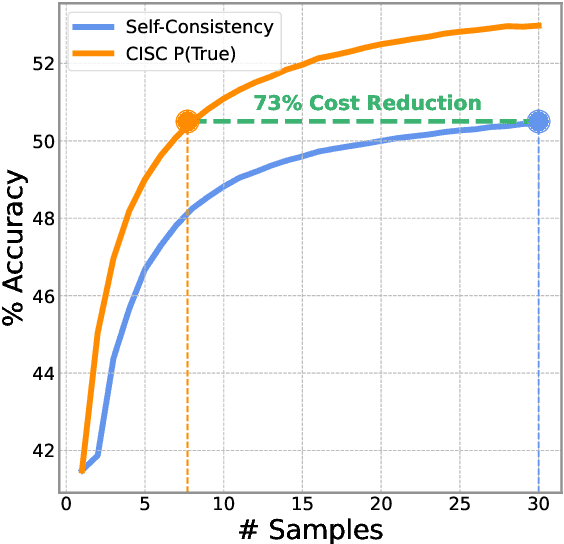
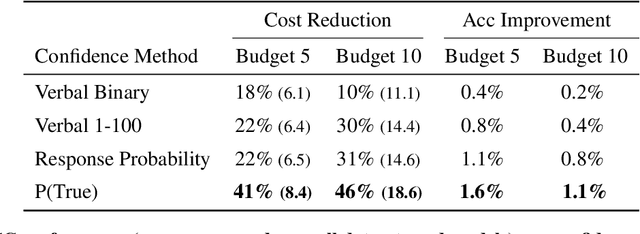
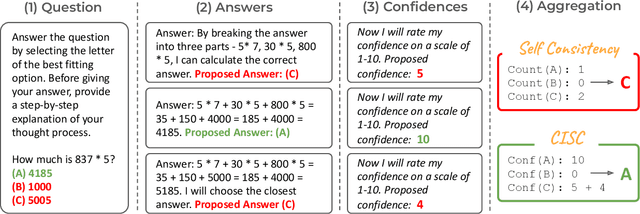
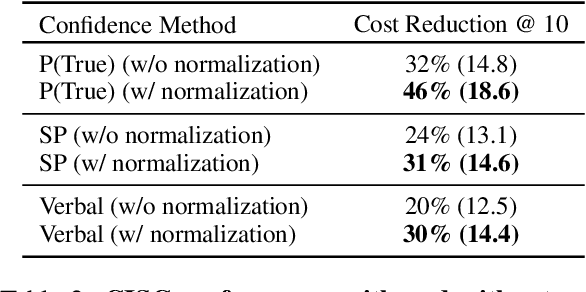
Self-consistency decoding enhances LLMs' performance on reasoning tasks by sampling diverse reasoning paths and selecting the most frequent answer. However, it is computationally expensive, as sampling many of these (lengthy) paths is required to increase the chances that the correct answer emerges as the most frequent one. To address this, we introduce Confidence-Informed Self-Consistency (CISC). CISC performs a weighted majority vote based on confidence scores obtained directly from the model. By prioritizing high-confidence paths, it can identify the correct answer with a significantly smaller sample size. When tested on nine models and four datasets, CISC outperforms self-consistency in nearly all configurations, reducing the required number of reasoning paths by over 40% on average. In addition, we introduce the notion of within-question confidence evaluation, after showing that standard evaluation methods are poor predictors of success in distinguishing correct and incorrect answers to the same question. In fact, the most calibrated confidence method proved to be the least effective for CISC. Lastly, beyond these practical implications, our results and analyses show that LLMs can effectively judge the correctness of their own outputs, contributing to the ongoing debate on this topic.
SAUCE: Synchronous and Asynchronous User-Customizable Environment for Multi-Agent LLM Interaction
Nov 05, 2024


Many human interactions, such as political debates, are carried out in group settings, where there are arbitrarily many participants, each with different views and agendas. To explore such complex social settings, we present SAUCE: a customizable Python platform, allowing researchers to plug-and-play various LLMs participating in discussions on any topic chosen by the user. Our platform takes care of instantiating the models, scheduling their responses, managing the discussion history, and producing a comprehensive output log, all customizable through configuration files, requiring little to no coding skills. A novel feature of SAUCE is our asynchronous communication feature, where models decide when to speak in addition to what to say, thus modeling an important facet of human communication. We show SAUCE's attractiveness in two initial experiments, and invite the community to use it in simulating various group simulations.
Systematic Biases in LLM Simulations of Debates
Feb 06, 2024Recent advancements in natural language processing, especially the emergence of Large Language Models (LLMs), have opened exciting possibilities for constructing computational simulations designed to replicate human behavior accurately. However, LLMs are complex statistical learners without straightforward deductive rules, making them prone to unexpected behaviors. In this study, we highlight the limitations of LLMs in simulating human interactions, particularly focusing on LLMs' ability to simulate political debates. Our findings indicate a tendency for LLM agents to conform to the model's inherent social biases despite being directed to debate from certain political perspectives. This tendency results in behavioral patterns that seem to deviate from well-established social dynamics among humans. We reinforce these observations using an automatic self-fine-tuning method, which enables us to manipulate the biases within the LLM and demonstrate that agents subsequently align with the altered biases. These results underscore the need for further research to develop methods that help agents overcome these biases, a critical step toward creating more realistic simulations.