 Add to Chrome
 Add to Firefox
 Add to Edge
DiffusionGemma Technical Report
Jul 31, 2026
We introduce DiffusionGemma, an experimental open-weight language model that uses discrete diffusion to generate text at exceptionally high speed. Rather than decoding one token at a time, DiffusionGemma iteratively refines blocks of 256 tokens in parallel, avoiding the sequential decoding bottleneck of conventional autoregressive (AR) large language models. Instead of training from scratch, we obtain DiffusionGemma by fine-tuning the mixture-of-experts Gemma 4 model with 3.8B activated and 25.2B total parameters. Our compute-efficient two-stage training pipeline uses fewer than 10% of the starting AR model's total training token budget. The first stage uses supervised fine-tuning to teach bidirectional denoising, while the second stage combines reinforcement learning with sampler distillation to jointly improve generation quality and inference efficiency. DiffusionGemma establishes a new Pareto frontier for the trade-off between generation speed and model capability. Averaged across our full evaluation suite, it generates around 20 tokens per forward pass and achieves roughly 1,500 output tokens per second on a single NVIDIA H100 GPU, which is substantially faster than AR models even with state-of-the-art speculative decoding. DiffusionGemma also retains the starting model's support for thinking mode, multimodal inputs, and long contexts. Despite diffusion fine-tuning, it remains capable of AR generation with only minor performance degradation, suggesting a path toward hybrid diffusion-AR decoding.

Decoupled DiLoCo for Resilient Distributed Pre-training
Apr 23, 2026Modern large-scale language model pre-training relies heavily on the single program multiple data (SPMD) paradigm, which requires tight coupling across accelerators. Due to this coupling, transient slowdowns, hardware failures, and synchronization overhead stall the entire computation, wasting significant compute time at scale. While recent distributed methods like DiLoCo reduced communication bandwidth, they remained fundamentally synchronous and vulnerable to these system stalls. To address this, we introduce Decoupled DiLoCo, an evolution of the DiLoCo framework designed to break the lock-step synchronization barrier and go beyond SPMD to maximize training goodput. Decoupled DiLoCo partitions compute across multiple independent ``learners'' that execute local inner optimization steps. These learners asynchronously communicate parameter fragments to a central synchronizer, which circumvents failed or straggling learners by aggregating updates using a minimum quorum, an adaptive grace window, and dynamic token-weighted merging. Inspired by ``chaos engineering'', we achieve significantly improved training efficiency in failure-prone environments with millions of simulated chips with strictly zero global downtime, while maintaining competitive model performance across text and vision tasks, for both dense and mixture-of-expert architectures.
Position: AI Competitions Provide the Gold Standard for Empirical Rigor in GenAI Evaluation
May 01, 2025In this position paper, we observe that empirical evaluation in Generative AI is at a crisis point since traditional ML evaluation and benchmarking strategies are insufficient to meet the needs of evaluating modern GenAI models and systems. There are many reasons for this, including the fact that these models typically have nearly unbounded input and output spaces, typically do not have a well defined ground truth target, and typically exhibit strong feedback loops and prediction dependence based on context of previous model outputs. On top of these critical issues, we argue that the problems of {\em leakage} and {\em contamination} are in fact the most important and difficult issues to address for GenAI evaluations. Interestingly, the field of AI Competitions has developed effective measures and practices to combat leakage for the purpose of counteracting cheating by bad actors within a competition setting. This makes AI Competitions an especially valuable (but underutilized) resource. Now is time for the field to view AI Competitions as the gold standard for empirical rigor in GenAI evaluation, and to harness and harvest their results with according value.
The FACTS Grounding Leaderboard: Benchmarking LLMs' Ability to Ground Responses to Long-Form Input
Jan 06, 2025

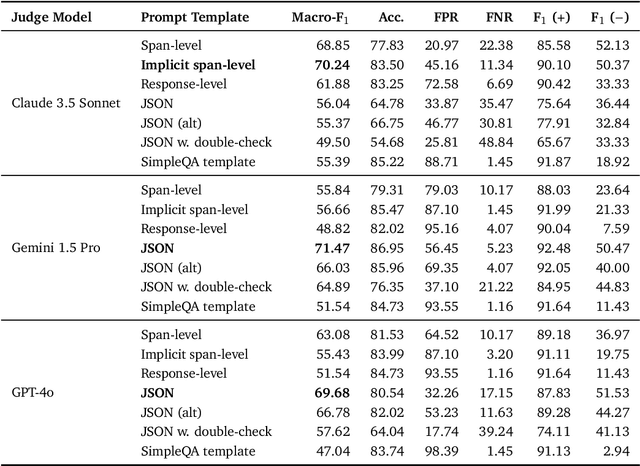

We introduce FACTS Grounding, an online leaderboard and associated benchmark that evaluates language models' ability to generate text that is factually accurate with respect to given context in the user prompt. In our benchmark, each prompt includes a user request and a full document, with a maximum length of 32k tokens, requiring long-form responses. The long-form responses are required to be fully grounded in the provided context document while fulfilling the user request. Models are evaluated using automated judge models in two phases: (1) responses are disqualified if they do not fulfill the user request; (2) they are judged as accurate if the response is fully grounded in the provided document. The automated judge models were comprehensively evaluated against a held-out test-set to pick the best prompt template, and the final factuality score is an aggregate of multiple judge models to mitigate evaluation bias. The FACTS Grounding leaderboard will be actively maintained over time, and contains both public and private splits to allow for external participation while guarding the integrity of the leaderboard. It can be found at https://www.kaggle.com/facts-leaderboard.