 Add to Chrome
 Add to Firefox
 Add to Edge
Kastor: An efficient fine-tuning strategy for generative emulation of PDE simulations
Aug 06, 2026
Machine learning offers a promising avenue to accelerate physical simulations by replacing computationally expensive traditional Partial Differential Equation (PDE) solvers with fast, differentiable surrogate models. However, standard auto-regressive ML emulators often suffer from error accumulation over long horizons and struggle to capture the stochasticity of complex physical systems. In this paper, we propose Kastor, a comprehensive methodology to adapt a deterministic physics foundation model into a highly efficient and accurate generative surrogate. First, we introduce a two-stage inference scheme that combines a large-stride causal auto-regressive model with a non-causal temporal super-resolution network, significantly reducing error accumulation while minimizing computational cost. Second, we present Mean prediction regularization (MPR), a novel training objective that constrains the generative model to predict the deterministic distribution mean under null noise conditioning. This regularization dramatically improves the performance and stability of both Functional Generative Networks (FGN) and diffusion-based emulators. Finally, we demonstrate that incorporating spatial gradient matching improves the accuracy and physical fidelity of the simulations as measured by power spectrum density. Extensive evaluations on diverse simulation datasets of the benchmark The Well show that with these components, our model outperforms competing methods in forecasting accuracy, spectral consistency, and computational efficiency. Our model achieves a 42.9% average reduction in forecasting compared to our reference based on the Walrus finetuning methodology, and outperforms Walrus for 8 out of 10 datasets on variance-normalized RMSE (VRMSE).

DiffusionGemma Technical Report
Jul 31, 2026We introduce DiffusionGemma, an experimental open-weight language model that uses discrete diffusion to generate text at exceptionally high speed. Rather than decoding one token at a time, DiffusionGemma iteratively refines blocks of 256 tokens in parallel, avoiding the sequential decoding bottleneck of conventional autoregressive (AR) large language models. Instead of training from scratch, we obtain DiffusionGemma by fine-tuning the mixture-of-experts Gemma 4 model with 3.8B activated and 25.2B total parameters. Our compute-efficient two-stage training pipeline uses fewer than 10% of the starting AR model's total training token budget. The first stage uses supervised fine-tuning to teach bidirectional denoising, while the second stage combines reinforcement learning with sampler distillation to jointly improve generation quality and inference efficiency. DiffusionGemma establishes a new Pareto frontier for the trade-off between generation speed and model capability. Averaged across our full evaluation suite, it generates around 20 tokens per forward pass and achieves roughly 1,500 output tokens per second on a single NVIDIA H100 GPU, which is substantially faster than AR models even with state-of-the-art speculative decoding. DiffusionGemma also retains the starting model's support for thinking mode, multimodal inputs, and long contexts. Despite diffusion fine-tuning, it remains capable of AR generation with only minor performance degradation, suggesting a path toward hybrid diffusion-AR decoding.
Understanding diffusion models requires rethinking (again) generalization
May 07, 2026This position paper argues that understanding generalization in diffusion models requires fundamentally new theoretical frameworks that go beyond both classical statistical learning theory and the benign overfitting paradigm developed for supervised learning. In diffusion models, unlike in supervised learning, memorization of training data and generalization to novel samples are incompatible: a model that has fully memorized its training set generates copies rather than novel data. Several theoretical explanations for why practical diffusion models nevertheless generalize have been proposed, based on capacity limitations, implicit regularization from optimization, or architectural inductive biases, but their interactions remain unclear. We argue that the field should pivot from explaining why the diffusion models do not memorize to investigating what the model actually learns during pre-memorization phase. To highlight our stance, we conduct empirical study of diffusion models trained on CIFAR-10, and we distill the findings into concrete open questions that we believe are key to improve understanding of generalization in diffusion models.
Taking a Big Step: Large Learning Rates in Denoising Score Matching Prevent Memorization
Feb 05, 2025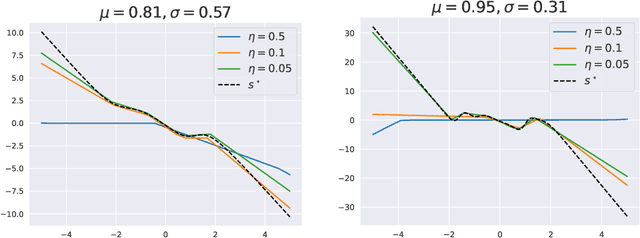
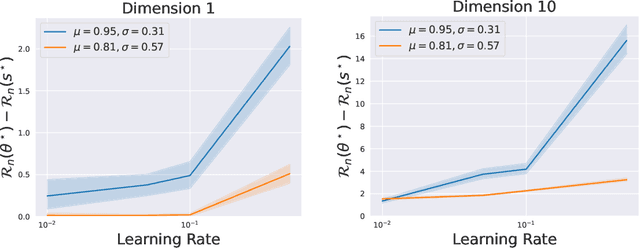
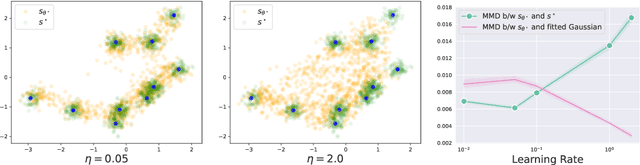
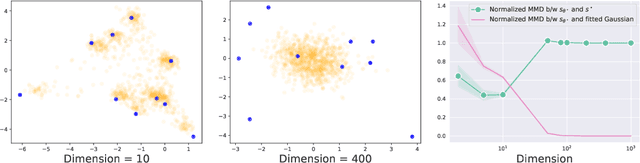
Denoising score matching plays a pivotal role in the performance of diffusion-based generative models. However, the empirical optimal score--the exact solution to the denoising score matching--leads to memorization, where generated samples replicate the training data. Yet, in practice, only a moderate degree of memorization is observed, even without explicit regularization. In this paper, we investigate this phenomenon by uncovering an implicit regularization mechanism driven by large learning rates. Specifically, we show that in the small-noise regime, the empirical optimal score exhibits high irregularity. We then prove that, when trained by stochastic gradient descent with a large enough learning rate, neural networks cannot stably converge to a local minimum with arbitrarily small excess risk. Consequently, the learned score cannot be arbitrarily close to the empirical optimal score, thereby mitigating memorization. To make the analysis tractable, we consider one-dimensional data and two-layer neural networks. Experiments validate the crucial role of the learning rate in preventing memorization, even beyond the one-dimensional setting.
Implicit regularization of deep residual networks towards neural ODEs
Sep 03, 2023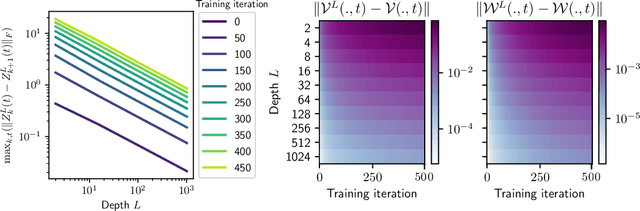
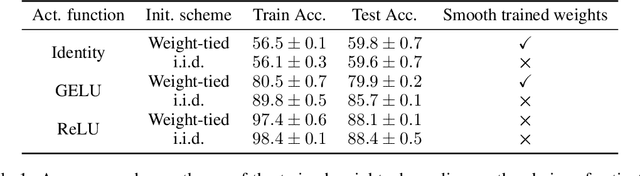
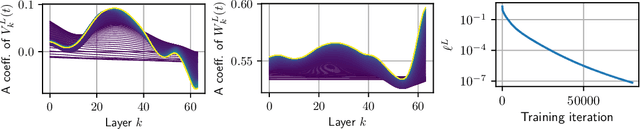
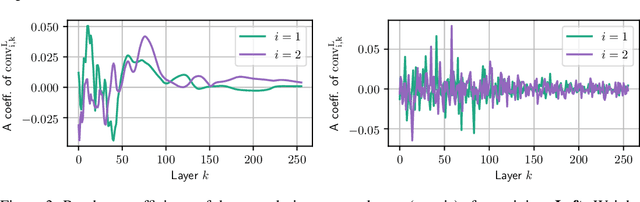
Residual neural networks are state-of-the-art deep learning models. Their continuous-depth analog, neural ordinary differential equations (ODEs), are also widely used. Despite their success, the link between the discrete and continuous models still lacks a solid mathematical foundation. In this article, we take a step in this direction by establishing an implicit regularization of deep residual networks towards neural ODEs, for nonlinear networks trained with gradient flow. We prove that if the network is initialized as a discretization of a neural ODE, then such a discretization holds throughout training. Our results are valid for a finite training time, and also as the training time tends to infinity provided that the network satisfies a Polyak-Lojasiewicz condition. Importantly, this condition holds for a family of residual networks where the residuals are two-layer perceptrons with an overparameterization in width that is only linear, and implies the convergence of gradient flow to a global minimum. Numerical experiments illustrate our results.