 Add to Chrome
 Add to Firefox
 Add to Edge
Evaluating Skill and Stability of ArchesWeather and ArchesWeatherGen under Multi-Decadal Climate Simulations
May 28, 2026
We evaluate the climate simulation capabilities of ArchesWeather and ArchesWeatherGen, two machine learning models originally trained for weather forecasting and evaluated up to a 10-day lead time. ArchesWeather is a deterministic model, while ArchesWeatherGen is a probabilistic flow-matching model leveraging ArchesWeather's forecasts, enabling ensemble-based uncertainty quantification. In this work, we adapt these models to act as forced atmospheric models by using additional conditioning on the monthly mean sea surface temperature (SST) and sea ice cover (SIC) as boundary conditions. In particular, we follow the AI Model Intercomparison Project (AIMIP) Phase 1 protocol, which, analogous to the Atmospheric Model Intercomparison Project (AMIP), proposes a standardized experimental setup to evaluate the climate skill of ML-based forced atmospheric models. We present a comprehensive evaluation of both models under these conditions, including comparison against numerical climate models, ablation studies that examine key design choices in the extension, and an analysis of forced versus unforced configurations. Despite being originally developed for weather forecasting, we demonstrate that forced configurations of ArchesWeather and ArchesWeatherGen produce stable long-term climate simulations, have a stable annual cycle, and capture the drift of many climate variables. The models faithfully reproduce ERA5's climatology, large-scale circulations and interannual variability, and they capture the tails of the distributions.

ArchesWeather & ArchesWeatherGen: a deterministic and generative model for efficient ML weather forecasting
Dec 17, 2024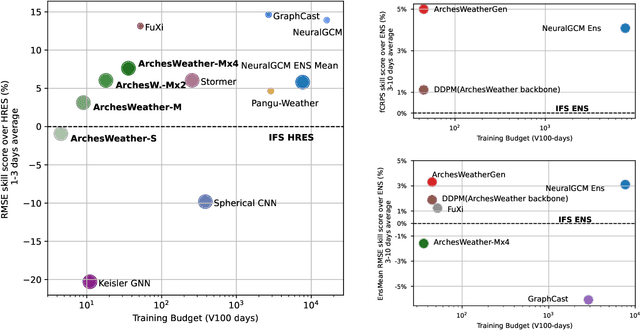
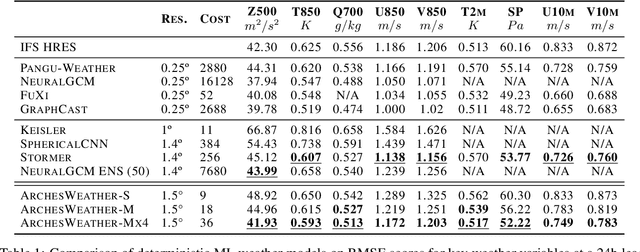
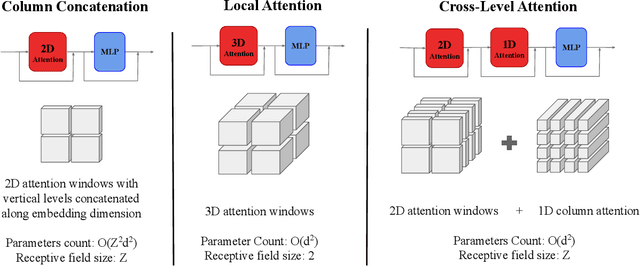
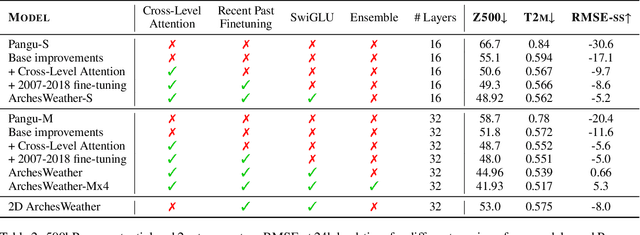
Weather forecasting plays a vital role in today's society, from agriculture and logistics to predicting the output of renewable energies, and preparing for extreme weather events. Deep learning weather forecasting models trained with the next state prediction objective on ERA5 have shown great success compared to numerical global circulation models. However, for a wide range of applications, being able to provide representative samples from the distribution of possible future weather states is critical. In this paper, we propose a methodology to leverage deterministic weather models in the design of probabilistic weather models, leading to improved performance and reduced computing costs. We first introduce \textbf{ArchesWeather}, a transformer-based deterministic model that improves upon Pangu-Weather by removing overrestrictive inductive priors. We then design a probabilistic weather model called \textbf{ArchesWeatherGen} based on flow matching, a modern variant of diffusion models, that is trained to project ArchesWeather's predictions to the distribution of ERA5 weather states. ArchesWeatherGen is a true stochastic emulator of ERA5 and surpasses IFS ENS and NeuralGCM on all WeatherBench headline variables (except for NeuralGCM's geopotential). Our work also aims to democratize the use of deterministic and generative machine learning models in weather forecasting research, with academic computing resources. All models are trained at 1.5{\deg} resolution, with a training budget of $\sim$9 V100 days for ArchesWeather and $\sim$45 V100 days for ArchesWeatherGen. For inference, ArchesWeatherGen generates 15-day weather trajectories at a rate of 1 minute per ensemble member on a A100 GPU card. To make our work fully reproducible, our code and models are open source, including the complete pipeline for data preparation, training, and evaluation, at https://github.com/INRIA/geoarches .