 Add to Chrome
 Add to Firefox
 Add to Edge
Agentic Service-Oriented Computing: A Manifesto for the Next Frontier of Service-Oriented Computing
Jul 14, 2026
The rapid emergence of LLM-powered autonomous and semi-autonomous agents is reshaping software systems from static, request-response components into goal-directed, adaptive, and tool-using computational actors. As these agents move from isolated cognitive prototypes into complex distributed workflows, they confront challenges that the Service-Oriented Computing community has studied for more than two decades: composition, interoperability, quality of service, lifecycle management, governance, security, and trust. Yet much of today's agentic AI ecosystem is developing these foundations ad hoc, without the engineering rigour required for dependable enterprise and societal deployment. This paper introduces Agentic Service-Oriented Computing (ASOC) as a new research and practice area concerned with engineering agents as services, orchestrating services through autonomous and semi-autonomous agents, and governing ecosystems of agents and services under constraints of trust, cybersecurity, compliance, performance, and accountability. We articulate six foundational principles of ASOC (harness-ability, composability, lifecycle engineering, trustworthiness by design, goal-driven orchestration, and observability/accountability) and organise a five-dimensional research agenda spanning: (i) agentic services foundations and lifecycle engineering; (ii) composition, orchestration, and interoperability; (iii) governance, observability, and accountability; (iv) security, trust, and risk management; and (v) evaluation, certification, and Agentic QoS. We argue that the Services Computing community is especially well positioned to provide the conceptual and engineering spine for this emerging field, transforming agentic AI from fragmented demonstrations into dependable, service-based systems worthy of human and organisational trust.

STELLA: Efficient Sensor-to-LLM Translation for On-Device Human Activity Recognition
Jul 03, 2026HAR is increasingly expected to run continuously on edge devices, yet recent LLM-based methods remain hard to deploy: raw sensor prompts are long, cloud inference adds latency and privacy risk, and fine-tuned LLM pipelines turn general-purpose models into task-specific classifiers. We present STELLA, an efficient sensor-to-LLM translation framework for on-device HAR that shifts the burden from LLM adaptation to sensor tokenization. A lightweight hierarchical tokenizer compresses an entire multi-channel inertial window into a fixed set of compact latent sensor tokens, which are projected into the embedding space of a frozen pretrained LLM and combined with a natural-language prompt for label scoring. This preserves activity-relevant temporal and cross-channel structure while keeping LLM-side computation predictable across sensor configurations. STELLA also supports on-device personalization, adapting only the lightweight tokenizer on small amounts of user-specific labelled data and augmenting inference with a local retrieval context, keeping the LLM, user data, and retrieval on device. Across seven public HAR datasets and eight benchmark settings, STELLA achieves new state-of-the-art performance, improving over prior methods by up to 11.83% F1; on-device personalization yields up to a further 21.91% F1 as user data accumulates after deployment. STELLA also outperforms representative time-series tokenizers under the same LLM pipeline and achieves real-time inference under practical mobile and edge budgets, showing that efficient sensor tokenization is a practical path toward accurate, private, and personalized LLM-based HAR on edge devices.
SHIELD: An Auto-Healing Agentic Defense Framework for LLM Resource Exhaustion Attacks
Jan 27, 2026Sponge attacks increasingly threaten LLM systems by inducing excessive computation and DoS. Existing defenses either rely on statistical filters that fail on semantically meaningful attacks or use static LLM-based detectors that struggle to adapt as attack strategies evolve. We introduce SHIELD, a multi-agent, auto-healing defense framework centered on a three-stage Defense Agent that integrates semantic similarity retrieval, pattern matching, and LLM-based reasoning. Two auxiliary agents, a Knowledge Updating Agent and a Prompt Optimization Agent, form a closed self-healing loop, when an attack bypasses detection, the system updates an evolving knowledgebase, and refines defense instructions. Extensive experiments show that SHIELD consistently outperforms perplexity-based and standalone LLM defenses, achieving high F1 scores across both non-semantic and semantic sponge attacks, demonstrating the effectiveness of agentic self-healing against evolving resource-exhaustion threats.
Multi-level Explanation of Deep Reinforcement Learning-based Scheduling
Sep 18, 2022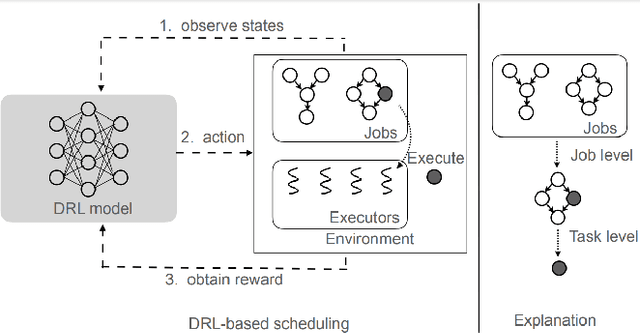
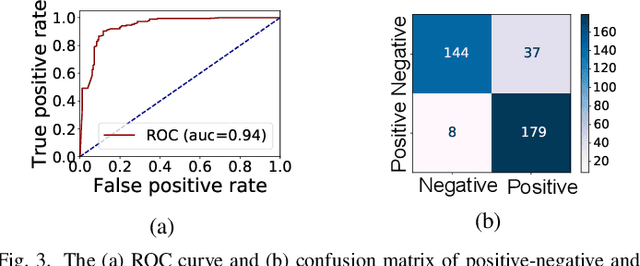
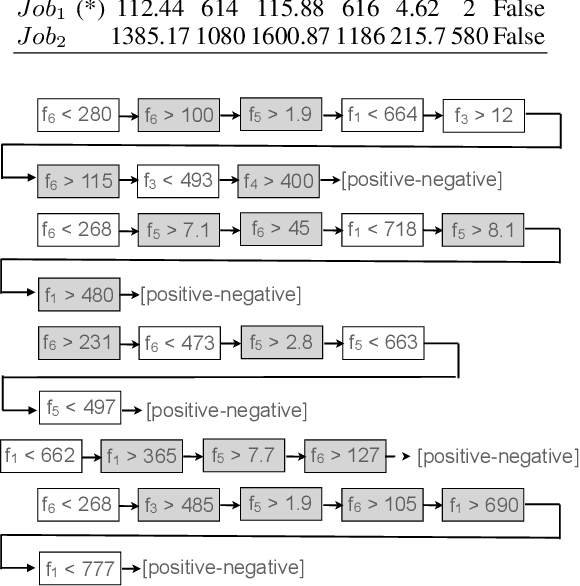
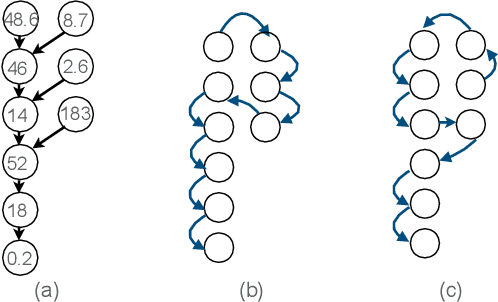
Dependency-aware job scheduling in the cluster is NP-hard. Recent work shows that Deep Reinforcement Learning (DRL) is capable of solving it. It is difficult for the administrator to understand the DRL-based policy even though it achieves remarkable performance gain. Therefore the complex model-based scheduler is not easy to gain trust in the system where simplicity is favored. In this paper, we give the multi-level explanation framework to interpret the policy of DRL-based scheduling. We dissect its decision-making process to job level and task level and approximate each level with interpretable models and rules, which align with operational practices. We show that the framework gives the system administrator insights into the state-of-the-art scheduler and reveals the robustness issue in regards to its behavior pattern.
Multi-Component Optimization and Efficient Deployment of Neural-Networks on Resource-Constrained IoT Hardware
Apr 20, 2022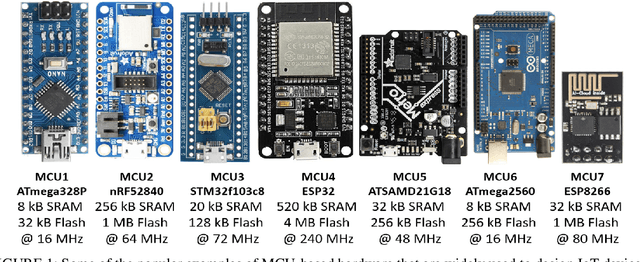
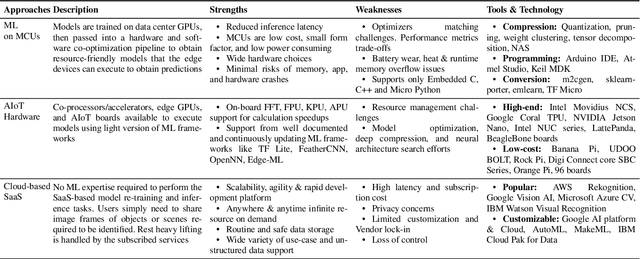
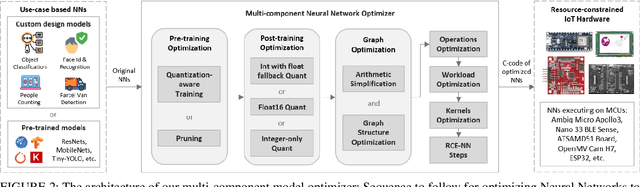
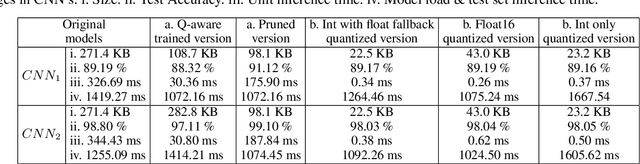
The majority of IoT devices like smartwatches, smart plugs, HVAC controllers, etc., are powered by hardware with a constrained specification (low memory, clock speed and processor) which is insufficient to accommodate and execute large, high-quality models. On such resource-constrained devices, manufacturers still manage to provide attractive functionalities (to boost sales) by following the traditional approach of programming IoT devices/products to collect and transmit data (image, audio, sensor readings, etc.) to their cloud-based ML analytics platforms. For decades, this online approach has been facing issues such as compromised data streams, non-real-time analytics due to latency, bandwidth constraints, costly subscriptions, recent privacy issues raised by users and the GDPR guidelines, etc. In this paper, to enable ultra-fast and accurate AI-based offline analytics on resource-constrained IoT devices, we present an end-to-end multi-component model optimization sequence and open-source its implementation. Researchers and developers can use our optimization sequence to optimize high memory, computation demanding models in multiple aspects in order to produce small size, low latency, low-power consuming models that can comfortably fit and execute on resource-constrained hardware. The experimental results show that our optimization components can produce models that are; (i) 12.06 x times compressed; (ii) 0.13% to 0.27% more accurate; (iii) Orders of magnitude faster unit inference at 0.06 ms. Our optimization sequence is generic and can be applied to any state-of-the-art models trained for anomaly detection, predictive maintenance, robotics, voice recognition, and machine vision.