 Add to Chrome
 Add to Firefox
 Add to Edge
RAG-HAR+: Towards Cost-Efficient LLM-Based Human Activity Recognition for Edge Deployment
Jul 29, 2026
Human Activity Recognition (HAR) from wearable sensors supports applications in healthcare, rehabilitation, fitness tracking, and smart environments. Yet, existing deep learning approaches require dataset-specific training, large labeled corpora, and repeated adaptation to new sensor settings or activity taxonomies. Retrieval-Augmented Generation for Human Activity Recognition (RAG-HAR) addresses this by framing HAR as a training-free, retrieval-augmented task, in which statistical descriptions of sensor windows are used to retrieve similar labeled examples that guide LLM-based classification. We introduce RAG-HAR+, a retrieval-first and cost-optimized extension that strengthens retrieval while reducing dependence on LLM-based inference. RAG-HAR+ uses an offline Retrieval Designer Agent to design dataset-specific feature groups from a diverse pool of motion descriptors, enabling sensor windows to be compared using features better aligned with dataset-specific activity patterns. During inference, RAG-HAR+ uses majority voting over retrieved neighbors for samples with strong retrieval evidence and defers only uncertain cases to an LLM-based Ambiguity Resolver Agent. Across six HAR benchmarks, RAG-HAR+ maintains competitive or improved performance while reducing LLM usage, token consumption, and inference time. We further extend the RAG-HAR mobile prototype to demonstrate the practical feasibility of retrieval-first, LLM-assisted HAR in mobile sensing scenarios.

STELLA: Efficient Sensor-to-LLM Translation for On-Device Human Activity Recognition
Jul 03, 2026HAR is increasingly expected to run continuously on edge devices, yet recent LLM-based methods remain hard to deploy: raw sensor prompts are long, cloud inference adds latency and privacy risk, and fine-tuned LLM pipelines turn general-purpose models into task-specific classifiers. We present STELLA, an efficient sensor-to-LLM translation framework for on-device HAR that shifts the burden from LLM adaptation to sensor tokenization. A lightweight hierarchical tokenizer compresses an entire multi-channel inertial window into a fixed set of compact latent sensor tokens, which are projected into the embedding space of a frozen pretrained LLM and combined with a natural-language prompt for label scoring. This preserves activity-relevant temporal and cross-channel structure while keeping LLM-side computation predictable across sensor configurations. STELLA also supports on-device personalization, adapting only the lightweight tokenizer on small amounts of user-specific labelled data and augmenting inference with a local retrieval context, keeping the LLM, user data, and retrieval on device. Across seven public HAR datasets and eight benchmark settings, STELLA achieves new state-of-the-art performance, improving over prior methods by up to 11.83% F1; on-device personalization yields up to a further 21.91% F1 as user data accumulates after deployment. STELLA also outperforms representative time-series tokenizers under the same LLM pipeline and achieves real-time inference under practical mobile and edge budgets, showing that efficient sensor tokenization is a practical path toward accurate, private, and personalized LLM-based HAR on edge devices.
SHIELD: An Auto-Healing Agentic Defense Framework for LLM Resource Exhaustion Attacks
Jan 27, 2026Sponge attacks increasingly threaten LLM systems by inducing excessive computation and DoS. Existing defenses either rely on statistical filters that fail on semantically meaningful attacks or use static LLM-based detectors that struggle to adapt as attack strategies evolve. We introduce SHIELD, a multi-agent, auto-healing defense framework centered on a three-stage Defense Agent that integrates semantic similarity retrieval, pattern matching, and LLM-based reasoning. Two auxiliary agents, a Knowledge Updating Agent and a Prompt Optimization Agent, form a closed self-healing loop, when an attack bypasses detection, the system updates an evolving knowledgebase, and refines defense instructions. Extensive experiments show that SHIELD consistently outperforms perplexity-based and standalone LLM defenses, achieving high F1 scores across both non-semantic and semantic sponge attacks, demonstrating the effectiveness of agentic self-healing against evolving resource-exhaustion threats.
Prompt-Induced Over-Generation as Denial-of-Service: A Black-Box Attack-Side Benchmark
Dec 29, 2025Large language models (LLMs) can be driven into over-generation, emitting thousands of tokens before producing an end-of-sequence (EOS) token. This degrades answer quality, inflates latency and cost, and can be weaponized as a denial-of-service (DoS) attack. Recent work has begun to study DoS-style prompt attacks, but typically focuses on a single attack algorithm or assumes white-box access, without an attack-side benchmark that compares prompt-based attackers in a black-box, query-only regime with a known tokenizer. We introduce such a benchmark and study two prompt-only attackers. The first is Evolutionary Over-Generation Prompt Search (EOGen), which searches the token space for prefixes that suppress EOS and induce long continuations. The second is a goal-conditioned reinforcement learning attacker (RL-GOAL) that trains a network to generate prefixes conditioned on a target length. To characterize behavior, we introduce Over-Generation Factor (OGF), the ratio of produced tokens to a model's context window, along with stall and latency summaries. Our evolutionary attacker achieves mean OGF = 1.38 +/- 1.15 and Success@OGF >= 2 of 24.5 percent on Phi-3. RL-GOAL is stronger: across victims it achieves higher mean OGF (up to 2.81 +/- 1.38).
Uncertainty Awareness Enables Efficient Labeling for Cancer Subtyping in Digital Pathology
Jun 13, 2025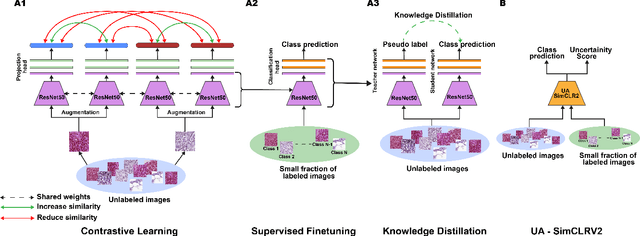
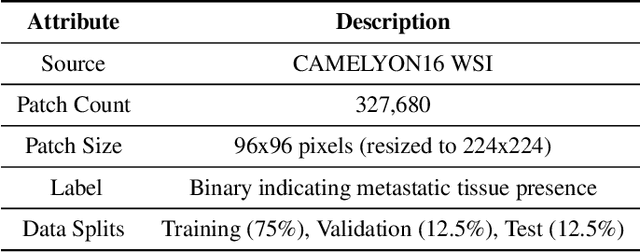
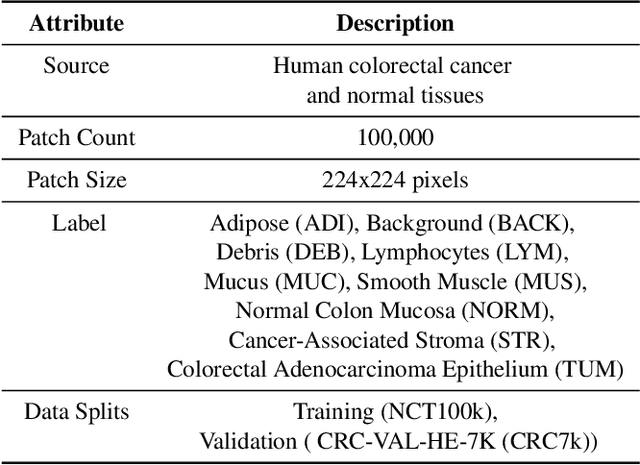
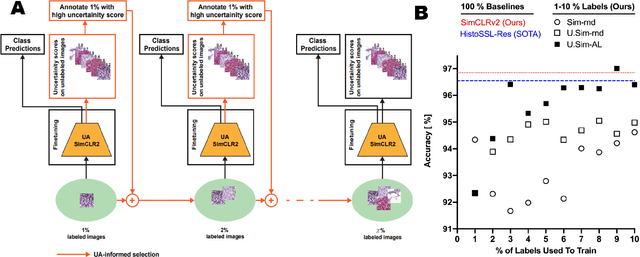
Machine-learning-assisted cancer subtyping is a promising avenue in digital pathology. Cancer subtyping models, however, require careful training using expert annotations so that they can be inferred with a degree of known certainty (or uncertainty). To this end, we introduce the concept of uncertainty awareness into a self-supervised contrastive learning model. This is achieved by computing an evidence vector at every epoch, which assesses the model's confidence in its predictions. The derived uncertainty score is then utilized as a metric to selectively label the most crucial images that require further annotation, thus iteratively refining the training process. With just 1-10% of strategically selected annotations, we attain state-of-the-art performance in cancer subtyping on benchmark datasets. Our method not only strategically guides the annotation process to minimize the need for extensive labeled datasets, but also improves the precision and efficiency of classifications. This development is particularly beneficial in settings where the availability of labeled data is limited, offering a promising direction for future research and application in digital pathology.
Contrastive Deep Encoding Enables Uncertainty-aware Machine-learning-assisted Histopathology
Sep 13, 2023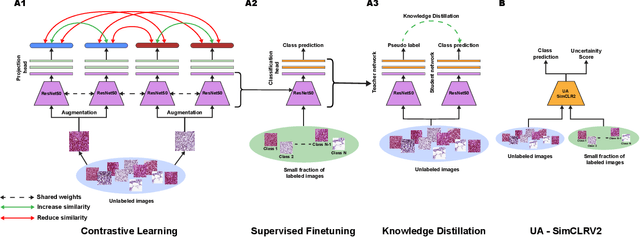
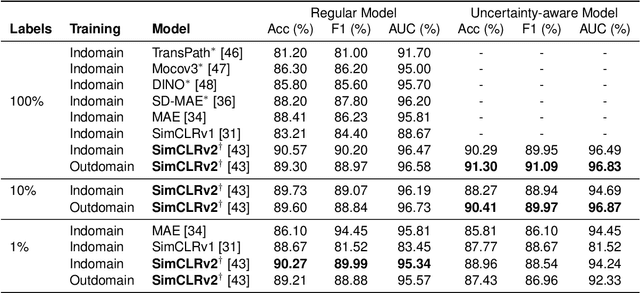
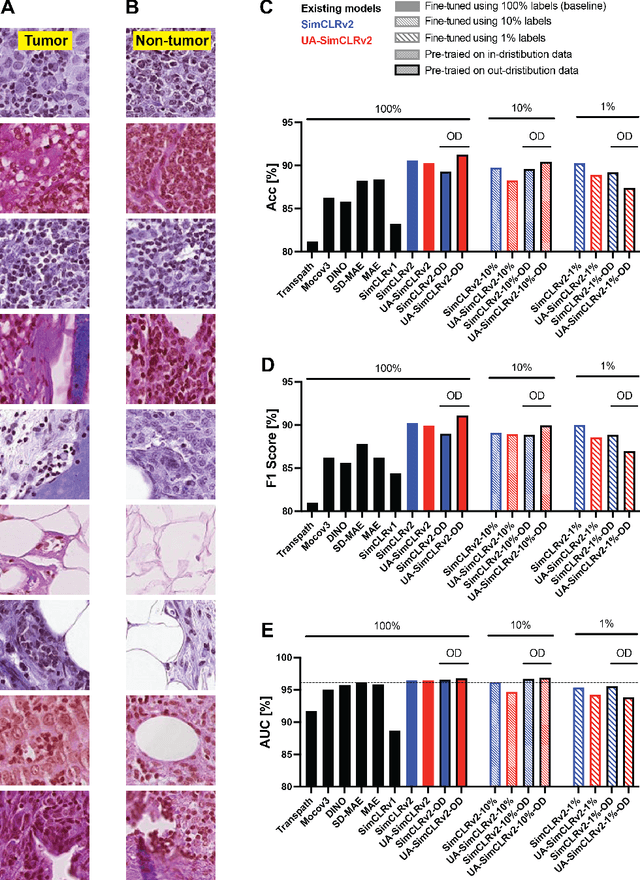
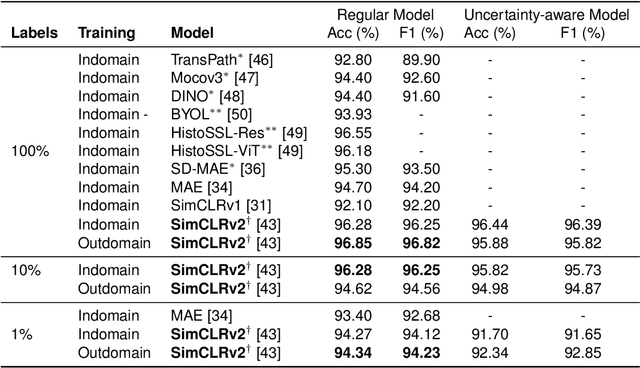
Deep neural network models can learn clinically relevant features from millions of histopathology images. However generating high-quality annotations to train such models for each hospital, each cancer type, and each diagnostic task is prohibitively laborious. On the other hand, terabytes of training data -- while lacking reliable annotations -- are readily available in the public domain in some cases. In this work, we explore how these large datasets can be consciously utilized to pre-train deep networks to encode informative representations. We then fine-tune our pre-trained models on a fraction of annotated training data to perform specific downstream tasks. We show that our approach can reach the state-of-the-art (SOTA) for patch-level classification with only 1-10% randomly selected annotations compared to other SOTA approaches. Moreover, we propose an uncertainty-aware loss function, to quantify the model confidence during inference. Quantified uncertainty helps experts select the best instances to label for further training. Our uncertainty-aware labeling reaches the SOTA with significantly fewer annotations compared to random labeling. Last, we demonstrate how our pre-trained encoders can surpass current SOTA for whole-slide image classification with weak supervision. Our work lays the foundation for data and task-agnostic pre-trained deep networks with quantified uncertainty.