 Add to Chrome
 Add to Firefox
 Add to Edge
MusicLM: Generating Music From Text
Jan 26, 2023
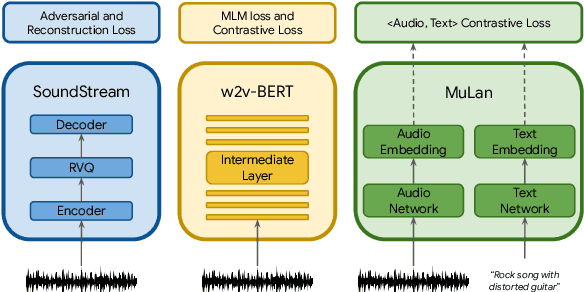


We introduce MusicLM, a model generating high-fidelity music from text descriptions such as "a calming violin melody backed by a distorted guitar riff". MusicLM casts the process of conditional music generation as a hierarchical sequence-to-sequence modeling task, and it generates music at 24 kHz that remains consistent over several minutes. Our experiments show that MusicLM outperforms previous systems both in audio quality and adherence to the text description. Moreover, we demonstrate that MusicLM can be conditioned on both text and a melody in that it can transform whistled and hummed melodies according to the style described in a text caption. To support future research, we publicly release MusicCaps, a dataset composed of 5.5k music-text pairs, with rich text descriptions provided by human experts.

Character-Aware Models Improve Visual Text Rendering
Dec 20, 2022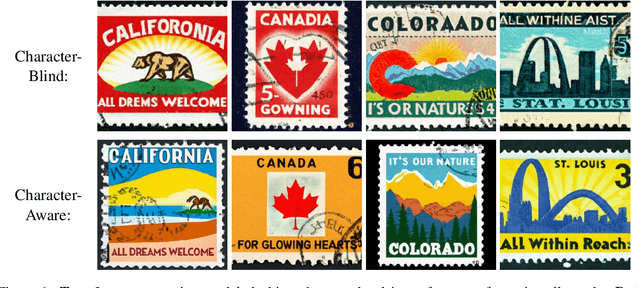
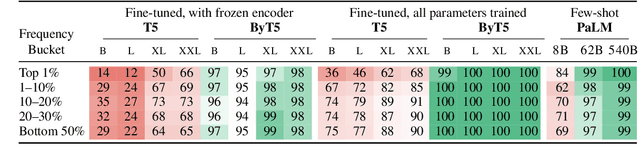
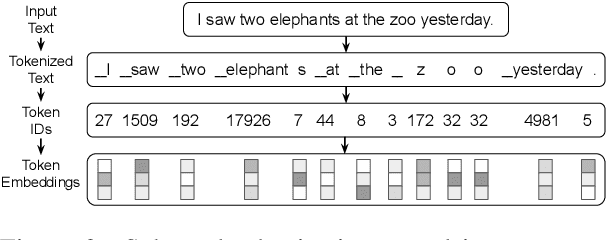
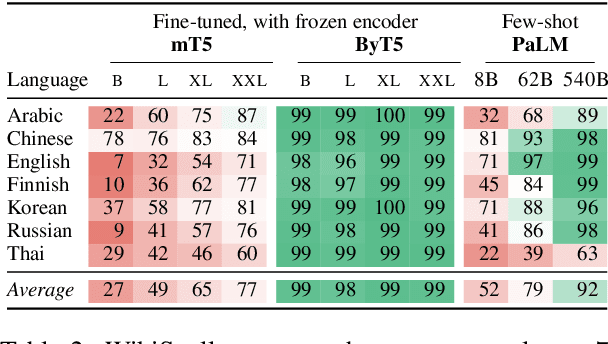
Current image generation models struggle to reliably produce well-formed visual text. In this paper, we investigate a key contributing factor: popular text-to-image models lack character-level input features, making it much harder to predict a word's visual makeup as a series of glyphs. To quantify the extent of this effect, we conduct a series of controlled experiments comparing character-aware vs. character-blind text encoders. In the text-only domain, we find that character-aware models provide large gains on a novel spelling task (WikiSpell). Transferring these learnings onto the visual domain, we train a suite of image generation models, and show that character-aware variants outperform their character-blind counterparts across a range of novel text rendering tasks (our DrawText benchmark). Our models set a much higher state-of-the-art on visual spelling, with 30+ point accuracy gains over competitors on rare words, despite training on far fewer examples.
VeLO: Training Versatile Learned Optimizers by Scaling Up
Nov 17, 2022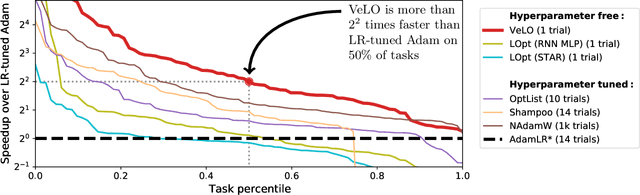
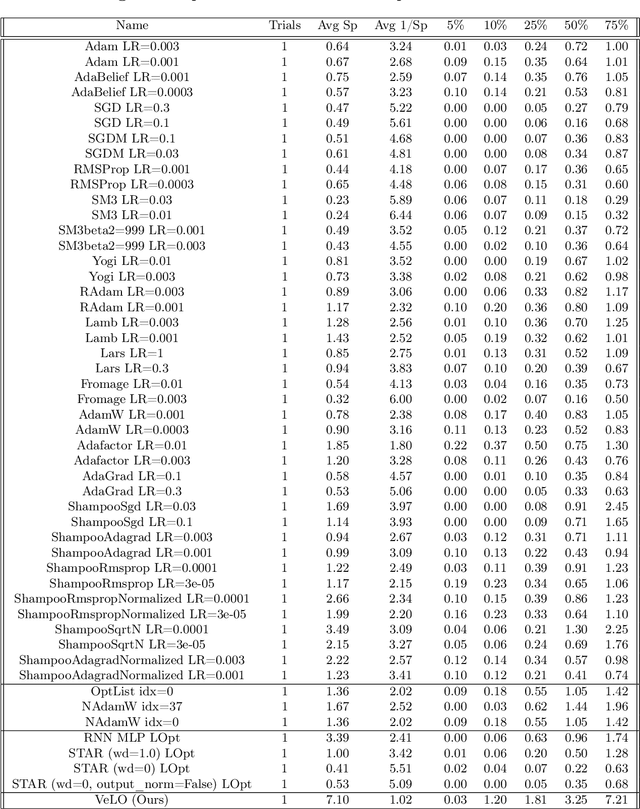
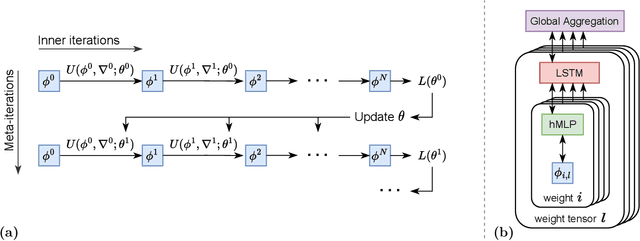
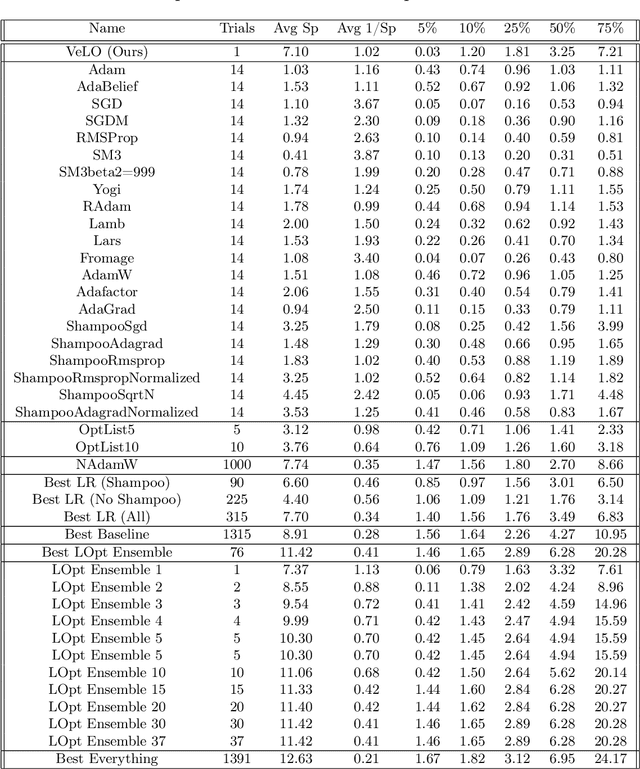
While deep learning models have replaced hand-designed features across many domains, these models are still trained with hand-designed optimizers. In this work, we leverage the same scaling approach behind the success of deep learning to learn versatile optimizers. We train an optimizer for deep learning which is itself a small neural network that ingests gradients and outputs parameter updates. Meta-trained with approximately four thousand TPU-months of compute on a wide variety of optimization tasks, our optimizer not only exhibits compelling performance, but optimizes in interesting and unexpected ways. It requires no hyperparameter tuning, instead automatically adapting to the specifics of the problem being optimized. We open source our learned optimizer, meta-training code, the associated train and test data, and an extensive optimizer benchmark suite with baselines at velo-code.github.io.
Large Language Models Struggle to Learn Long-Tail Knowledge
Nov 15, 2022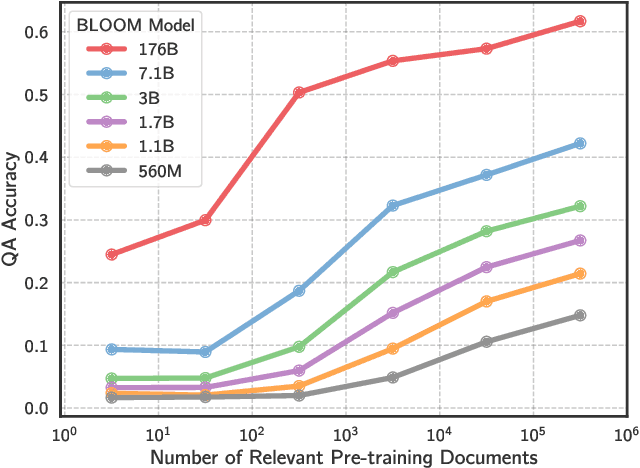
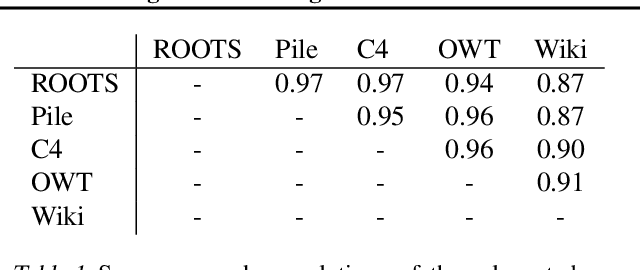
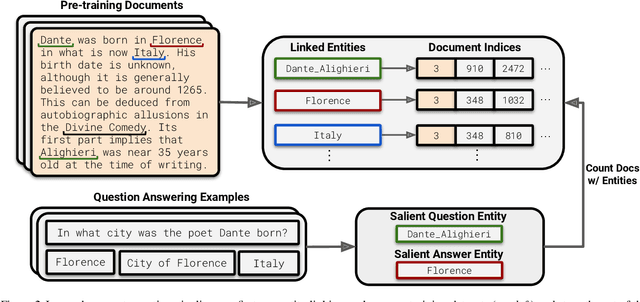
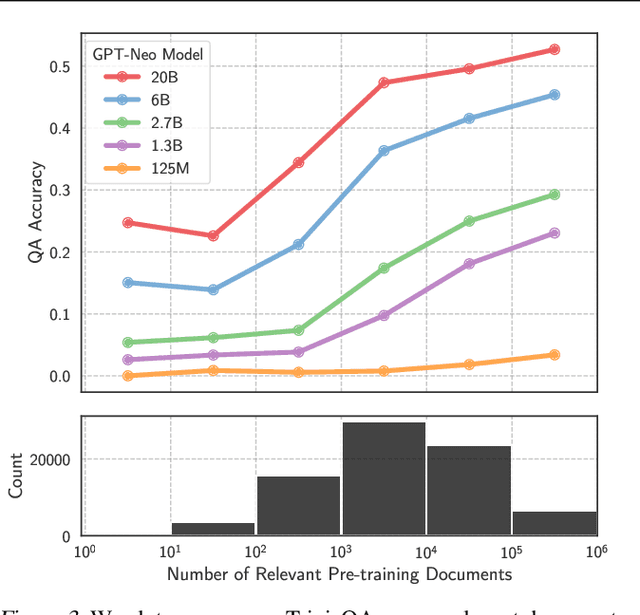
The internet contains a wealth of knowledge -- from the birthdays of historical figures to tutorials on how to code -- all of which may be learned by language models. However, there is a huge variability in the number of times a given piece of information appears on the web. In this paper, we study the relationship between the knowledge memorized by large language models and the information in their pre-training datasets. In particular, we show that a language model's ability to answer a fact-based question relates to how many documents associated with that question were seen during pre-training. We identify these relevant documents by entity linking pre-training datasets and counting documents that contain the same entities as a given question-answer pair. Our results demonstrate strong correlational and causal relationships between accuracy and relevant document count for numerous question answering datasets (e.g., TriviaQA), pre-training corpora (e.g., ROOTS), and model sizes (e.g., 176B parameters). Moreover, we find that while larger models are better at learning long-tail knowledge, we estimate that today's models must be scaled by many orders of magnitude to reach competitive QA performance on questions with little support in the pre-training data. Finally, we show that retrieval-augmentation can reduce the dependence on relevant document count, presenting a promising approach for capturing the long-tail.
BLOOM: A 176B-Parameter Open-Access Multilingual Language Model
Nov 09, 2022Large language models (LLMs) have been shown to be able to perform new tasks based on a few demonstrations or natural language instructions. While these capabilities have led to widespread adoption, most LLMs are developed by resource-rich organizations and are frequently kept from the public. As a step towards democratizing this powerful technology, we present BLOOM, a 176B-parameter open-access language model designed and built thanks to a collaboration of hundreds of researchers. BLOOM is a decoder-only Transformer language model that was trained on the ROOTS corpus, a dataset comprising hundreds of sources in 46 natural and 13 programming languages (59 in total). We find that BLOOM achieves competitive performance on a wide variety of benchmarks, with stronger results after undergoing multitask prompted finetuning. To facilitate future research and applications using LLMs, we publicly release our models and code under the Responsible AI License.
Crosslingual Generalization through Multitask Finetuning
Nov 03, 2022Multitask prompted finetuning (MTF) has been shown to help large language models generalize to new tasks in a zero-shot setting, but so far explorations of MTF have focused on English data and models. We apply MTF to the pretrained multilingual BLOOM and mT5 model families to produce finetuned variants called BLOOMZ and mT0. We find finetuning large multilingual language models on English tasks with English prompts allows for task generalization to non-English languages that appear only in the pretraining corpus. Finetuning on multilingual tasks with English prompts further improves performance on English and non-English tasks leading to various state-of-the-art zero-shot results. We also investigate finetuning on multilingual tasks with prompts that have been machine-translated from English to match the language of each dataset. We find training on these machine-translated prompts leads to better performance on human-written prompts in the respective languages. Surprisingly, we find models are capable of zero-shot generalization to tasks in languages they have never intentionally seen. We conjecture that the models are learning higher-level capabilities that are both task- and language-agnostic. In addition, we introduce xP3, a composite of supervised datasets in 46 languages with English and machine-translated prompts. Our code, datasets and models are publicly available at https://github.com/bigscience-workshop/xmtf.
Scaling Instruction-Finetuned Language Models
Oct 20, 2022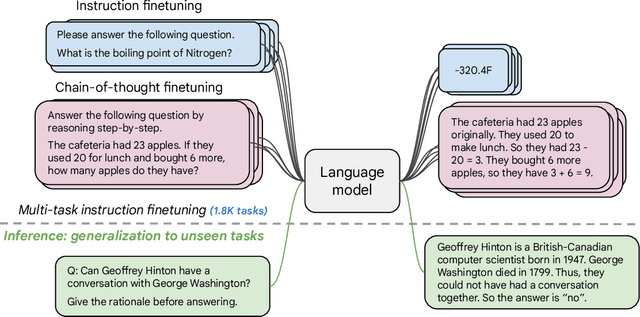
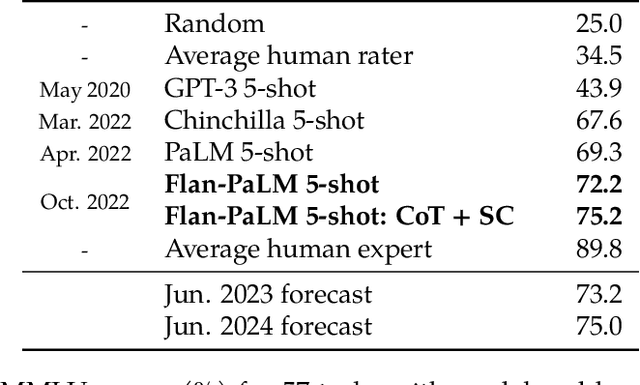
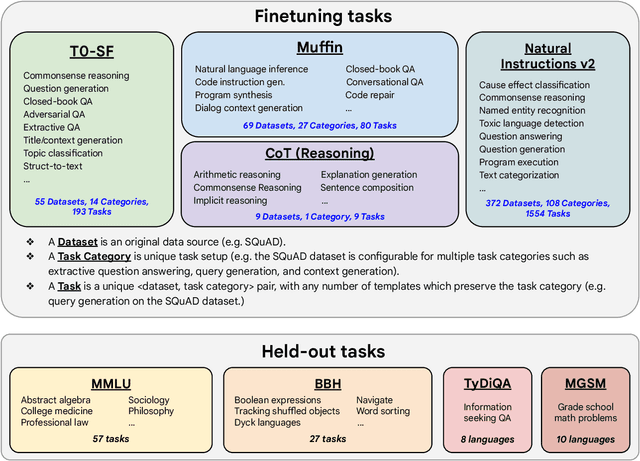
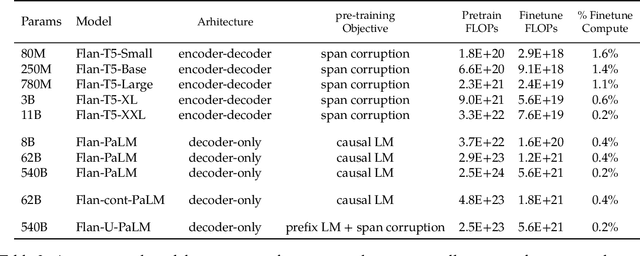
Finetuning language models on a collection of datasets phrased as instructions has been shown to improve model performance and generalization to unseen tasks. In this paper we explore instruction finetuning with a particular focus on (1) scaling the number of tasks, (2) scaling the model size, and (3) finetuning on chain-of-thought data. We find that instruction finetuning with the above aspects dramatically improves performance on a variety of model classes (PaLM, T5, U-PaLM), prompting setups (zero-shot, few-shot, CoT), and evaluation benchmarks (MMLU, BBH, TyDiQA, MGSM, open-ended generation). For instance, Flan-PaLM 540B instruction-finetuned on 1.8K tasks outperforms PALM 540B by a large margin (+9.4% on average). Flan-PaLM 540B achieves state-of-the-art performance on several benchmarks, such as 75.2% on five-shot MMLU. We also publicly release Flan-T5 checkpoints, which achieve strong few-shot performance even compared to much larger models, such as PaLM 62B. Overall, instruction finetuning is a general method for improving the performance and usability of pretrained language models.
Multi-instrument Music Synthesis with Spectrogram Diffusion
Jun 11, 2022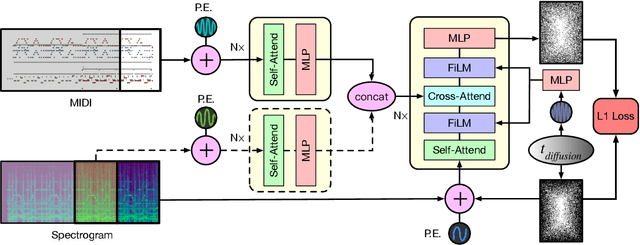
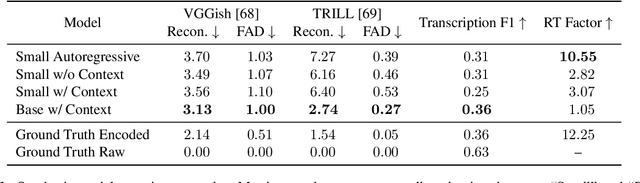

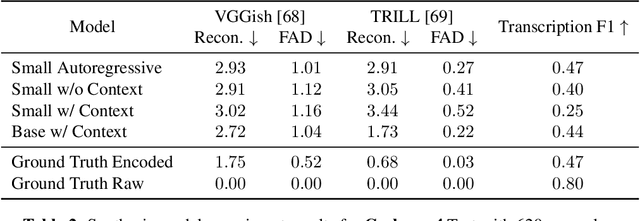
An ideal music synthesizer should be both interactive and expressive, generating high-fidelity audio in realtime for arbitrary combinations of instruments and notes. Recent neural synthesizers have exhibited a tradeoff between domain-specific models that offer detailed control of only specific instruments, or raw waveform models that can train on all of music but with minimal control and slow generation. In this work, we focus on a middle ground of neural synthesizers that can generate audio from MIDI sequences with arbitrary combinations of instruments in realtime. This enables training on a wide range of transcription datasets with a single model, which in turn offers note-level control of composition and instrumentation across a wide range of instruments. We use a simple two-stage process: MIDI to spectrograms with an encoder-decoder Transformer, then spectrograms to audio with a generative adversarial network (GAN) spectrogram inverter. We compare training the decoder as an autoregressive model and as a Denoising Diffusion Probabilistic Model (DDPM) and find that the DDPM approach is superior both qualitatively and as measured by audio reconstruction and Fr\'echet distance metrics. Given the interactivity and generality of this approach, we find this to be a promising first step towards interactive and expressive neural synthesis for arbitrary combinations of instruments and notes.
PaLM: Scaling Language Modeling with Pathways
Apr 19, 2022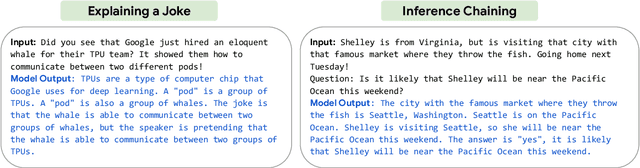

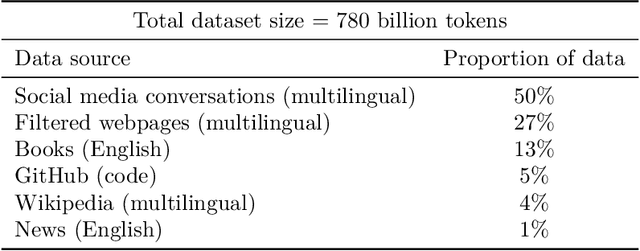
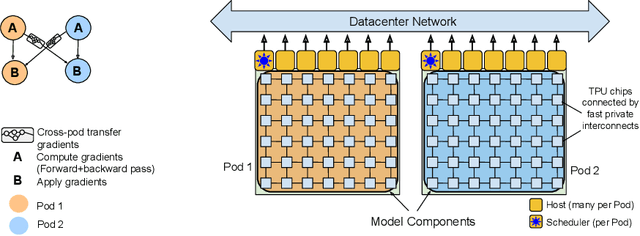
Large language models have been shown to achieve remarkable performance across a variety of natural language tasks using few-shot learning, which drastically reduces the number of task-specific training examples needed to adapt the model to a particular application. To further our understanding of the impact of scale on few-shot learning, we trained a 540-billion parameter, densely activated, Transformer language model, which we call Pathways Language Model PaLM. We trained PaLM on 6144 TPU v4 chips using Pathways, a new ML system which enables highly efficient training across multiple TPU Pods. We demonstrate continued benefits of scaling by achieving state-of-the-art few-shot learning results on hundreds of language understanding and generation benchmarks. On a number of these tasks, PaLM 540B achieves breakthrough performance, outperforming the finetuned state-of-the-art on a suite of multi-step reasoning tasks, and outperforming average human performance on the recently released BIG-bench benchmark. A significant number of BIG-bench tasks showed discontinuous improvements from model scale, meaning that performance steeply increased as we scaled to our largest model. PaLM also has strong capabilities in multilingual tasks and source code generation, which we demonstrate on a wide array of benchmarks. We additionally provide a comprehensive analysis on bias and toxicity, and study the extent of training data memorization with respect to model scale. Finally, we discuss the ethical considerations related to large language models and discuss potential mitigation strategies.
What Language Model Architecture and Pretraining Objective Work Best for Zero-Shot Generalization?
Apr 12, 2022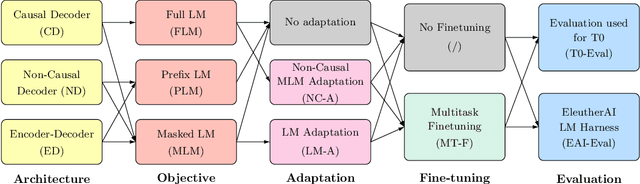
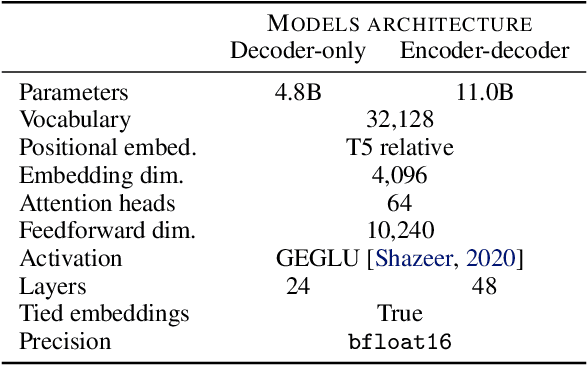
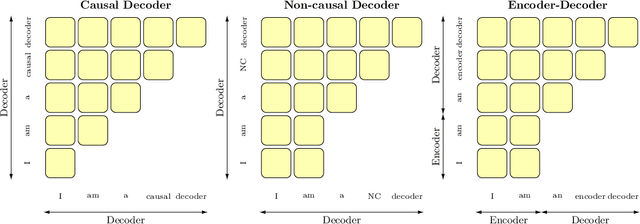
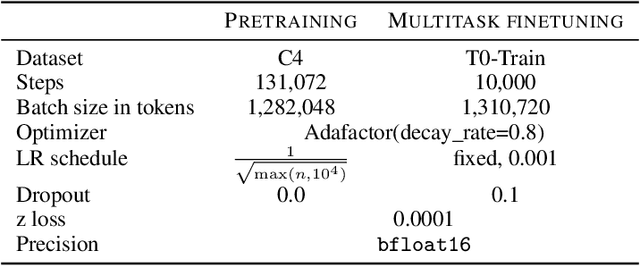
Large pretrained Transformer language models have been shown to exhibit zero-shot generalization, i.e. they can perform a wide variety of tasks that they were not explicitly trained on. However, the architectures and pretraining objectives used across state-of-the-art models differ significantly, and there has been limited systematic comparison of these factors. In this work, we present a large-scale evaluation of modeling choices and their impact on zero-shot generalization. In particular, we focus on text-to-text models and experiment with three model architectures (causal/non-causal decoder-only and encoder-decoder), trained with two different pretraining objectives (autoregressive and masked language modeling), and evaluated with and without multitask prompted finetuning. We train models with over 5 billion parameters for more than 170 billion tokens, thereby increasing the likelihood that our conclusions will transfer to even larger scales. Our experiments show that causal decoder-only models trained on an autoregressive language modeling objective exhibit the strongest zero-shot generalization after purely unsupervised pretraining. However, models with non-causal visibility on their input trained with a masked language modeling objective followed by multitask finetuning perform the best among our experiments. We therefore consider the adaptation of pretrained models across architectures and objectives. We find that pretrained non-causal decoder models can be adapted into performant generative causal decoder models, using autoregressive language modeling as a downstream task. Furthermore, we find that pretrained causal decoder models can be efficiently adapted into non-causal decoder models, ultimately achieving competitive performance after multitask finetuning. Code and checkpoints are available at https://github.com/bigscience-workshop/architecture-objective.