 Add to Chrome
 Add to Firefox
 Add to Edge
Slot Filling
Papers and Code
Exploring the Robustness of Task-oriented Dialogue Systems for Colloquial German Varieties
Feb 03, 2024
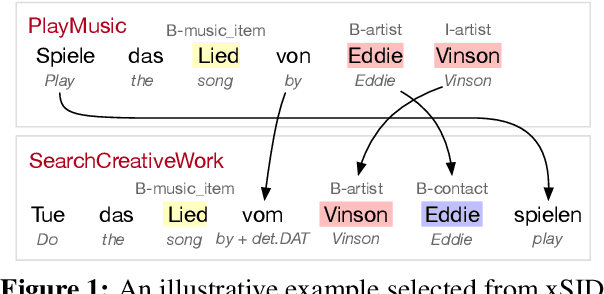
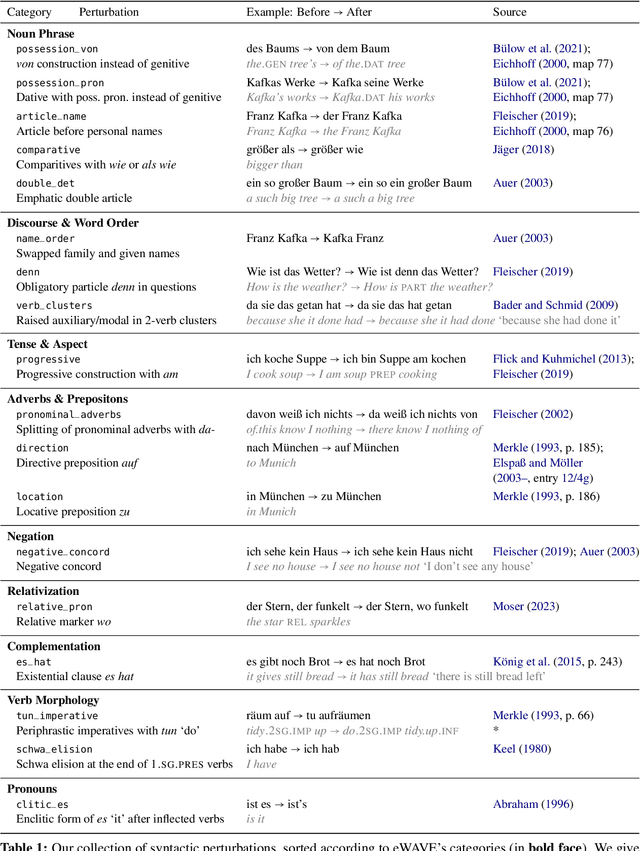
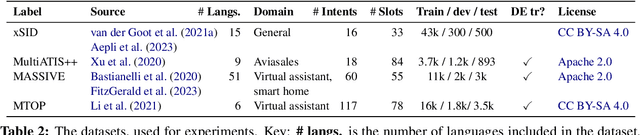
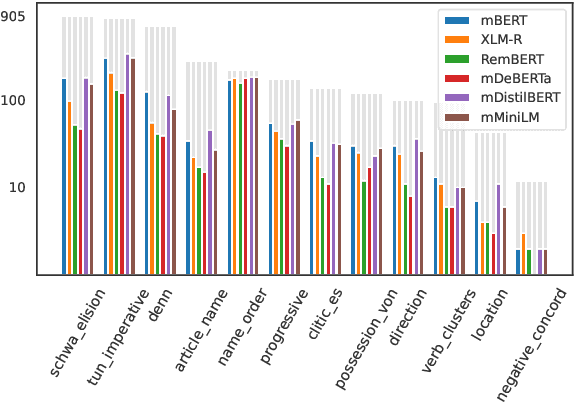
Mainstream cross-lingual task-oriented dialogue (ToD) systems leverage the transfer learning paradigm by training a joint model for intent recognition and slot-filling in English and applying it, zero-shot, to other languages. We address a gap in prior research, which often overlooked the transfer to lower-resource colloquial varieties due to limited test data. Inspired by prior work on English varieties, we craft and manually evaluate perturbation rules that transform German sentences into colloquial forms and use them to synthesize test sets in four ToD datasets. Our perturbation rules cover 18 distinct language phenomena, enabling us to explore the impact of each perturbation on slot and intent performance. Using these new datasets, we conduct an experimental evaluation across six different transformers. Here, we demonstrate that when applied to colloquial varieties, ToD systems maintain their intent recognition performance, losing 6% (4.62 percentage points) in accuracy on average. However, they exhibit a significant drop in slot detection, with a decrease of 31% (21 percentage points) in slot F1 score. Our findings are further supported by a transfer experiment from Standard American English to synthetic Urban African American Vernacular English.

HierarchicalContrast: A Coarse-to-Fine Contrastive Learning Framework for Cross-Domain Zero-Shot Slot Filling
Oct 20, 2023In task-oriented dialogue scenarios, cross-domain zero-shot slot filling plays a vital role in leveraging source domain knowledge to learn a model with high generalization ability in unknown target domain where annotated data is unavailable. However, the existing state-of-the-art zero-shot slot filling methods have limited generalization ability in target domain, they only show effective knowledge transfer on seen slots and perform poorly on unseen slots. To alleviate this issue, we present a novel Hierarchical Contrastive Learning Framework (HiCL) for zero-shot slot filling. Specifically, we propose a coarse- to fine-grained contrastive learning based on Gaussian-distributed embedding to learn the generalized deep semantic relations between utterance-tokens, by optimizing inter- and intra-token distribution distance. This encourages HiCL to generalize to the slot types unseen at training phase. Furthermore, we present a new iterative label set semantics inference method to unbiasedly and separately evaluate the performance of unseen slot types which entangled with their counterparts (i.e., seen slot types) in the previous zero-shot slot filling evaluation methods. The extensive empirical experiments on four datasets demonstrate that the proposed method achieves comparable or even better performance than the current state-of-the-art zero-shot slot filling approaches.
Adaptive End-to-End Metric Learning for Zero-Shot Cross-Domain Slot Filling
Oct 23, 2023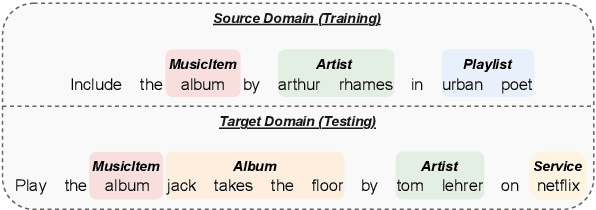
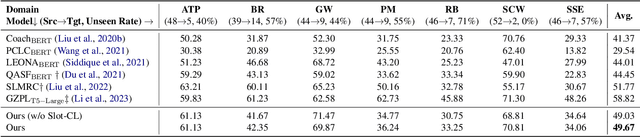
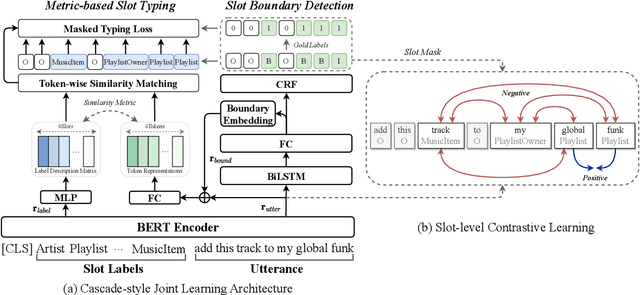
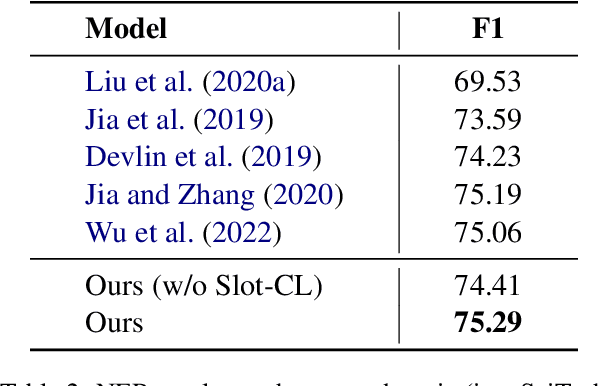
Recently slot filling has witnessed great development thanks to deep learning and the availability of large-scale annotated data. However, it poses a critical challenge to handle a novel domain whose samples are never seen during training. The recognition performance might be greatly degraded due to severe domain shifts. Most prior works deal with this problem in a two-pass pipeline manner based on metric learning. In practice, these dominant pipeline models may be limited in computational efficiency and generalization capacity because of non-parallel inference and context-free discrete label embeddings. To this end, we re-examine the typical metric-based methods, and propose a new adaptive end-to-end metric learning scheme for the challenging zero-shot slot filling. Considering simplicity, efficiency and generalizability, we present a cascade-style joint learning framework coupled with context-aware soft label representations and slot-level contrastive representation learning to mitigate the data and label shift problems effectively. Extensive experiments on public benchmarks demonstrate the superiority of the proposed approach over a series of competitive baselines.
Towards Robust and Generalizable Training: An Empirical Study of Noisy Slot Filling for Input Perturbations
Oct 05, 2023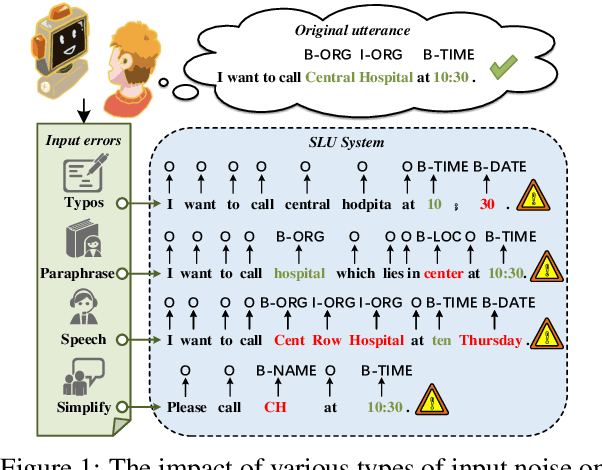


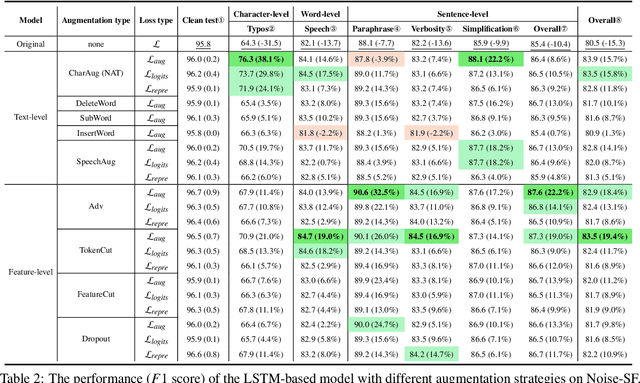
In real dialogue scenarios, as there are unknown input noises in the utterances, existing supervised slot filling models often perform poorly in practical applications. Even though there are some studies on noise-robust models, these works are only evaluated on rule-based synthetic datasets, which is limiting, making it difficult to promote the research of noise-robust methods. In this paper, we introduce a noise robustness evaluation dataset named Noise-SF for slot filling task. The proposed dataset contains five types of human-annotated noise, and all those noises are exactly existed in real extensive robust-training methods of slot filling into the proposed framework. By conducting exhaustive empirical evaluation experiments on Noise-SF, we find that baseline models have poor performance in robustness evaluation, and the proposed framework can effectively improve the robustness of models. Based on the empirical experimental results, we make some forward-looking suggestions to fuel the research in this direction. Our dataset Noise-SF will be released at https://github.com/dongguanting/Noise-SF.
DemoNSF: A Multi-task Demonstration-based Generative Framework for Noisy Slot Filling Task
Oct 16, 2023Recently, prompt-based generative frameworks have shown impressive capabilities in sequence labeling tasks. However, in practical dialogue scenarios, relying solely on simplistic templates and traditional corpora presents a challenge for these methods in generalizing to unknown input perturbations. To address this gap, we propose a multi-task demonstration based generative framework for noisy slot filling, named DemoNSF. Specifically, we introduce three noisy auxiliary tasks, namely noisy recovery (NR), random mask (RM), and hybrid discrimination (HD), to implicitly capture semantic structural information of input perturbations at different granularities. In the downstream main task, we design a noisy demonstration construction strategy for the generative framework, which explicitly incorporates task-specific information and perturbed distribution during training and inference. Experiments on two benchmarks demonstrate that DemoNSF outperforms all baseline methods and achieves strong generalization. Further analysis provides empirical guidance for the practical application of generative frameworks. Our code is released at https://github.com/dongguanting/Demo-NSF.
Revisit Input Perturbation Problems for LLMs: A Unified Robustness Evaluation Framework for Noisy Slot Filling Task
Oct 10, 2023With the increasing capabilities of large language models (LLMs), these high-performance models have achieved state-of-the-art results on a wide range of natural language processing (NLP) tasks. However, the models' performance on commonly-used benchmark datasets often fails to accurately reflect their reliability and robustness when applied to real-world noisy data. To address these challenges, we propose a unified robustness evaluation framework based on the slot-filling task to systematically evaluate the dialogue understanding capability of LLMs in diverse input perturbation scenarios. Specifically, we construct a input perturbation evaluation dataset, Noise-LLM, which contains five types of single perturbation and four types of mixed perturbation data. Furthermore, we utilize a multi-level data augmentation method (character, word, and sentence levels) to construct a candidate data pool, and carefully design two ways of automatic task demonstration construction strategies (instance-level and entity-level) with various prompt templates. Our aim is to assess how well various robustness methods of LLMs perform in real-world noisy scenarios. The experiments have demonstrated that the current open-source LLMs generally achieve limited perturbation robustness performance. Based on these experimental observations, we make some forward-looking suggestions to fuel the research in this direction.
Joint Multiple Intent Detection and Slot Filling with Supervised Contrastive Learning and Self-Distillation
Aug 28, 2023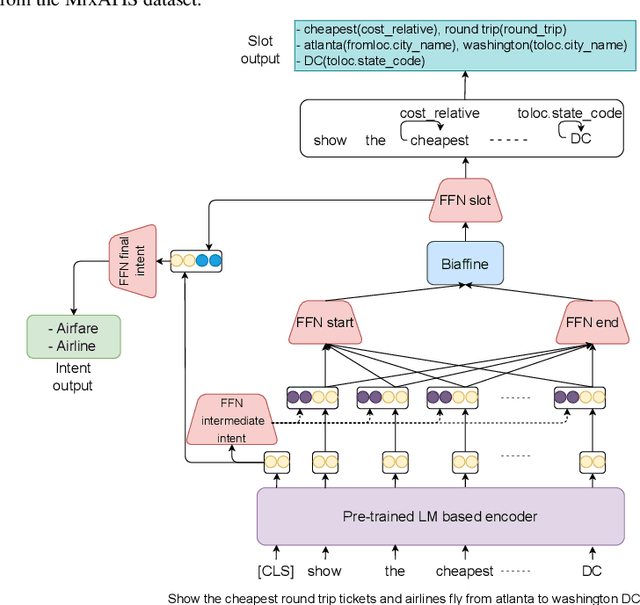
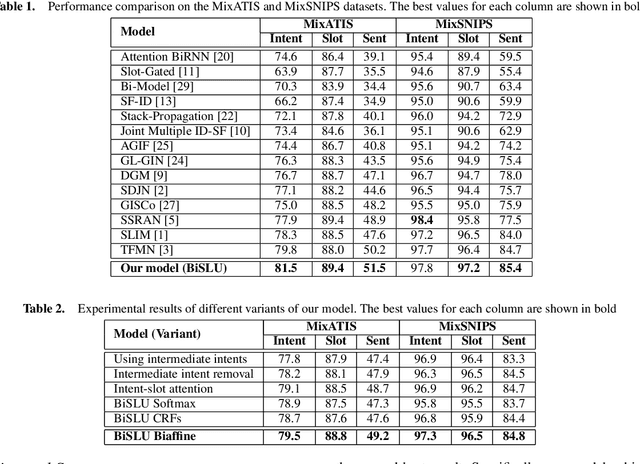
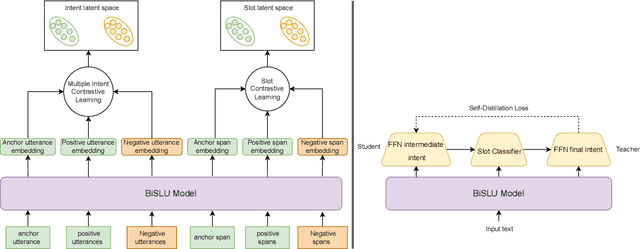
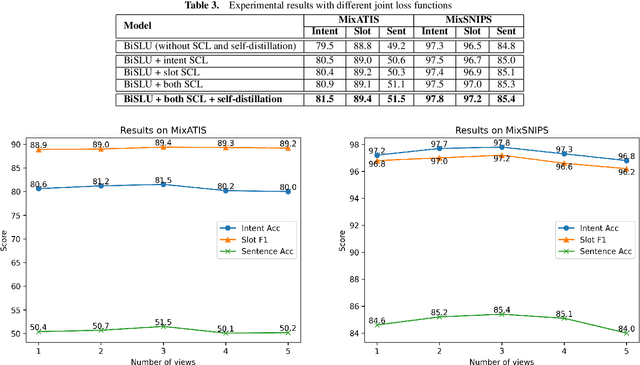
Multiple intent detection and slot filling are two fundamental and crucial tasks in spoken language understanding. Motivated by the fact that the two tasks are closely related, joint models that can detect intents and extract slots simultaneously are preferred to individual models that perform each task independently. The accuracy of a joint model depends heavily on the ability of the model to transfer information between the two tasks so that the result of one task can correct the result of the other. In addition, since a joint model has multiple outputs, how to train the model effectively is also challenging. In this paper, we present a method for multiple intent detection and slot filling by addressing these challenges. First, we propose a bidirectional joint model that explicitly employs intent information to recognize slots and slot features to detect intents. Second, we introduce a novel method for training the proposed joint model using supervised contrastive learning and self-distillation. Experimental results on two benchmark datasets MixATIS and MixSNIPS show that our method outperforms state-of-the-art models in both tasks. The results also demonstrate the contributions of both bidirectional design and the training method to the accuracy improvement. Our source code is available at https://github.com/anhtunguyen98/BiSLU
Schema Graph-Guided Prompt for Multi-Domain Dialogue State Tracking
Nov 10, 2023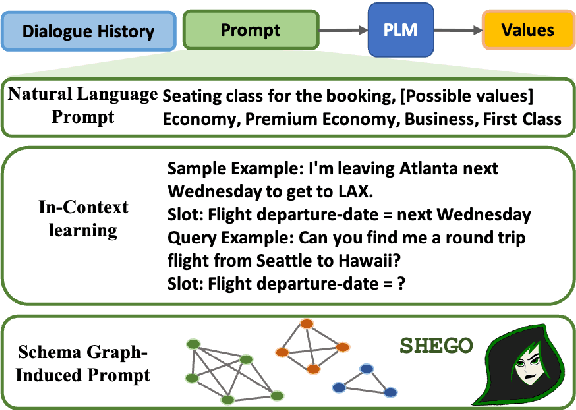
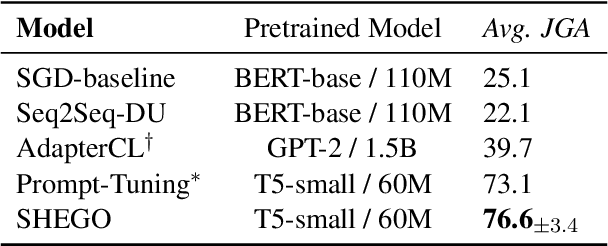
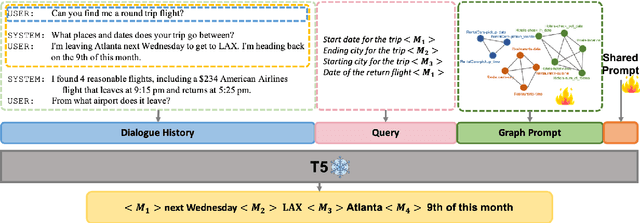
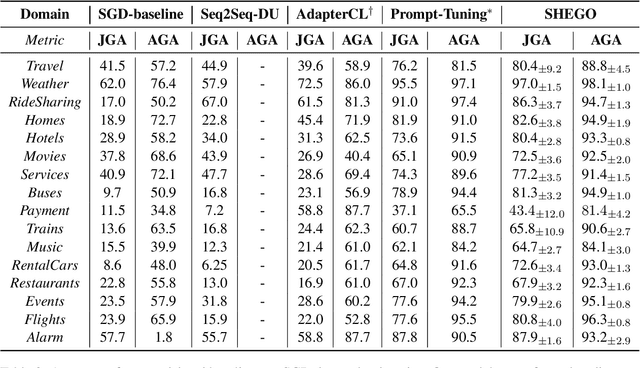
Tracking dialogue states is an essential topic in task-oriented dialogue systems, which involve filling in the necessary information in pre-defined slots corresponding to a schema. While general pre-trained language models have been shown effective in slot-filling, their performance is limited when applied to specific domains. We propose a graph-based framework that learns domain-specific prompts by incorporating the dialogue schema. Specifically, we embed domain-specific schema encoded by a graph neural network into the pre-trained language model, which allows for relations in the schema to guide the model for better adaptation to the specific domain. Our experiments demonstrate that the proposed graph-based method outperforms other multi-domain DST approaches while using similar or fewer trainable parameters. We also conduct a comprehensive study of schema graph architectures, parameter usage, and module ablation that demonstrate the effectiveness of our model on multi-domain dialogue state tracking.
Ranking with Slot Constraints
Oct 27, 2023We introduce the problem of ranking with slot constraints, which can be used to model a wide range of application problems -- from college admission with limited slots for different majors, to composing a stratified cohort of eligible participants in a medical trial. We show that the conventional Probability Ranking Principle (PRP) can be highly sub-optimal for slot-constrained ranking problems, and we devise a new ranking algorithm, called MatchRank. The goal of MatchRank is to produce rankings that maximize the number of filled slots if candidates are evaluated by a human decision maker in the order of the ranking. In this way, MatchRank generalizes the PRP, and it subsumes the PRP as a special case when there are no slot constraints. Our theoretical analysis shows that MatchRank has a strong approximation guarantee without any independence assumptions between slots or candidates. Furthermore, we show how MatchRank can be implemented efficiently. Beyond the theoretical guarantees, empirical evaluations show that MatchRank can provide substantial improvements over a range of synthetic and real-world tasks.
Introducing "Forecast Utterance" for Conversational Data Science
Sep 07, 2023Envision an intelligent agent capable of assisting users in conducting forecasting tasks through intuitive, natural conversations, without requiring in-depth knowledge of the underlying machine learning (ML) processes. A significant challenge for the agent in this endeavor is to accurately comprehend the user's prediction goals and, consequently, formulate precise ML tasks. In this paper, we take a pioneering step towards this ambitious goal by introducing a new concept called Forecast Utterance and then focus on the automatic and accurate interpretation of users' prediction goals from these utterances. Specifically, we frame the task as a slot-filling problem, where each slot corresponds to a specific aspect of the goal prediction task. We then employ two zero-shot methods for solving the slot-filling task, namely: 1) Entity Extraction (EE), and 2) Question-Answering (QA) techniques. Our experiments, conducted with three meticulously crafted data sets, validate the viability of our ambitious goal and demonstrate the effectiveness of both EE and QA techniques in interpreting Forecast Utterances.