 Add to Chrome
 Add to Firefox
 Add to Edge
Challenges and Recommendations for LLMs-as-a-Judge in Multilingual Settings and Low-Resource Languages
Jul 02, 2026
LLM-as-a-Judge has become the dominant evaluation paradigm for many natural language generation tasks, due to shortcomings of conventional metrics and high correlations with human judgment, albeit mostly in English. There are now attempts to extend LLM-as-a-Judge to multilingual settings including low-resource languages. However, LLMs have limited proficiency in low-resource languages, and there is often no adequate human validation in these settings. To highlight the scope of the problem and current practices, we explore the use of LLM-as-a-Judge evaluators in ACL Anthology papers focusing on multilingual settings and low-resource languages across a diverse set of tasks. Out of 650 papers mentioning LLM-as-a-judge, only 33 of them focus on low-resource or multilingual settings. Our in-depth analysis of these papers indicates inconsistent evaluation outcomes, a tendency to overtrust LLM judgments in multilingual settings, and the widespread reliance on a single judge model per study. To help the NLP community further, we conclude with recommendations about how to use LLM-as-a-Judge in multilingual and low-resource settings.

Are Non-English Papers Reviewed Fairly? Language-of-Study Bias in NLP Peer Reviews
Apr 08, 2026Peer review plays a central role in the NLP publication process, but is susceptible to various biases. Here, we study language-of-study (LoS) bias: the tendency for reviewers to evaluate a paper differently based on the language(s) it studies, rather than its scientific merit. Despite being explicitly flagged in reviewing guidelines, such biases are poorly understood. Prior work treats such comments as part of broader categories of weak or unconstructive reviews without defining them as a distinct form of bias. We present the first systematic characterization of LoS bias, distinguishing negative and positive forms, and introduce the human-annotated dataset LOBSTER (Language-Of-study Bias in ScienTific pEer Review) and a method achieving 87.37 macro F1 for detection. We analyze 15,645 reviews to estimate how negative and positive biases differ with respect to the LoS, and find that non-English papers face substantially higher bias rates than English-only ones, with negative bias consistently outweighing positive bias. Finally, we identify four subcategories of negative bias, and find that demanding unjustified cross-lingual generalization is the most dominant form. We publicly release all resources to support work on fairer reviewing practices in NLP and beyond.
Variation is the Norm: Embracing Sociolinguistics in NLP
Mar 25, 2026In Natural Language Processing (NLP), variation is typically seen as noise and "normalised away" before processing, even though it is an integral part of language. Conversely, studying language variation in social contexts is central to sociolinguistics. We present a framework to combine the sociolinguistic dimension of language with the technical dimension of NLP. We argue that by embracing sociolinguistics, variation can actively be included in a research setup, in turn informing the NLP side. To illustrate this, we provide a case study on Luxembourgish, an evolving language featuring a large amount of orthographic variation, demonstrating how NLP performance is impacted. The results show large discrepancies in the performance of models tested and fine-tuned on data with a large amount of orthographic variation in comparison to data closer to the (orthographic) standard. Furthermore, we provide a possible solution to improve the performance by including variation in the fine-tuning process. This case study highlights the importance of including variation in the research setup, as models are currently not robust to occurring variation. Our framework facilitates the inclusion of variation in the thought-process while also being grounded in the theoretical framework of sociolinguistics.
Indirect Question Answering in English, German and Bavarian: A Challenging Task for High- and Low-Resource Languages Alike
Mar 16, 2026Indirectness is a common feature of daily communication, yet is underexplored in NLP research for both low-resource as well as high-resource languages. Indirect Question Answering (IQA) aims at classifying the polarity of indirect answers. In this paper, we present two multilingual corpora for IQA of varying quality that both cover English, Standard German and Bavarian, a German dialect without standard orthography: InQA+, a small high-quality evaluation dataset with hand-annotated labels, and GenIQA, a larger training dataset, that contains artificial data generated by GPT-4o-mini. We find that IQA is a pragmatically hard task that comes with various challenges, based on several experiment variations with multilingual transformer models (mBERT, XLM-R and mDeBERTa). We suggest and employ recommendations to tackle these challenges. Our results reveal low performance, even for English, and severe overfitting. We analyse various factors that influence these results, including label ambiguity, label set and dataset size. We find that the IQA performance is poor in high- (English, German) and low-resource languages (Bavarian) and that it is beneficial to have a large amount of training data. Further, GPT-4o-mini does not possess enough pragmatic understanding to generate high-quality IQA data in any of our tested languages.
Information Asymmetry across Language Varieties: A Case Study on Cantonese-Mandarin and Bavarian-German QA
Mar 16, 2026Large Language Models (LLMs) are becoming a common way for humans to seek knowledge, yet their coverage and reliability vary widely. Especially for local language varieties, there are large asymmetries, e.g., information in local Wikipedia that is absent from the standard variant. However, little is known about how well LLMs perform under such information asymmetry, especially on closely related languages. We manually construct a novel challenge question-answering (QA) dataset that captures knowledge conveyed on a local Wikipedia page, which is absent from their higher-resource counterparts-covering Mandarin Chinese vs. Cantonese and German vs. Bavarian. Our experiments show that LLMs fail to answer questions about information only in local editions of Wikipedia. Providing context from lead sections substantially improves performance, with further gains possible via translation. Our topical, geographic annotations, and stratified evaluations reveal the usefulness of local Wikipedia editions as sources of both regional and global information. These findings raise critical questions about inclusivity and cultural coverage of LLMs.
Standard-to-Dialect Transfer Trends Differ across Text and Speech: A Case Study on Intent and Topic Classification in German Dialects
Oct 09, 2025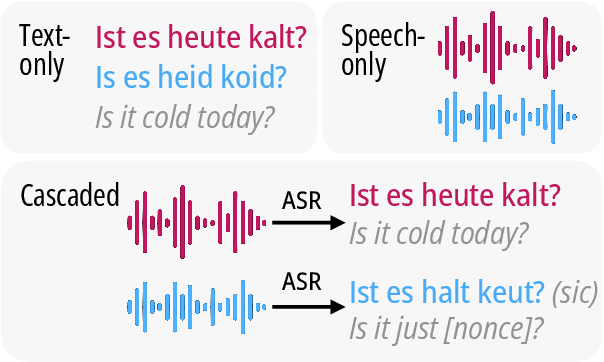
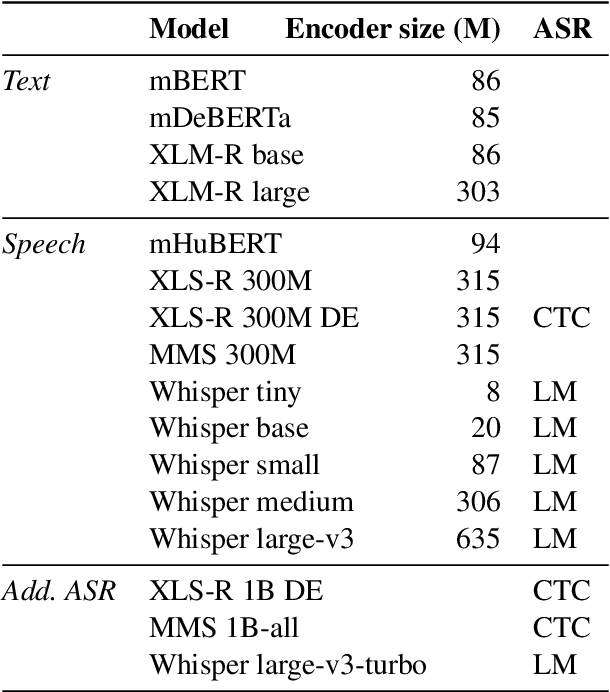
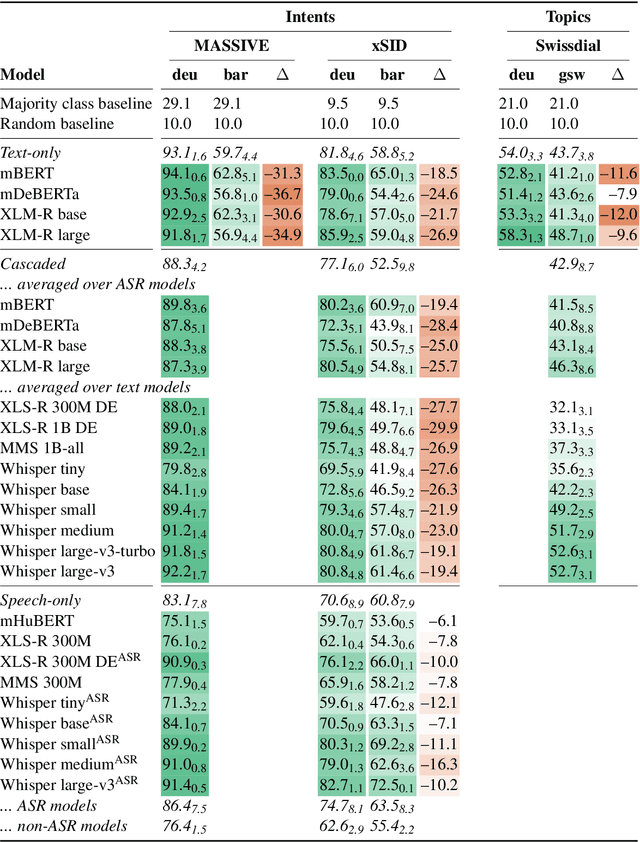
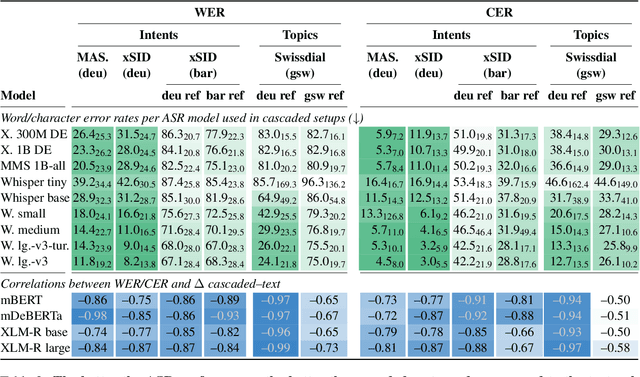
Research on cross-dialectal transfer from a standard to a non-standard dialect variety has typically focused on text data. However, dialects are primarily spoken, and non-standard spellings are known to cause issues in text processing. We compare standard-to-dialect transfer in three settings: text models, speech models, and cascaded systems where speech first gets automatically transcribed and then further processed by a text model. In our experiments, we focus on German and multiple German dialects in the context of written and spoken intent and topic classification. To that end, we release the first dialectal audio intent classification dataset. We find that the speech-only setup provides the best results on the dialect data while the text-only setup works best on the standard data. While the cascaded systems lag behind the text-only models for German, they perform relatively well on the dialectal data if the transcription system generates normalized, standard-like output.
Analyzing the Effect of Linguistic Similarity on Cross-Lingual Transfer: Tasks and Experimental Setups Matter
Jan 24, 2025Cross-lingual transfer is a popular approach to increase the amount of training data for NLP tasks in a low-resource context. However, the best strategy to decide which cross-lingual data to include is unclear. Prior research often focuses on a small set of languages from a few language families and/or a single task. It is still an open question how these findings extend to a wider variety of languages and tasks. In this work, we analyze cross-lingual transfer for 266 languages from a wide variety of language families. Moreover, we include three popular NLP tasks: POS tagging, dependency parsing, and topic classification. Our findings indicate that the effect of linguistic similarity on transfer performance depends on a range of factors: the NLP task, the (mono- or multilingual) input representations, and the definition of linguistic similarity.
Add Noise, Tasks, or Layers? MaiNLP at the VarDial 2025 Shared Task on Norwegian Dialectal Slot and Intent Detection
Jan 07, 2025

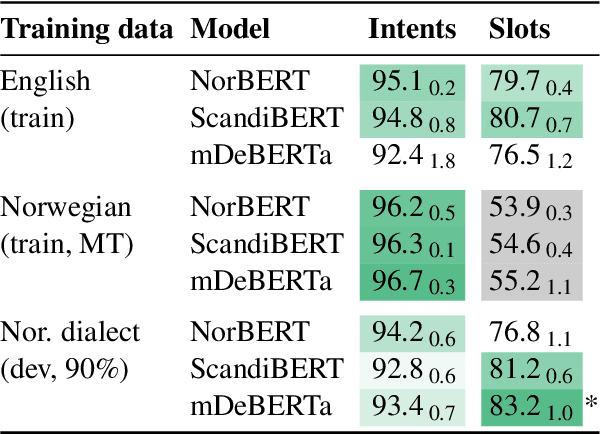

Slot and intent detection (SID) is a classic natural language understanding task. Despite this, research has only more recently begun focusing on SID for dialectal and colloquial varieties. Many approaches for low-resource scenarios have not yet been applied to dialectal SID data, or compared to each other on the same datasets. We participate in the VarDial 2025 shared task on slot and intent detection in Norwegian varieties, and compare multiple set-ups: varying the training data (English, Norwegian, or dialectal Norwegian), injecting character-level noise, training on auxiliary tasks, and applying Layer Swapping, a technique in which layers of models fine-tuned on different datasets are assembled into a model. We find noise injection to be beneficial while the effects of auxiliary tasks are mixed. Though some experimentation was required to successfully assemble a model from layers, it worked surprisingly well; a combination of models trained on English and small amounts of dialectal data produced the most robust slot predictions. Our best models achieve 97.6% intent accuracy and 85.6% slot F1 in the shared task.
Improving Dialectal Slot and Intent Detection with Auxiliary Tasks: A Multi-Dialectal Bavarian Case Study
Jan 07, 2025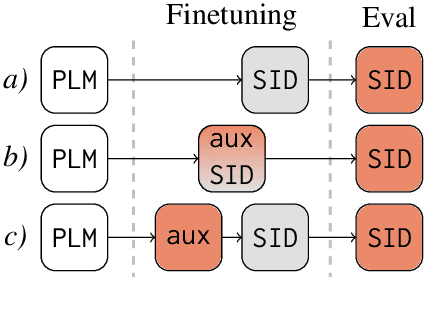
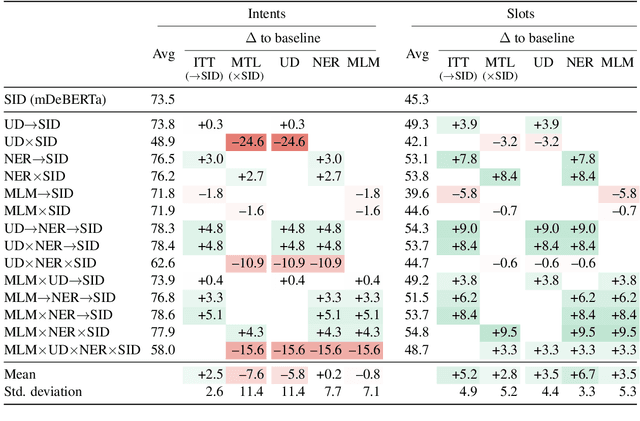
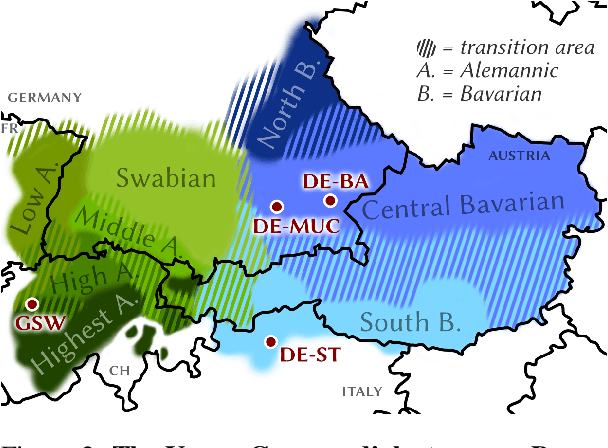
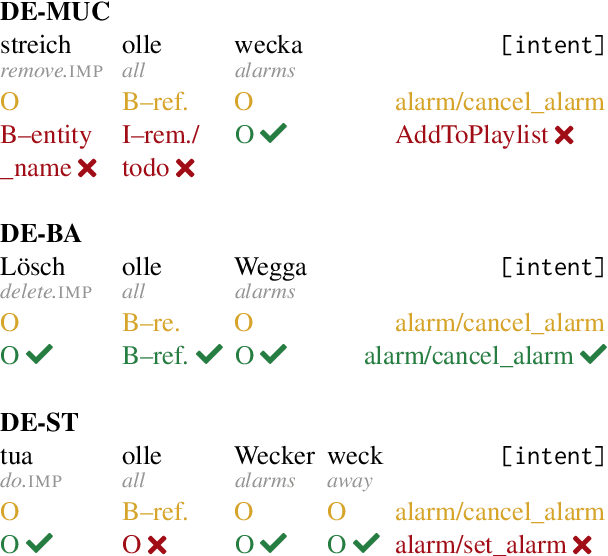
Reliable slot and intent detection (SID) is crucial in natural language understanding for applications like digital assistants. Encoder-only transformer models fine-tuned on high-resource languages generally perform well on SID. However, they struggle with dialectal data, where no standardized form exists and training data is scarce and costly to produce. We explore zero-shot transfer learning for SID, focusing on multiple Bavarian dialects, for which we release a new dataset for the Munich dialect. We evaluate models trained on auxiliary tasks in Bavarian, and compare joint multi-task learning with intermediate-task training. We also compare three types of auxiliary tasks: token-level syntactic tasks, named entity recognition (NER), and language modelling. We find that the included auxiliary tasks have a more positive effect on slot filling than intent classification (with NER having the most positive effect), and that intermediate-task training yields more consistent performance gains. Our best-performing approach improves intent classification performance on Bavarian dialects by 5.1 and slot filling F1 by 8.4 percentage points.
Cross-Dialect Information Retrieval: Information Access in Low-Resource and High-Variance Languages
Dec 17, 2024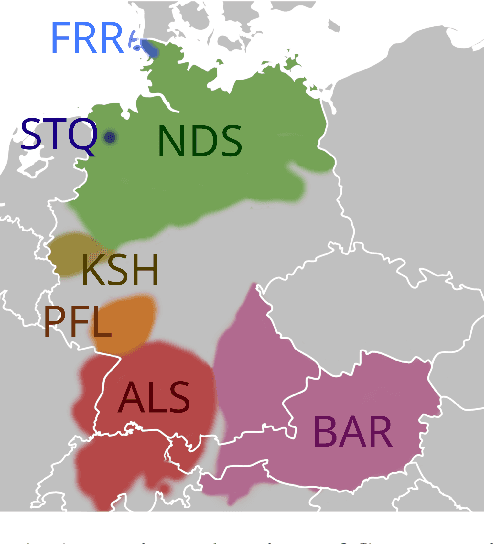
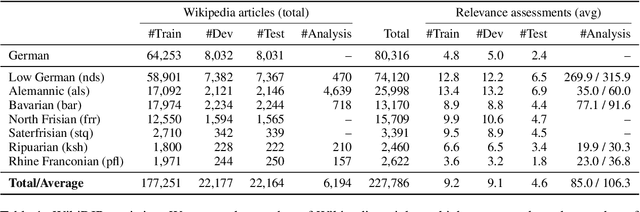
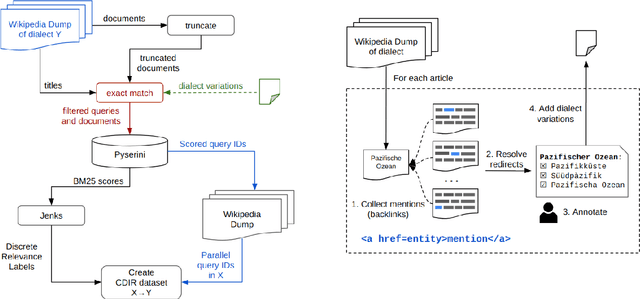
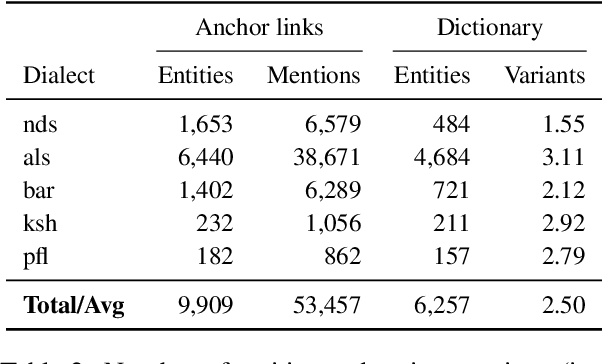
A large amount of local and culture-specific knowledge (e.g., people, traditions, food) can only be found in documents written in dialects. While there has been extensive research conducted on cross-lingual information retrieval (CLIR), the field of cross-dialect retrieval (CDIR) has received limited attention. Dialect retrieval poses unique challenges due to the limited availability of resources to train retrieval models and the high variability in non-standardized languages. We study these challenges on the example of German dialects and introduce the first German dialect retrieval dataset, dubbed WikiDIR, which consists of seven German dialects extracted from Wikipedia. Using WikiDIR, we demonstrate the weakness of lexical methods in dealing with high lexical variation in dialects. We further show that commonly used zero-shot cross-lingual transfer approach with multilingual encoders do not transfer well to extremely low-resource setups, motivating the need for resource-lean and dialect-specific retrieval models. We finally demonstrate that (document) translation is an effective way to reduce the dialect gap in CDIR.