 Add to Chrome
 Add to Firefox
 Add to Edge
Snli
Papers and Code
Atomic-SNLI: Fine-Grained Natural Language Inference through Atomic Fact Decomposition
Jan 10, 2026
Current Natural Language Inference (NLI) systems primarily operate at the sentence level, providing black-box decisions that lack explanatory power. While atomic-level NLI offers a promising alternative by decomposing hypotheses into individual facts, we demonstrate that the conventional assumption that a hypothesis is entailed only when all its atomic facts are entailed fails in practice due to models' poor performance on fine-grained reasoning. Our analysis reveals that existing models perform substantially worse on atomic level inference compared to sentence level tasks. To address this limitation, we introduce Atomic-SNLI, a novel dataset constructed by decomposing SNLI and enriching it with carefully curated atomic level examples through linguistically informed generation strategies. Experimental results demonstrate that models fine-tuned on Atomic-SNLI achieve significant improvements in atomic reasoning capabilities while maintaining strong sentence level performance, enabling both accurate judgements and transparent, explainable results at the fact level.

Reverse-engineering NLI: A study of the meta-inferential properties of Natural Language Inference
Jan 08, 2026Natural Language Inference (NLI) has been an important task for evaluating language models for Natural Language Understanding, but the logical properties of the task are poorly understood and often mischaracterized. Understanding the notion of inference captured by NLI is key to interpreting model performance on the task. In this paper we formulate three possible readings of the NLI label set and perform a comprehensive analysis of the meta-inferential properties they entail. Focusing on the SNLI dataset, we exploit (1) NLI items with shared premises and (2) items generated by LLMs to evaluate models trained on SNLI for meta-inferential consistency and derive insights into which reading of the logical relations is encoded by the dataset.
Attention Is Not What You Need
Dec 22, 2025We revisit a basic question in sequence modeling: is explicit self-attention actually necessary for strong performance and reasoning? We argue that standard multi-head attention is best seen as a form of tensor lifting: hidden vectors are mapped into a high-dimensional space of pairwise interactions, and learning proceeds by constraining this lifted tensor through gradient descent. This mechanism is extremely expressive but mathematically opaque, because after many layers it becomes very hard to describe the model with a small family of explicit invariants. To explore an alternative, we propose an attention-free architecture based on Grassmann flows. Instead of forming an L by L attention matrix, our Causal Grassmann layer (i) linearly reduces token states, (ii) encodes local token pairs as two-dimensional subspaces on a Grassmann manifold via Plucker coordinates, and (iii) fuses these geometric features back into the hidden states through gated mixing. Information therefore propagates by controlled deformations of low-rank subspaces over multi-scale local windows, so the core computation lives on a finite-dimensional manifold rather than in an unstructured tensor space. On the Wikitext-2 language modeling benchmark, purely Grassmann-based models with 13 to 18 million parameters achieve validation perplexities within about 10 to 15 percent of size-matched Transformers. On the SNLI natural language inference task, a Grassmann-Plucker head on top of DistilBERT slightly outperforms a Transformer head, with best validation and test accuracies of 0.8550 and 0.8538 compared to 0.8545 and 0.8511. We analyze the complexity of Grassmann mixing, show linear scaling in sequence length for fixed rank, and argue that such manifold-based designs offer a more structured route toward geometric and invariant-based interpretations of neural reasoning.
Analyzing and Mitigating Negation Artifacts using Data Augmentation for Improving ELECTRA-Small Model Accuracy
Nov 09, 2025Pre-trained models for natural language inference (NLI) often achieve high performance on benchmark datasets by using spurious correlations, or dataset artifacts, rather than understanding language touches such as negation. In this project, we investigate the performance of an ELECTRA-small model fine-tuned on the Stanford Natural Language Inference (SNLI) dataset, focusing on its handling of negation. Through analysis, we identify that the model struggles with correctly classifying examples containing negation. To address this, we augment the training data with contrast sets and adversarial examples emphasizing negation. Our results demonstrate that this targeted data augmentation improves the model's accuracy on negation-containing examples without adversely affecting overall performance, therefore mitigating the identified dataset artifact.
NLKI: A lightweight Natural Language Knowledge Integration Framework for Improving Small VLMs in Commonsense VQA Tasks
Aug 28, 2025Commonsense visual-question answering often hinges on knowledge that is missing from the image or the question. Small vision-language models (sVLMs) such as ViLT, VisualBERT and FLAVA therefore lag behind their larger generative counterparts. To study the effect of careful commonsense knowledge integration on sVLMs, we present an end-to-end framework (NLKI) that (i) retrieves natural language facts, (ii) prompts an LLM to craft natural language explanations, and (iii) feeds both signals to sVLMs respectively across two commonsense VQA datasets (CRIC, AOKVQA) and a visual-entailment dataset (e-SNLI-VE). Facts retrieved using a fine-tuned ColBERTv2 and an object information-enriched prompt yield explanations that largely cut down hallucinations, while lifting the end-to-end answer accuracy by up to 7% (across 3 datasets), making FLAVA and other models in NLKI match or exceed medium-sized VLMs such as Qwen-2 VL-2B and SmolVLM-2.5B. As these benchmarks contain 10-25% label noise, additional finetuning using noise-robust losses (such as symmetric cross entropy and generalised cross entropy) adds another 2.5% in CRIC, and 5.5% in AOKVQA. Our findings expose when LLM-based commonsense knowledge beats retrieval from commonsense knowledge bases, how noise-aware training stabilises small models in the context of external knowledge augmentation, and why parameter-efficient commonsense reasoning is now within reach for 250M models.
Probing Vision-Language Understanding through the Visual Entailment Task: promises and pitfalls
Jul 23, 2025This study investigates the extent to which the Visual Entailment (VE) task serves as a reliable probe of vision-language understanding in multimodal language models, using the LLaMA 3.2 11B Vision model as a test case. Beyond reporting performance metrics, we aim to interpret what these results reveal about the underlying possibilities and limitations of the VE task. We conduct a series of experiments across zero-shot, few-shot, and fine-tuning settings, exploring how factors such as prompt design, the number and order of in-context examples and access to visual information might affect VE performance. To further probe the reasoning processes of the model, we used explanation-based evaluations. Results indicate that three-shot inference outperforms the zero-shot baselines. However, additional examples introduce more noise than they provide benefits. Additionally, the order of the labels in the prompt is a critical factor that influences the predictions. In the absence of visual information, the model has a strong tendency to hallucinate and imagine content, raising questions about the model's over-reliance on linguistic priors. Fine-tuning yields strong results, achieving an accuracy of 83.3% on the e-SNLI-VE dataset and outperforming the state-of-the-art OFA-X model. Additionally, the explanation evaluation demonstrates that the fine-tuned model provides semantically meaningful explanations similar to those of humans, with a BERTScore F1-score of 89.2%. We do, however, find comparable BERTScore results in experiments with limited vision, questioning the visual grounding of this task. Overall, our results highlight both the utility and limitations of VE as a diagnostic task for vision-language understanding and point to directions for refining multimodal evaluation methods.
EPIC: Efficient Prompt Interaction for Text-Image Classification
Jul 10, 2025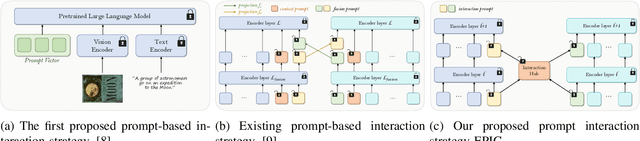
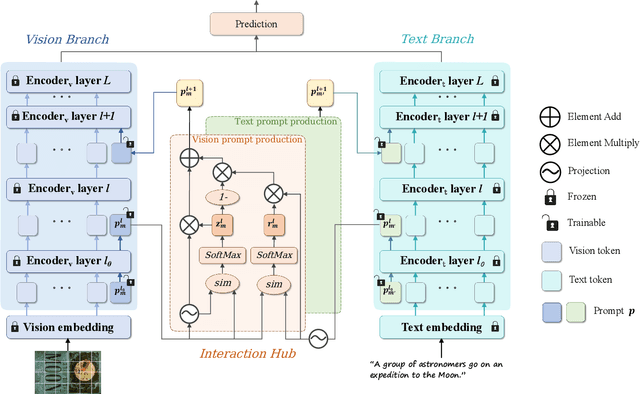
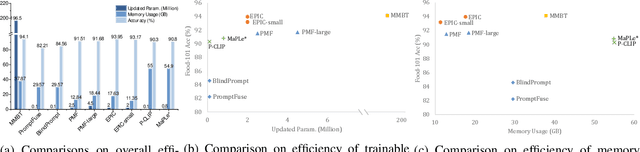

In recent years, large-scale pre-trained multimodal models (LMMs) generally emerge to integrate the vision and language modalities, achieving considerable success in multimodal tasks, such as text-image classification. The growing size of LMMs, however, results in a significant computational cost for fine-tuning these models for downstream tasks. Hence, prompt-based interaction strategy is studied to align modalities more efficiently. In this context, we propose a novel efficient prompt-based multimodal interaction strategy, namely Efficient Prompt Interaction for text-image Classification (EPIC). Specifically, we utilize temporal prompts on intermediate layers, and integrate different modalities with similarity-based prompt interaction, to leverage sufficient information exchange between modalities. Utilizing this approach, our method achieves reduced computational resource consumption and fewer trainable parameters (about 1\% of the foundation model) compared to other fine-tuning strategies. Furthermore, it demonstrates superior performance on the UPMC-Food101 and SNLI-VE datasets, while achieving comparable performance on the MM-IMDB dataset.
Faithful and Robust LLM-Driven Theorem Proving for NLI Explanations
May 30, 2025Natural language explanations play a fundamental role in Natural Language Inference (NLI) by revealing how premises logically entail hypotheses. Recent work has shown that the interaction of large language models (LLMs) with theorem provers (TPs) can help verify and improve the validity of NLI explanations. However, TPs require translating natural language into machine-verifiable formal representations, a process that introduces the risk of semantic information loss and unfaithful interpretation, an issue compounded by LLMs' challenges in capturing critical logical structures with sufficient precision. Moreover, LLMs are still limited in their capacity for rigorous and robust proof construction within formal verification frameworks. To mitigate issues related to faithfulness and robustness, this paper investigates strategies to (1) alleviate semantic loss during autoformalisation, (2) efficiently identify and correct syntactic errors in logical representations, (3) explicitly use logical expressions to guide LLMs in generating structured proof sketches, and (4) increase LLMs' capacity of interpreting TP's feedback for iterative refinement. Our empirical results on e-SNLI, QASC and WorldTree using different LLMs demonstrate that the proposed strategies yield significant improvements in autoformalisation (+18.46%, +34.2%, +39.77%) and explanation refinement (+29.5%, +51.5%, +41.25%) over the state-of-the-art model. Moreover, we show that specific interventions on the hybrid LLM-TP architecture can substantially improve efficiency, drastically reducing the number of iterations required for successful verification.
LiTEx: A Linguistic Taxonomy of Explanations for Understanding Within-Label Variation in Natural Language Inference
May 28, 2025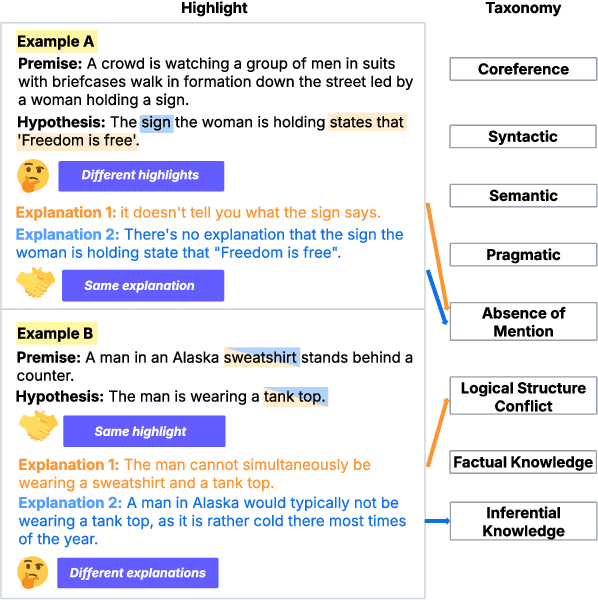
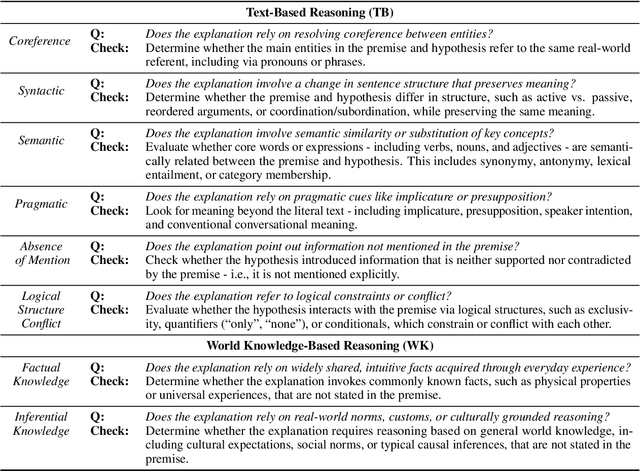
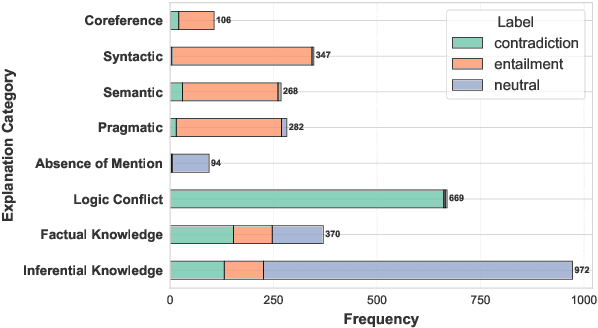
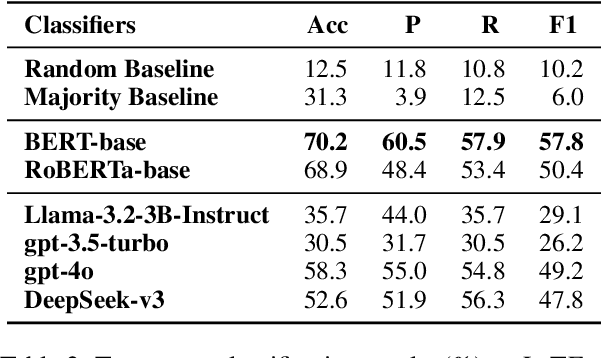
There is increasing evidence of Human Label Variation (HLV) in Natural Language Inference (NLI), where annotators assign different labels to the same premise-hypothesis pair. However, within-label variation--cases where annotators agree on the same label but provide divergent reasoning--poses an additional and mostly overlooked challenge. Several NLI datasets contain highlighted words in the NLI item as explanations, but the same spans on the NLI item can be highlighted for different reasons, as evidenced by free-text explanations, which offer a window into annotators' reasoning. To systematically understand this problem and gain insight into the rationales behind NLI labels, we introduce LITEX, a linguistically-informed taxonomy for categorizing free-text explanations. Using this taxonomy, we annotate a subset of the e-SNLI dataset, validate the taxonomy's reliability, and analyze how it aligns with NLI labels, highlights, and explanations. We further assess the taxonomy's usefulness in explanation generation, demonstrating that conditioning generation on LITEX yields explanations that are linguistically closer to human explanations than those generated using only labels or highlights. Our approach thus not only captures within-label variation but also shows how taxonomy-guided generation for reasoning can bridge the gap between human and model explanations more effectively than existing strategies.
Parameter-Efficient Transformer Embeddings
May 04, 2025Embedding layers in transformer-based NLP models typically account for the largest share of model parameters, scaling with vocabulary size but not yielding performance gains proportional to scale. We propose an alternative approach in which token embedding vectors are first generated deterministically, directly from the token IDs using a Fourier expansion of their normalized values, followed by a lightweight multilayer perceptron (MLP) that captures higher-order interactions. We train standard transformers and our architecture on natural language inference tasks (SNLI and MNLI), and evaluate zero-shot performance on sentence textual similarity (STS-B). Our results demonstrate that the proposed method achieves competitive performance using significantly fewer parameters, trains faster, and operates effectively without the need for dropout. This proof-of-concept study highlights the potential for scalable, memory-efficient language models and motivates further large-scale experimentation based on our findings.