 Add to Chrome
 Add to Firefox
 Add to Edge
DnA: Denoising Attention for Visual Tasks
Jun 25, 2026
The softmax activation in multihead attention (MHA) is the de facto standard for attention-based models in visual perception tasks. However, standard softmax can produce noisy attention patterns that dilute relevant features and degrade its performance. In this paper, we propose Denoising Attention or DnA, in which, first, a positive query identifies which image features belong to the correct class, and a negative query identifies closely associated but irrelevant image features. DnA then projects these interactions into two distinct subspaces with larger principal angles, promoting subspace separation and improved discriminability. Using a ViT-B backbone, our proposed DnA achieves an absolute gain of 0.8% on ImageNet-1K compared to the baseline. We further show improvements across multiple visual understanding tasks, including video understanding with video transformers (1.8%) and video LLMs (0.5%). Our extensive empirical analyses justify the design choices involving two interacting subspaces and the denoising effect of DnA.

Beyond LoRA: Is Sparsity-Induced Adaptation Better?
Jun 11, 2026Low-rank adaptation (LoRA) and its variants provide a memory- and compute-efficient alternative to full fine-tuning of pre-trained models. However, questions remain about the comparative generalizability of these approaches and how the structural restrictions on low-rank updates preserve effective adaptation performance. We present a historical framing, covering the past (full fine-tuning and original LoRA), the present (different variants of LoRA), and propose simpler, cheaper, parameter-efficient extensions by inducing sparsity within existing LoRA variants: Cheap LoRA (cLA), training a single low-rank factor with the other fixed (deterministically or, in its randomized variant, stochastically), and the chained circulant variant, ${c}^3$LA. We frame cLA as a structured instance of asymmetric LoRA, serving as a controlled column-subspace restriction of full fine-tuning. We derive information-theoretic generalization error bounds for these variants, marking one of the first endeavors in this area. Empirically, we evaluate 11 fine-tuning methods across 10 pre-trained models and 14 datasets, analyzing the fine-tuned models' performance and generalization using tools such as loss landscapes and spectral analysis. Despite the sensitivity of fine-tuned models to the pre-trained model, datasets, and other factors, our study suggests that restricting LoRA-based PEFT methods' adaptation to a sparse, structured column space remains competitive across tasks with their parameter-matched baselines while reducing up to 10% training time and peak GPU memory up to 15%, even with a naïve, non-optimized, sparse implementation. Our theoretical and empirical generalization measures provide a more consistent and principled approach to their cost-effective adaptation than commonly used analytical tools. Overview and code are available at: https://elicaden.github.io/Beyond_LoRA/.
MuCRASP: Multimodal Chain-of-thought Reasoning aware Structured Pruning
May 25, 2026Vision-language models (VLMs) increasingly rely on chain-of-thought (CoT) reasoning to solve complex multimodal tasks, but their large parameter sizes make deployment expensive. Structured pruning offers a natural solution; however, existing methods fail to preserve CoT reasoning accuracy in VLMs. We identify two key reasons: (1) CoT consistency depends on sparse transition points (pivot tokens) in the generation trajectory, while existing pruning methods are CoT-agnostic; and (2) pruning methods designed for unimodal LLMs do not account for activation-distribution differences across visual and textual modalities. Motivated by these observations, we propose MuCRASP, a structured pruning framework that targets reasoning-critical components while preserving cross-modal alignment and accounting for layer-wise sensitivity under a global parameter budget. Experiments on four VLMs across three reasoning benchmarks show that MuCRASP consistently preserves reasoning quality under increasing compression. At 30% pruning on Qwen2.5-VL-7B, MuCRASP achieves an LLM-as-a-Judge score of 8.87 versus 7.32 for the strongest baseline on physical reasoning tasks. Furthermore, MuCRASP maintains high reasoning consistency up to 50% pruning, significantly outperforming prior pruning approaches while exhibiting lower perplexity degradation.
FinTradeBench: A Financial Reasoning Benchmark for LLMs
Mar 19, 2026Real-world financial decision-making is a challenging problem that requires reasoning over heterogeneous signals, including company fundamentals derived from regulatory filings and trading signals computed from price dynamics. Recently, with the advancement of Large Language Models (LLMs), financial analysts have begun to use them for financial decision-making tasks. However, existing financial question answering benchmarks for testing these models primarily focus on company balance sheet data and rarely evaluate reasoning over how company stocks trade in the market or their interactions with fundamentals. To take advantage of the strengths of both approaches, we introduce FinTradeBench, a benchmark for evaluating financial reasoning that integrates company fundamentals and trading signals. FinTradeBench contains 1,400 questions grounded in NASDAQ-100 companies over a ten-year historical window. The benchmark is organized into three reasoning categories: fundamentals-focused, trading-signal-focused, and hybrid questions requiring cross-signal reasoning. To ensure reliability at scale, we adopt a calibration-then-scaling framework that combines expert seed questions, multi-model response generation, intra-model self-filtering, numerical auditing, and human-LLM judge alignment. We evaluate 14 LLMs under zero-shot prompting and retrieval-augmented settings and witness a clear performance gap. Retrieval substantially improves reasoning over textual fundamentals, but provides limited benefit for trading-signal reasoning. These findings highlight fundamental challenges in the numerical and time-series reasoning for current LLMs and motivate future research in financial intelligence.
NLKI: A lightweight Natural Language Knowledge Integration Framework for Improving Small VLMs in Commonsense VQA Tasks
Aug 28, 2025Commonsense visual-question answering often hinges on knowledge that is missing from the image or the question. Small vision-language models (sVLMs) such as ViLT, VisualBERT and FLAVA therefore lag behind their larger generative counterparts. To study the effect of careful commonsense knowledge integration on sVLMs, we present an end-to-end framework (NLKI) that (i) retrieves natural language facts, (ii) prompts an LLM to craft natural language explanations, and (iii) feeds both signals to sVLMs respectively across two commonsense VQA datasets (CRIC, AOKVQA) and a visual-entailment dataset (e-SNLI-VE). Facts retrieved using a fine-tuned ColBERTv2 and an object information-enriched prompt yield explanations that largely cut down hallucinations, while lifting the end-to-end answer accuracy by up to 7% (across 3 datasets), making FLAVA and other models in NLKI match or exceed medium-sized VLMs such as Qwen-2 VL-2B and SmolVLM-2.5B. As these benchmarks contain 10-25% label noise, additional finetuning using noise-robust losses (such as symmetric cross entropy and generalised cross entropy) adds another 2.5% in CRIC, and 5.5% in AOKVQA. Our findings expose when LLM-based commonsense knowledge beats retrieval from commonsense knowledge bases, how noise-aware training stabilises small models in the context of external knowledge augmentation, and why parameter-efficient commonsense reasoning is now within reach for 250M models.
GAEA: A Geolocation Aware Conversational Model
Mar 20, 2025
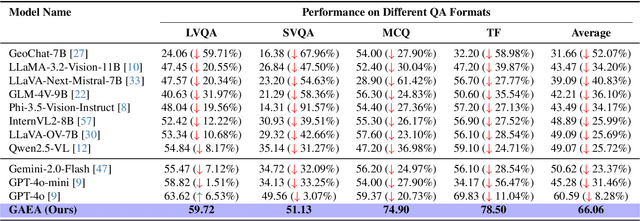
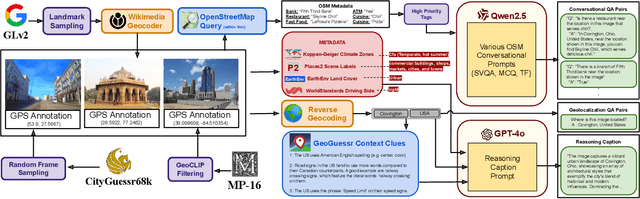
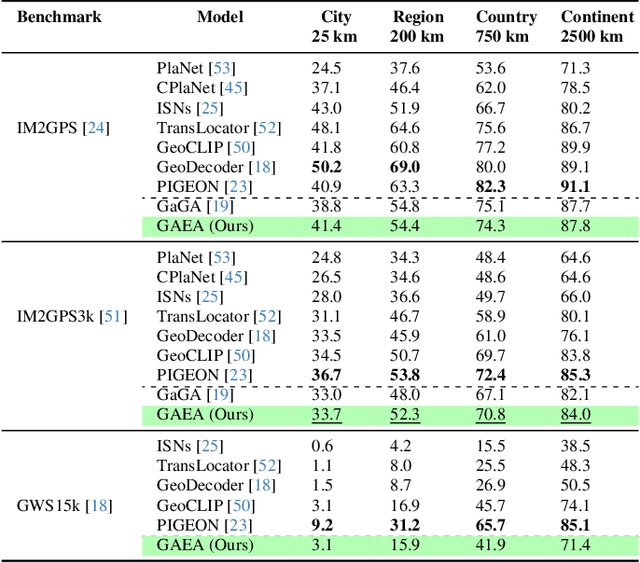
Image geolocalization, in which, traditionally, an AI model predicts the precise GPS coordinates of an image is a challenging task with many downstream applications. However, the user cannot utilize the model to further their knowledge other than the GPS coordinate; the model lacks an understanding of the location and the conversational ability to communicate with the user. In recent days, with tremendous progress of large multimodal models (LMMs) proprietary and open-source researchers have attempted to geolocalize images via LMMs. However, the issues remain unaddressed; beyond general tasks, for more specialized downstream tasks, one of which is geolocalization, LMMs struggle. In this work, we propose to solve this problem by introducing a conversational model GAEA that can provide information regarding the location of an image, as required by a user. No large-scale dataset enabling the training of such a model exists. Thus we propose a comprehensive dataset GAEA with 800K images and around 1.6M question answer pairs constructed by leveraging OpenStreetMap (OSM) attributes and geographical context clues. For quantitative evaluation, we propose a diverse benchmark comprising 4K image-text pairs to evaluate conversational capabilities equipped with diverse question types. We consider 11 state-of-the-art open-source and proprietary LMMs and demonstrate that GAEA significantly outperforms the best open-source model, LLaVA-OneVision by 25.69% and the best proprietary model, GPT-4o by 8.28%. Our dataset, model and codes are available
Kolmogorov-Arnold Attention: Is Learnable Attention Better For Vision Transformers?
Mar 13, 2025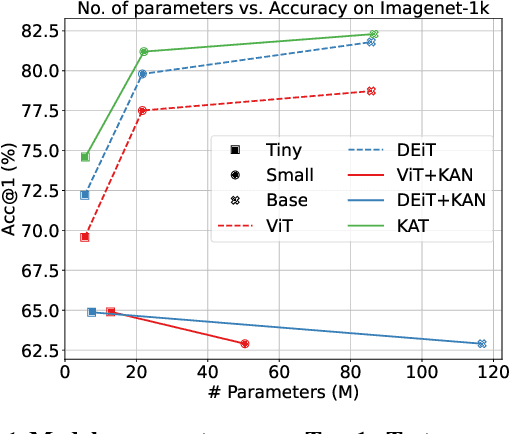
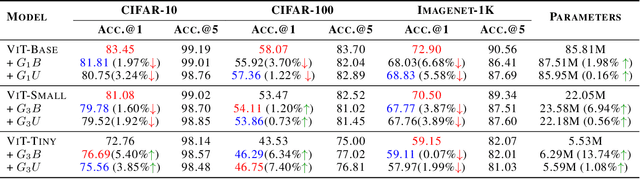

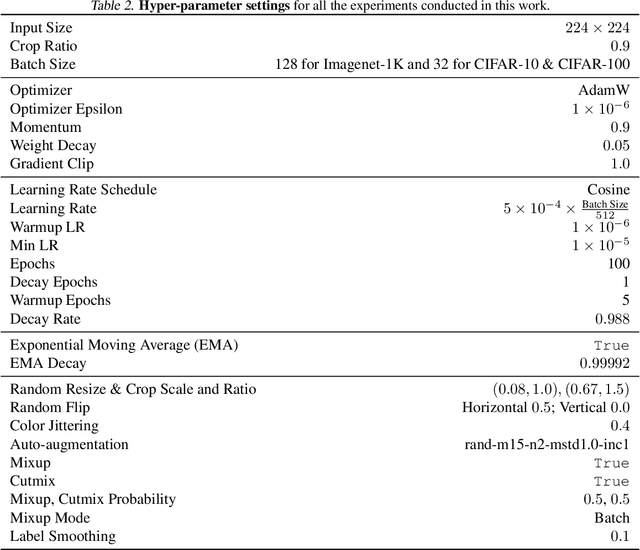
Kolmogorov-Arnold networks (KANs) are a remarkable innovation consisting of learnable activation functions with the potential to capture more complex relationships from data. Although KANs are useful in finding symbolic representations and continual learning of one-dimensional functions, their effectiveness in diverse machine learning (ML) tasks, such as vision, remains questionable. Presently, KANs are deployed by replacing multilayer perceptrons (MLPs) in deep network architectures, including advanced architectures such as vision Transformers (ViTs). In this paper, we are the first to design a general learnable Kolmogorov-Arnold Attention (KArAt) for vanilla ViTs that can operate on any choice of basis. However, the computing and memory costs of training them motivated us to propose a more modular version, and we designed particular learnable attention, called Fourier-KArAt. Fourier-KArAt and its variants either outperform their ViT counterparts or show comparable performance on CIFAR-10, CIFAR-100, and ImageNet-1K datasets. We dissect these architectures' performance and generalization capacity by analyzing their loss landscapes, weight distributions, optimizer path, attention visualization, and spectral behavior, and contrast them with vanilla ViTs. The goal of this paper is not to produce parameter- and compute-efficient attention, but to encourage the community to explore KANs in conjunction with more advanced architectures that require a careful understanding of learnable activations. Our open-source code and implementation details are available on: https://subhajitmaity.me/KArAt
Fibottention: Inceptive Visual Representation Learning with Diverse Attention Across Heads
Jun 27, 2024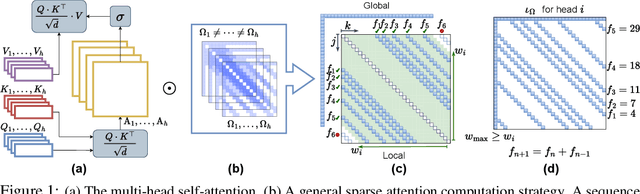
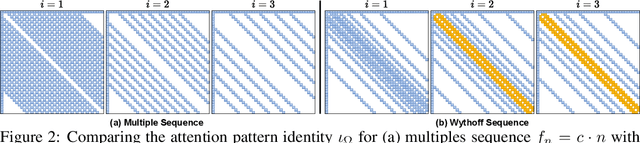

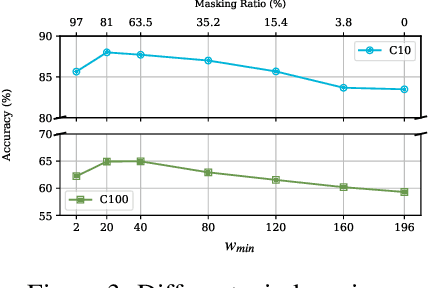
Visual perception tasks are predominantly solved by Vision Transformer (ViT) architectures, which, despite their effectiveness, encounter a computational bottleneck due to the quadratic complexity of computing self-attention. This inefficiency is largely due to the self-attention heads capturing redundant token interactions, reflecting inherent redundancy within visual data. Many works have aimed to reduce the computational complexity of self-attention in ViTs, leading to the development of efficient and sparse transformer architectures. In this paper, viewing through the efficiency lens, we realized that introducing any sparse self-attention strategy in ViTs can keep the computational overhead low. However, these strategies are sub-optimal as they often fail to capture fine-grained visual details. This observation leads us to propose a general, efficient, sparse architecture, named Fibottention, for approximating self-attention with superlinear complexity that is built upon Fibonacci sequences. The key strategies in Fibottention include: it excludes proximate tokens to reduce redundancy, employs structured sparsity by design to decrease computational demands, and incorporates inception-like diversity across attention heads. This diversity ensures the capture of complementary information through non-overlapping token interactions, optimizing both performance and resource utilization in ViTs for visual representation learning. We embed our Fibottention mechanism into multiple state-of-the-art transformer architectures dedicated to visual tasks. Leveraging only 2-6% of the elements in the self-attention heads, Fibottention in conjunction with ViT and its variants, consistently achieves significant performance boosts compared to standard ViTs in nine datasets across three domains $\unicode{x2013}$ image classification, video understanding, and robot learning tasks.
Towards Multi-modal Transformers in Federated Learning
Apr 18, 2024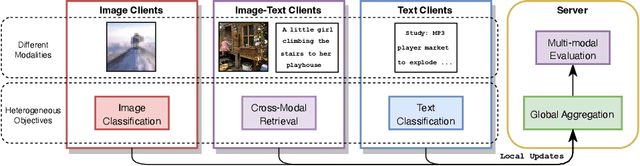
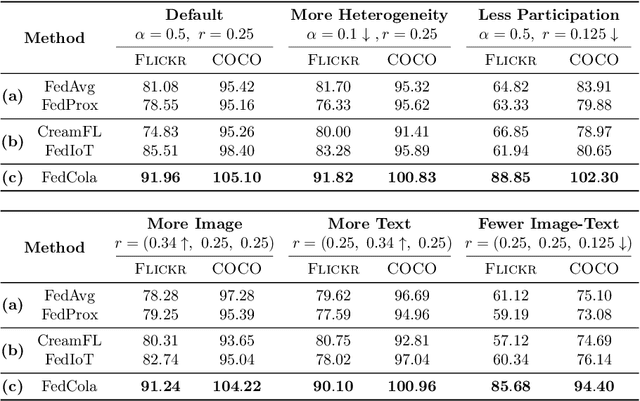
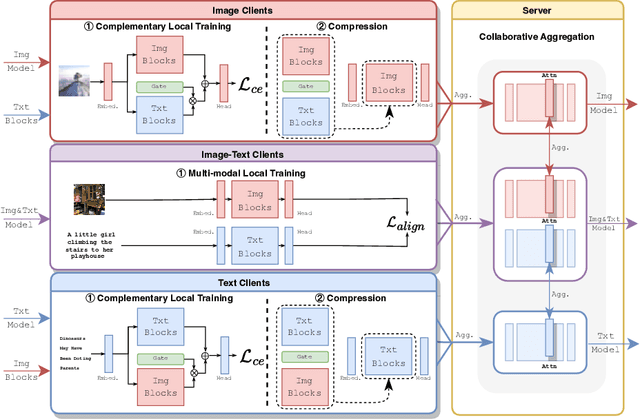
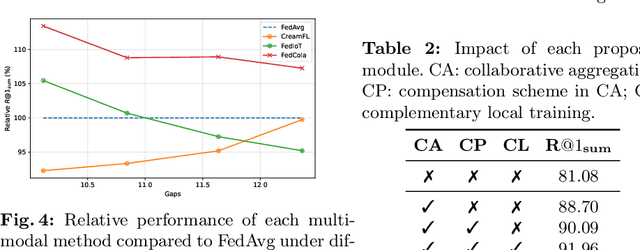
Multi-modal transformers mark significant progress in different domains, but siloed high-quality data hinders their further improvement. To remedy this, federated learning (FL) has emerged as a promising privacy-preserving paradigm for training models without direct access to the raw data held by different clients. Despite its potential, a considerable research direction regarding the unpaired uni-modal clients and the transformer architecture in FL remains unexplored. To fill this gap, this paper explores a transfer multi-modal federated learning (MFL) scenario within the vision-language domain, where clients possess data of various modalities distributed across different datasets. We systematically evaluate the performance of existing methods when a transformer architecture is utilized and introduce a novel framework called Federated modality complementary and collaboration (FedCola) by addressing the in-modality and cross-modality gaps among clients. Through extensive experiments across various FL settings, FedCola demonstrates superior performance over previous approaches, offering new perspectives on future federated training of multi-modal transformers.
Robust Multi-Modal Image Stitching for Improved Scene Understanding
Dec 28, 2023Multi-modal image stitching can be a difficult feat. That's why, in this paper, we've devised a unique and comprehensive image-stitching pipeline that taps into OpenCV's stitching module. Our approach integrates feature-based matching, transformation estimation, and blending techniques to bring about panoramic views that are of top-tier quality - irrespective of lighting, scale or orientation differences between images. We've put our pipeline to the test with a varied dataset and found that it's very effective in enhancing scene understanding and finding real-world applications.