 Add to Chrome
 Add to Firefox
 Add to Edge
Breaking Symmetry Bottlenecks in GNN Readouts
Feb 05, 2026
Graph neural networks (GNNs) are widely used for learning on structured data, yet their ability to distinguish non-isomorphic graphs is fundamentally limited. These limitations are usually attributed to message passing; in this work we show that an independent bottleneck arises at the readout stage. Using finite-dimensional representation theory, we prove that all linear permutation-invariant readouts, including sum and mean pooling, factor through the Reynolds (group-averaging) operator and therefore project node embeddings onto the fixed subspace of the permutation action, erasing all non-trivial symmetry-aware components regardless of encoder expressivity. This yields both a new expressivity barrier and an interpretable characterization of what global pooling preserves or destroys. To overcome this collapse, we introduce projector-based invariant readouts that decompose node representations into symmetry-aware channels and summarize them with nonlinear invariant statistics, preserving permutation invariance while retaining information provably invisible to averaging. Empirically, swapping only the readout enables fixed encoders to separate WL-hard graph pairs and improves performance across multiple benchmarks, demonstrating that readout design is a decisive and under-appreciated factor in GNN expressivity.

Parameter-Efficient Transformer Embeddings
May 04, 2025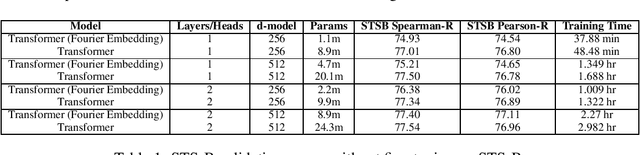
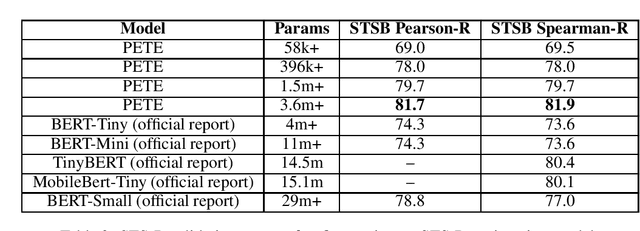
Embedding layers in transformer-based NLP models typically account for the largest share of model parameters, scaling with vocabulary size but not yielding performance gains proportional to scale. We propose an alternative approach in which token embedding vectors are first generated deterministically, directly from the token IDs using a Fourier expansion of their normalized values, followed by a lightweight multilayer perceptron (MLP) that captures higher-order interactions. We train standard transformers and our architecture on natural language inference tasks (SNLI and MNLI), and evaluate zero-shot performance on sentence textual similarity (STS-B). Our results demonstrate that the proposed method achieves competitive performance using significantly fewer parameters, trains faster, and operates effectively without the need for dropout. This proof-of-concept study highlights the potential for scalable, memory-efficient language models and motivates further large-scale experimentation based on our findings.