 Add to Chrome
 Add to Firefox
 Add to Edge
Serial Speakers
Papers and Code
Modeling Overlapped Speech with Shuffles
Mar 18, 2026
We propose to model parallel streams of data, such as overlapped speech, using shuffles. Specifically, this paper shows how the shuffle product and partial order finite-state automata (FSAs) can be used for alignment and speaker-attributed transcription of overlapped speech. We train using the total score on these FSAs as a loss function, marginalizing over all possible serializations of overlapping sequences at subword, word, and phrase levels. To reduce graph size, we impose temporal constraints by constructing partial order FSAs. We address speaker attribution by modeling (token, speaker) tuples directly. Viterbi alignment through the shuffle product FSA directly enables one-pass alignment. We evaluate performance on synthetic LibriSpeech overlaps. To our knowledge, this is the first algorithm that enables single-pass alignment of multi-talker recordings. All algorithms are implemented using k2 / Icefall.

End-to-End Joint ASR and Speaker Role Diarization with Child-Adult Interactions
Jan 25, 2026Accurate transcription and speaker diarization of child-adult spoken interactions are crucial for developmental and clinical research. However, manual annotation is time-consuming and challenging to scale. Existing automated systems typically rely on cascaded speaker diarization and speech recognition pipelines, which can lead to error propagation. This paper presents a unified end-to-end framework that extends the Whisper encoder-decoder architecture to jointly model ASR and child-adult speaker role diarization. The proposed approach integrates: (i) a serialized output training scheme that emits speaker tags and start/end timestamps, (ii) a lightweight frame-level diarization head that enhances speaker-discriminative encoder representations, (iii) diarization-guided silence suppression for improved temporal precision, and (iv) a state-machine-based forced decoding procedure that guarantees structurally valid outputs. Comprehensive evaluations on two datasets demonstrate consistent and substantial improvements over two cascaded baselines, achieving lower multi-talker word error rates and demonstrating competitive diarization accuracy across both Whisper-small and Whisper-large models. These findings highlight the effectiveness and practical utility of the proposed joint modeling framework for generating reliable, speaker-attributed transcripts of child-adult interactions at scale. The code and model weights are publicly available
CodeSep: Low-Bitrate Codec-Driven Speech Separation with Base-Token Disentanglement and Auxiliary-Token Serial Prediction
Jan 19, 2026This paper targets a new scenario that integrates speech separation with speech compression, aiming to disentangle multiple speakers while producing discrete representations for efficient transmission or storage, with applications in online meetings and dialogue archiving. To address this scenario, we propose CodeSep, a codec-driven model that jointly performs speech separation and low-bitrate compression. CodeSep comprises a residual vector quantizer (RVQ)-based plain neural speech codec, a base-token disentanglement (BTD) module, and parallel auxiliary-token serial prediction (ATSP) modules. The BTD module disentangles mixed-speech mel-spectrograms into base tokens for each speaker, which are then refined by ATSP modules to serially predict auxiliary tokens, and finally, all tokens are decoded to reconstruct separated waveforms through the codec decoder. During training, the codec's RVQ provides supervision with permutation-invariant and teacher-forcing-based cross-entropy losses. As only base tokens are transmitted or stored, CodeSep achieves low-bitrate compression. Experimental results show that CodeSep attains satisfactory separation performance at only 1 kbps compared with baseline methods.
LTS-VoiceAgent: A Listen-Think-Speak Framework for Efficient Streaming Voice Interaction via Semantic Triggering and Incremental Reasoning
Jan 26, 2026Real-time voice agents face a dilemma: end-to-end models often lack deep reasoning, while cascaded pipelines incur high latency by executing ASR, LLM reasoning, and TTS strictly in sequence, unlike human conversation where listeners often start thinking before the speaker finishes. Since cascaded architectures remain the dominant choice for complex tasks, existing cascaded streaming strategies attempt to reduce this latency via mechanical segmentation (e.g., fixed chunks, VAD-based splitting) or speculative generation, but they frequently either break semantic units or waste computation on predictions that must be rolled back. To address these challenges, we propose LTS-VoiceAgent, a Listen-Think-Speak framework that explicitly separates when to think from how to reason incrementally. It features a Dynamic Semantic Trigger to detect meaningful prefixes, and a Dual-Role Stream Orchestrator that coordinates a background Thinker (for state maintenance) and a foreground Speaker (for speculative solving). This parallel design enables "thinking while speaking" without blocking responses. We also introduce a Pause-and-Repair benchmark containing natural disfluencies to stress-test streaming robustness. Experiments across VERA, Spoken-MQA, BigBenchAudio, and our benchmark show that LTS-VoiceAgent achieves a stronger accuracy-latency-efficiency trade-off than serial cascaded baselines and existing streaming strategies.
TagSpeech: End-to-End Multi-Speaker ASR and Diarization with Fine-Grained Temporal Grounding
Jan 11, 2026We present TagSpeech, a unified LLM-based framework that utilizes Temporal Anchor Grounding for joint multi-speaker ASR and diarization. The framework is built on two key designs: (1) decoupled semantic and speaker streams fine-tuned via Serialized Output Training (SOT) to learn turn-taking dynamics; and (2) an interleaved time anchor mechanism that not only supports fine-grained timestamp prediction but also acts as a synchronization signal between semantic understanding and speaker tracking. Compared to previous works that primarily focus on speaker-attributed ASR or implicit diarization, TagSpeech addresses the challenge of fine-grained speaker-content alignment and explicitly models "who spoke what and when" in an end-to-end manner. Experiments on AMI and AliMeeting benchmarks demonstrate that our method achieves consistent improvements in Diarization Error Rate (DER) over strong end-to-end baselines, including Qwen-Omni and Gemini, particularly in handling complex speech overlaps. Moreover, TagSpeech employs a parameter-efficient training paradigm in which the LLM backbone is frozen and only lightweight projectors are trained, resulting in strong performance with low computational cost.
Joint ASR and Speaker Role Tagging with Serialized Output Training
Jun 12, 2025
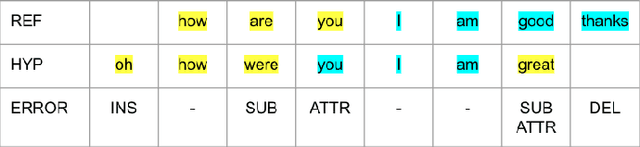
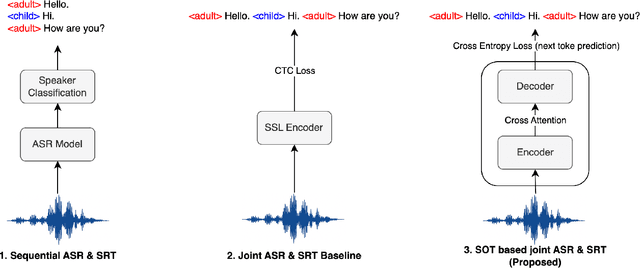
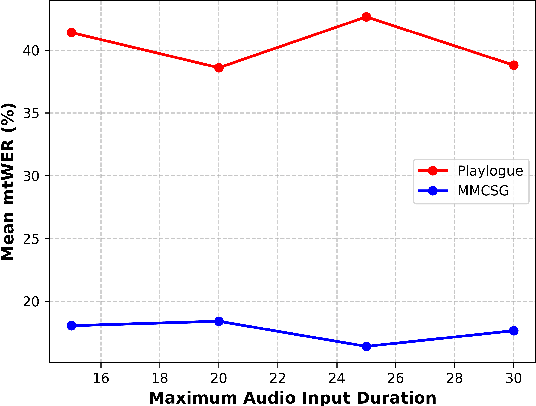
Automatic Speech Recognition systems have made significant progress with large-scale pre-trained models. However, most current systems focus solely on transcribing the speech without identifying speaker roles, a function that is critical for conversational AI. In this work, we investigate the use of serialized output training (SOT) for joint ASR and speaker role tagging. By augmenting Whisper with role-specific tokens and fine-tuning it with SOT, we enable the model to generate role-aware transcriptions in a single decoding pass. We compare the SOT approach against a self-supervised previous baseline method on two real-world conversational datasets. Our findings show that this approach achieves more than 10% reduction in multi-talker WER, demonstrating its feasibility as a unified model for speaker-role aware speech transcription.
SC-SOT: Conditioning the Decoder on Diarized Speaker Information for End-to-End Overlapped Speech Recognition
Jun 15, 2025We propose Speaker-Conditioned Serialized Output Training (SC-SOT), an enhanced SOT-based training for E2E multi-talker ASR. We first probe how SOT handles overlapped speech, and we found the decoder performs implicit speaker separation. We hypothesize this implicit separation is often insufficient due to ambiguous acoustic cues in overlapping regions. To address this, SC-SOT explicitly conditions the decoder on speaker information, providing detailed information about "who spoke when". Specifically, we enhance the decoder by incorporating: (1) speaker embeddings, which allow the model to focus on the acoustic characteristics of the target speaker, and (2) speaker activity information, which guides the model to suppress non-target speakers. The speaker embeddings are derived from a jointly trained E2E speaker diarization model, mitigating the need for speaker enrollment. Experimental results demonstrate the effectiveness of our conditioning approach on overlapped speech.
Speaker-Distinguishable CTC: Learning Speaker Distinction Using CTC for Multi-Talker Speech Recognition
Jun 09, 2025This paper presents a novel framework for multi-talker automatic speech recognition without the need for auxiliary information. Serialized Output Training (SOT), a widely used approach, suffers from recognition errors due to speaker assignment failures. Although incorporating auxiliary information, such as token-level timestamps, can improve recognition accuracy, extracting such information from natural conversational speech remains challenging. To address this limitation, we propose Speaker-Distinguishable CTC (SD-CTC), an extension of CTC that jointly assigns a token and its corresponding speaker label to each frame. We further integrate SD-CTC into the SOT framework, enabling the SOT model to learn speaker distinction using only overlapping speech and transcriptions. Experimental comparisons show that multi-task learning with SD-CTC and SOT reduces the error rate of the SOT model by 26% and achieves performance comparable to state-of-the-art methods relying on auxiliary information.
Diarization-Aware Multi-Speaker Automatic Speech Recognition via Large Language Models
Jun 06, 2025Multi-speaker automatic speech recognition (MS-ASR) faces significant challenges in transcribing overlapped speech, a task critical for applications like meeting transcription and conversational analysis. While serialized output training (SOT)-style methods serve as common solutions, they often discard absolute timing information, limiting their utility in time-sensitive scenarios. Leveraging recent advances in large language models (LLMs) for conversational audio processing, we propose a novel diarization-aware multi-speaker ASR system that integrates speaker diarization with LLM-based transcription. Our framework processes structured diarization inputs alongside frame-level speaker and semantic embeddings, enabling the LLM to generate segment-level transcriptions. Experiments demonstrate that the system achieves robust performance in multilingual dyadic conversations and excels in complex, high-overlap multi-speaker meeting scenarios. This work highlights the potential of LLMs as unified back-ends for joint speaker-aware segmentation and transcription.
Improving Practical Aspects of End-to-End Multi-Talker Speech Recognition for Online and Offline Scenarios
Jun 17, 2025We extend the frameworks of Serialized Output Training (SOT) to address practical needs of both streaming and offline automatic speech recognition (ASR) applications. Our approach focuses on balancing latency and accuracy, catering to real-time captioning and summarization requirements. We propose several key improvements: (1) Leveraging Continuous Speech Separation (CSS) single-channel front-end with end-to-end (E2E) systems for highly overlapping scenarios, challenging the conventional wisdom of E2E versus cascaded setups. The CSS framework improves the accuracy of the ASR system by separating overlapped speech from multiple speakers. (2) Implementing dual models -- Conformer Transducer for streaming and Sequence-to-Sequence for offline -- or alternatively, a two-pass model based on cascaded encoders. (3) Exploring segment-based SOT (segSOT) which is better suited for offline scenarios while also enhancing readability of multi-talker transcriptions.