 Add to Chrome
 Add to Firefox
 Add to Edge
Who Spoke What When? Evaluating Spoken Language Models for Conversational ASR with Semantic and Overlap-Aware Metrics
Mar 24, 2026
Conversational automatic speech recognition remains challenging due to overlapping speech, far-field noise, and varying speaker counts. While recent LLM-based systems perform well on single-speaker benchmarks, their robustness in multi-speaker settings is unclear. We systematically compare LLM-based and modular pipeline approaches along four axes: overlap robustness, semantic fidelity, speaker count, and single- versus multi-channel input. To capture meaning-altering errors that conventional metrics miss, we introduce tcpSemER, which extends tcpWER by replacing Levenshtein distance with embedding-based semantic similarity. We further decompose tcpWER into overlapping and non-overlapping components for finer-grained analysis. Experiments across three datasets show that LLM-based systems are competitive in two-speaker settings but degrade as speaker count and overlap increase, whereas modular pipelines remain more robust.

Modeling Overlapped Speech with Shuffles
Mar 18, 2026We propose to model parallel streams of data, such as overlapped speech, using shuffles. Specifically, this paper shows how the shuffle product and partial order finite-state automata (FSAs) can be used for alignment and speaker-attributed transcription of overlapped speech. We train using the total score on these FSAs as a loss function, marginalizing over all possible serializations of overlapping sequences at subword, word, and phrase levels. To reduce graph size, we impose temporal constraints by constructing partial order FSAs. We address speaker attribution by modeling (token, speaker) tuples directly. Viterbi alignment through the shuffle product FSA directly enables one-pass alignment. We evaluate performance on synthetic LibriSpeech overlaps. To our knowledge, this is the first algorithm that enables single-pass alignment of multi-talker recordings. All algorithms are implemented using k2 / Icefall.
SE-DiCoW: Self-Enrolled Diarization-Conditioned Whisper
Jan 27, 2026Speaker-attributed automatic speech recognition (ASR) in multi-speaker environments remains a major challenge. While some approaches achieve strong performance when fine-tuned on specific domains, few systems generalize well across out-of-domain datasets. Our prior work, Diarization-Conditioned Whisper (DiCoW), leverages speaker diarization outputs as conditioning information and, with minimal fine-tuning, demonstrated strong multilingual and multi-domain performance. In this paper, we address a key limitation of DiCoW: ambiguity in Silence-Target-Non-target-Overlap (STNO) masks, where two or more fully overlapping speakers may have nearly identical conditioning despite differing transcriptions. We introduce SE-DiCoW (Self-Enrolled Diarization-Conditioned Whisper), which uses diarization output to locate an enrollment segment anywhere in the conversation where the target speaker is most active. This enrollment segment is used as fixed conditioning via cross-attention at each encoder layer. We further refine DiCoW with improved data segmentation, model initialization, and augmentation. Together, these advances yield substantial gains: SE-DiCoW reduces macro-averaged tcpWER by 52.4% relative to the original DiCoW on the EMMA MT-ASR benchmark.
On the Role of Spatial Features in Foundation-Model-Based Speaker Diarization
Jan 05, 2026Recent advances in speaker diarization exploit large pretrained foundation models, such as WavLM, to achieve state-of-the-art performance on multiple datasets. Systems like DiariZen leverage these rich single-channel representations, but are limited to single-channel audio, preventing the use of spatial cues available in multi-channel recordings. This work analyzes the impact of incorporating spatial information into a state-of-the-art single-channel diarization system by evaluating several strategies for conditioning the model on multi-channel spatial features. Experiments on meeting-style datasets indicate that spatial information can improve diarization performance, but the overall improvement is smaller than expected for the proposed system, suggesting that the features aggregated over all WavLM layers already capture much of the information needed for accurate speaker discrimination, also in overlapping speech regions. These findings provide insight into the potential and limitations of using spatial cues to enhance foundation model-based diarization.
DeCRED: Decoder-Centric Regularization for Encoder-Decoder Based Speech Recognition
Aug 12, 2025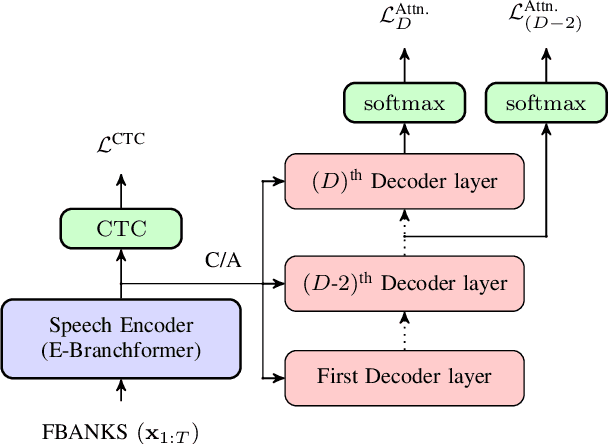
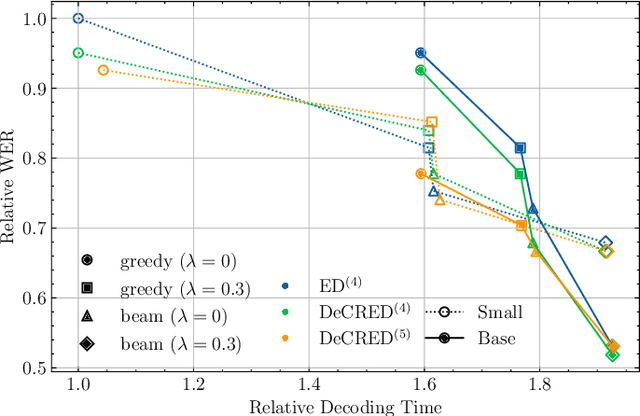

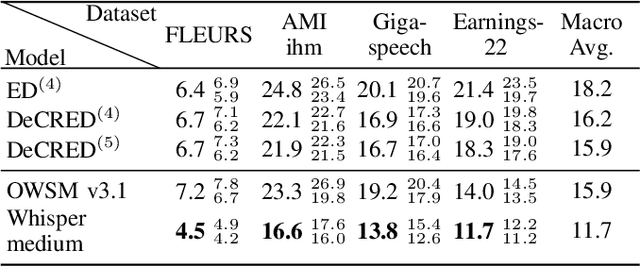
This paper presents a simple yet effective regularization for the internal language model induced by the decoder in encoder-decoder ASR models, thereby improving robustness and generalization in both in- and out-of-domain settings. The proposed method, Decoder-Centric Regularization in Encoder-Decoder (DeCRED), adds auxiliary classifiers to the decoder, enabling next token prediction via intermediate logits. Empirically, DeCRED reduces the mean internal LM BPE perplexity by 36.6% relative to 11 test sets. Furthermore, this translates into actual WER improvements over the baseline in 5 of 7 in-domain and 3 of 4 out-of-domain test sets, reducing macro WER from 6.4% to 6.3% and 18.2% to 16.2%, respectively. On TEDLIUM3, DeCRED achieves 7.0% WER, surpassing the baseline and encoder-centric InterCTC regularization by 0.6% and 0.5%, respectively. Finally, we compare DeCRED with OWSM v3.1 and Whisper-medium, showing competitive WERs despite training on much less data with fewer parameters.
BUT System for the MLC-SLM Challenge
Jun 16, 2025
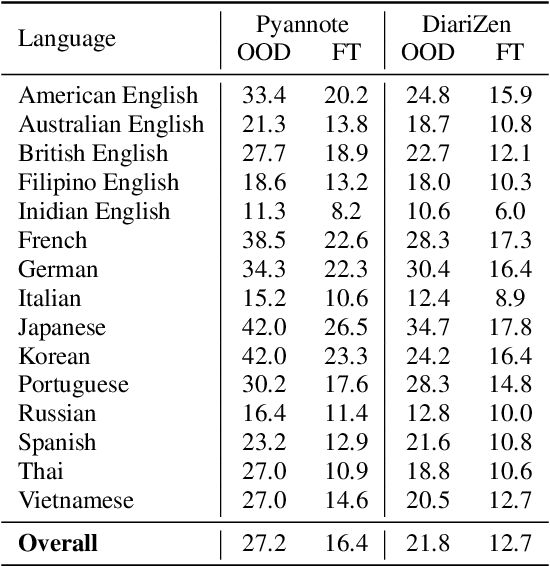
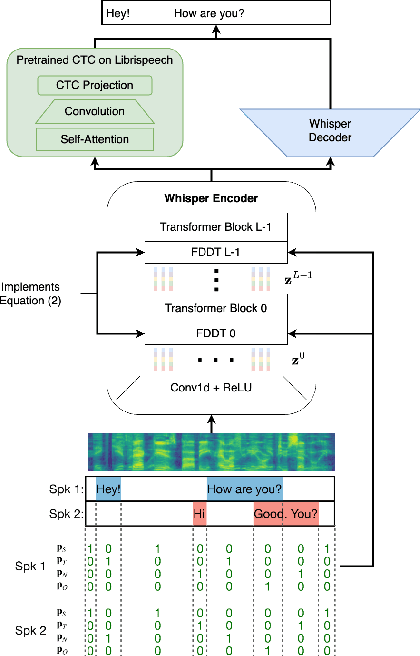
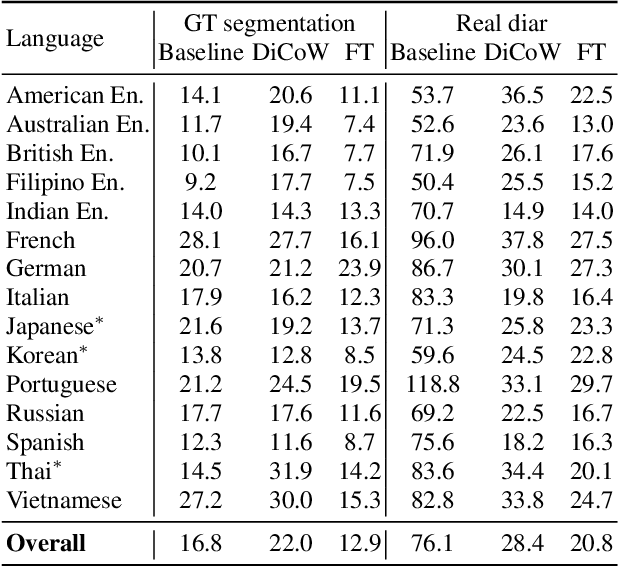
We present a two-speaker automatic speech recognition (ASR) system that combines DiCoW -- a diarization-conditioned variant of Whisper -- with DiariZen, a diarization pipeline built on top of Pyannote. We first evaluate both systems in out-of-domain (OOD) multilingual scenarios without any fine-tuning. In this scenario, DiariZen consistently outperforms the baseline Pyannote diarization model, demonstrating strong generalization. Despite being fine-tuned on English-only data for target-speaker ASR, DiCoW retains solid multilingual performance, indicating that encoder modifications preserve Whisper's multilingual capabilities. We then fine-tune both DiCoW and DiariZen on the MLC-SLM challenge data. The fine-tuned DiariZen continues to outperform the fine-tuned Pyannote baseline, while DiCoW sees further gains from domain adaptation. Our final system achieves a micro-average tcpWER/CER of 16.75% and ranks second in Task 2 of the MLC-SLM challenge. Lastly, we identify several labeling inconsistencies in the training data -- such as missing speech segments and incorrect silence annotations -- which can hinder diarization fine-tuning. We propose simple mitigation strategies to address these issues and improve system robustness.
Analysis of ABC Frontend Audio Systems for the NIST-SRE24
May 21, 2025We present a comprehensive analysis of the embedding extractors (frontends) developed by the ABC team for the audio track of NIST SRE 2024. We follow the two scenarios imposed by NIST: using only a provided set of telephone recordings for training (fixed) or adding publicly available data (open condition). Under these constraints, we develop the best possible speaker embedding extractors for the pre-dominant conversational telephone speech (CTS) domain. We explored architectures based on ResNet with different pooling mechanisms, recently introduced ReDimNet architecture, as well as a system based on the XLS-R model, which represents the family of large pre-trained self-supervised models. In open condition, we train on VoxBlink2 dataset, containing 110 thousand speakers across multiple languages. We observed a good performance and robustness of VoxBlink-trained models, and our experiments show practical recipes for developing state-of-the-art frontends for speaker recognition.
DiCoW: Diarization-Conditioned Whisper for Target Speaker Automatic Speech Recognition
Dec 30, 2024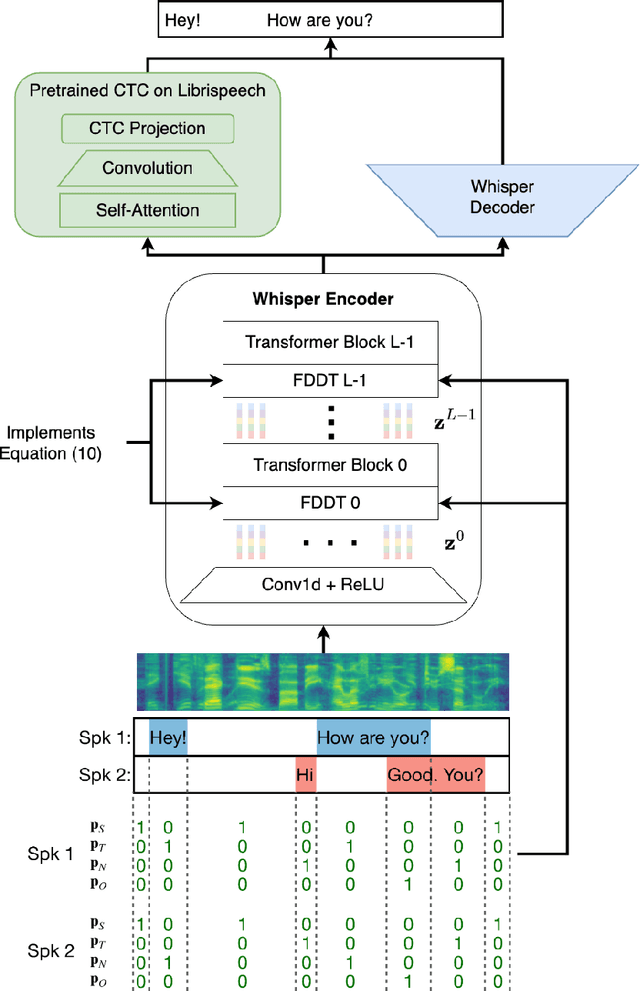
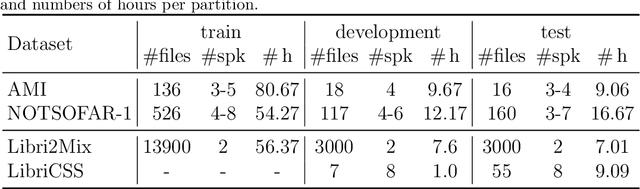
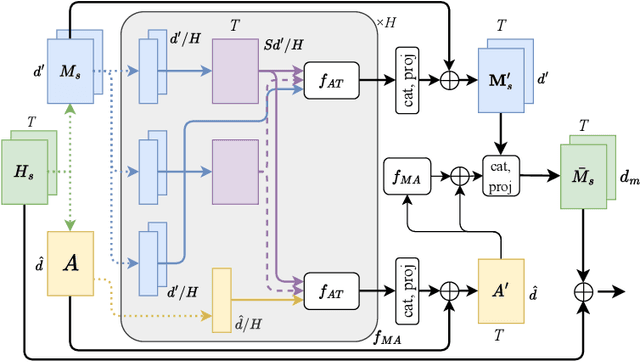
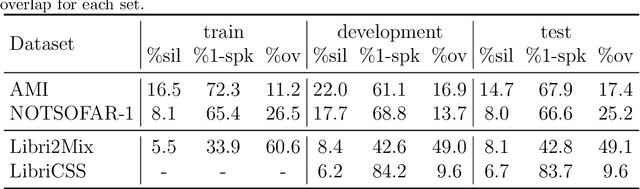
Speaker-attributed automatic speech recognition (ASR) in multi-speaker environments remains a significant challenge, particularly when systems conditioned on speaker embeddings fail to generalize to unseen speakers. In this work, we propose Diarization-Conditioned Whisper (DiCoW), a novel approach to target-speaker ASR that leverages speaker diarization outputs as conditioning information. DiCoW extends the pre-trained Whisper model by integrating diarization labels directly, eliminating reliance on speaker embeddings and reducing the need for extensive speaker-specific training data. Our method introduces frame-level diarization-dependent transformations (FDDT) and query-key biasing (QKb) techniques to refine the model's focus on target speakers while effectively handling overlapping speech. By leveraging diarization outputs as conditioning signals, DiCoW simplifies the workflow for multi-speaker ASR, improves generalization to unseen speakers and enables more reliable transcription in real-world multi-speaker recordings. Additionally, we explore the integration of a connectionist temporal classification (CTC) head to Whisper and demonstrate its ability to improve transcription efficiency through hybrid decoding. Notably, we show that our approach is not limited to Whisper; it also provides similar benefits when applied to the Branchformer model. We validate DiCoW on real-world datasets, including AMI and NOTSOFAR-1 from CHiME-8 challenge, as well as synthetic benchmarks such as Libri2Mix and LibriCSS, enabling direct comparisons with previous methods. Results demonstrate that DiCoW enhances the model's target-speaker ASR capabilities while maintaining Whisper's accuracy and robustness on single-speaker data.
Joint Training of Speaker Embedding Extractor, Speech and Overlap Detection for Diarization
Nov 04, 2024


In spite of the popularity of end-to-end diarization systems nowadays, modular systems comprised of voice activity detection (VAD), speaker embedding extraction plus clustering, and overlapped speech detection (OSD) plus handling still attain competitive performance in many conditions. However, one of the main drawbacks of modular systems is the need to run (and train) different modules independently. In this work, we propose an approach to jointly train a model to produce speaker embeddings, VAD and OSD simultaneously and reach competitive performance at a fraction of the inference time of a standard approach. Furthermore, the joint inference leads to a simplified overall pipeline which brings us one step closer to a unified clustering-based method that can be trained end-to-end towards a diarization-specific objective.
Improving Automatic Speech Recognition with Decoder-Centric Regularisation in Encoder-Decoder Models
Oct 22, 2024


This paper proposes a simple yet effective way of regularising the encoder-decoder-based automatic speech recognition (ASR) models that enhance the robustness of the model and improve the generalisation to out-of-domain scenarios. The proposed approach is dubbed as $\textbf{De}$coder-$\textbf{C}$entric $\textbf{R}$egularisation in $\textbf{E}$ncoder-$\textbf{D}$ecoder (DeCRED) architecture for ASR, where auxiliary classifier(s) is introduced in layers of the decoder module. Leveraging these classifiers, we propose two decoding strategies that re-estimate the next token probabilities. Using the recent E-branchformer architecture, we build strong ASR systems that obtained competitive WERs as compared to Whisper-medium and outperformed OWSM v3; while relying only on a fraction of training data and model size. On top of such a strong baseline, we show that DeCRED can further improve the results and, moreover, generalise much better to out-of-domain scenarios, where we show an absolute reduction of 2.7 and 2.9 WERs on AMI and Gigaspeech datasets, respectively. We provide extensive analysis and accompanying experiments that support the benefits of the proposed regularisation scheme.