 Add to Chrome
 Add to Firefox
 Add to Edge
Modeling Overlapped Speech with Shuffles
Mar 18, 2026
We propose to model parallel streams of data, such as overlapped speech, using shuffles. Specifically, this paper shows how the shuffle product and partial order finite-state automata (FSAs) can be used for alignment and speaker-attributed transcription of overlapped speech. We train using the total score on these FSAs as a loss function, marginalizing over all possible serializations of overlapping sequences at subword, word, and phrase levels. To reduce graph size, we impose temporal constraints by constructing partial order FSAs. We address speaker attribution by modeling (token, speaker) tuples directly. Viterbi alignment through the shuffle product FSA directly enables one-pass alignment. We evaluate performance on synthetic LibriSpeech overlaps. To our knowledge, this is the first algorithm that enables single-pass alignment of multi-talker recordings. All algorithms are implemented using k2 / Icefall.

spINAch: A Diachronic Corpus of French Broadcast Speech Controlled for Speakers' Age and Gender
Mar 16, 2026We present spINAch, a large diachronic corpus of French speech from radio and television archives, balanced by speakers' gender, age (20-95 years old), and spanning 60 years from 1955 to 2015. The dataset includes over 320 hours of recordings from more than two thousand speakers. The methodology for building the corpus is described, focusing on the quality of collected samples in acoustic terms. The data were automatically transcribed and phonetically aligned to allow studies at a phonemic level. More than 3 million oral vowels have been analyzed to propose their fundamental frequency and formants. The corpus, available to the community for research purposes, is valuable for describing the evolution of Parisian French through the representation of gender and age. The presented analyses also demonstrate that the diachronic nature of the corpus allows the observation of various phonetic phenomena, such as the evolution of voice pitch over time (which does not differ by gender in our data) and the neutralization of the /a/-/$a$/ opposition in Parisian French during this period.
Training dynamic models using early exits for automatic speech recognition on resource-constrained devices
Sep 18, 2023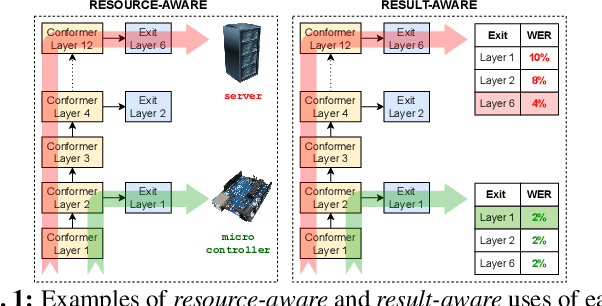
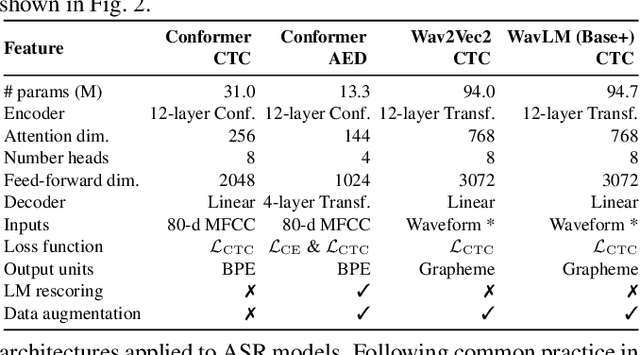
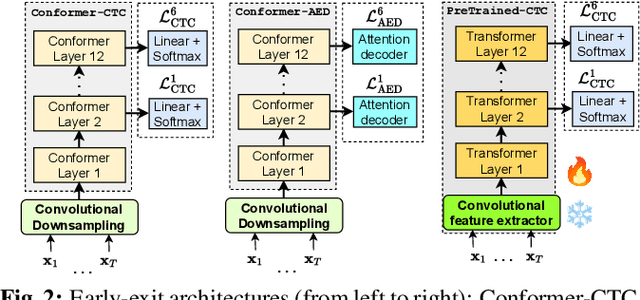
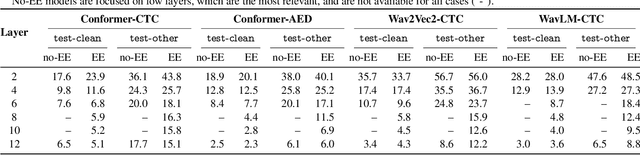
The possibility of dynamically modifying the computational load of neural models at inference time is crucial for on-device processing, where computational power is limited and time-varying. Established approaches for neural model compression exist, but they provide architecturally static models. In this paper, we investigate the use of early-exit architectures, that rely on intermediate exit branches, applied to large-vocabulary speech recognition. This allows for the development of dynamic models that adjust their computational cost to the available resources and recognition performance. Unlike previous works, besides using pre-trained backbones we also train the model from scratch with an early-exit architecture. Experiments on public datasets show that early-exit architectures from scratch not only preserve performance levels when using fewer encoder layers, but also improve task accuracy as compared to using single-exit models or using pre-trained models. Additionally, we investigate an exit selection strategy based on posterior probabilities as an alternative to frame-based entropy.