 Add to Chrome
 Add to Firefox
 Add to Edge
Point Set Upsampling
Papers and Code
PUFM++: Point Cloud Upsampling via Enhanced Flow Matching
Dec 24, 2025
Recent advances in generative modeling have demonstrated strong promise for high-quality point cloud upsampling. In this work, we present PUFM++, an enhanced flow-matching framework for reconstructing dense and accurate point clouds from sparse, noisy, and partial observations. PUFM++ improves flow matching along three key axes: (i) geometric fidelity, (ii) robustness to imperfect input, and (iii) consistency with downstream surface-based tasks. We introduce a two-stage flow-matching strategy that first learns a direct, straight-path flow from sparse inputs to dense targets, and then refines it using noise-perturbed samples to approximate the terminal marginal distribution better. To accelerate and stabilize inference, we propose a data-driven adaptive time scheduler that improves sampling efficiency based on interpolation behavior. We further impose on-manifold constraints during sampling to ensure that generated points remain aligned with the underlying surface. Finally, we incorporate a recurrent interface network~(RIN) to strengthen hierarchical feature interactions and boost reconstruction quality. Extensive experiments on synthetic benchmarks and real-world scans show that PUFM++ sets a new state of the art in point cloud upsampling, delivering superior visual fidelity and quantitative accuracy across a wide range of tasks. Code and pretrained models are publicly available at https://github.com/Holmes-Alan/Enhanced_PUFM.

CoDi -- an exemplar-conditioned diffusion model for low-shot counting
Dec 23, 2025Low-shot object counting addresses estimating the number of previously unobserved objects in an image using only few or no annotated test-time exemplars. A considerable challenge for modern low-shot counters are dense regions with small objects. While total counts in such situations are typically well addressed by density-based counters, their usefulness is limited by poor localization capabilities. This is better addressed by point-detection-based counters, which are based on query-based detectors. However, due to limited number of pre-trained queries, they underperform on images with very large numbers of objects, and resort to ad-hoc techniques like upsampling and tiling. We propose CoDi, the first latent diffusion-based low-shot counter that produces high-quality density maps on which object locations can be determined by non-maxima suppression. Our core contribution is the new exemplar-based conditioning module that extracts and adjusts the object prototypes to the intermediate layers of the denoising network, leading to accurate object location estimation. On FSC benchmark, CoDi outperforms state-of-the-art by 15% MAE, 13% MAE and 10% MAE in the few-shot, one-shot, and reference-less scenarios, respectively, and sets a new state-of-the-art on MCAC benchmark by outperforming the top method by 44% MAE. The code is available at https://github.com/gsustar/CoDi.
Improving Predictions on Highly Unbalanced Data Using Open Source Synthetic Data Upsampling
Jul 22, 2025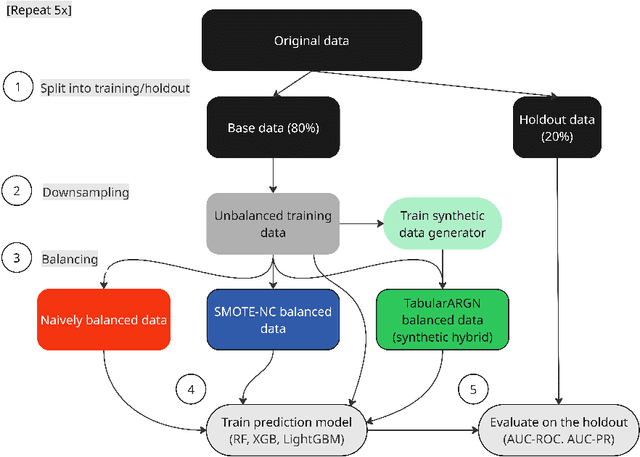

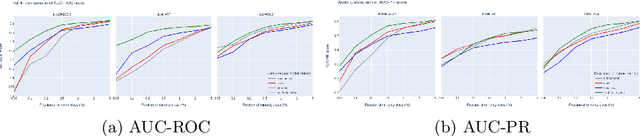

Unbalanced tabular data sets present significant challenges for predictive modeling and data analysis across a wide range of applications. In many real-world scenarios, such as fraud detection, medical diagnosis, and rare event prediction, minority classes are vastly underrepresented, making it difficult for traditional machine learning algorithms to achieve high accuracy. These algorithms tend to favor the majority class, leading to biased models that struggle to accurately represent minority classes. Synthetic data holds promise for addressing the under-representation of minority classes by providing new, diverse, and highly realistic samples. This paper presents a benchmark study on the use of AI-generated synthetic data for upsampling highly unbalanced tabular data sets. We evaluate the effectiveness of an open-source solution, the Synthetic Data SDK by MOSTLY AI, which provides a flexible and user-friendly approach to synthetic upsampling for mixed-type data. We compare predictive models trained on data sets upsampled with synthetic records to those using standard methods, such as naive oversampling and SMOTE-NC. Our results demonstrate that synthetic data can improve predictive accuracy for minority groups by generating diverse data points that fill gaps in sparse regions of the feature space. We show that upsampled synthetic training data consistently results in top-performing predictive models, particularly for mixed-type data sets containing very few minority samples.
Dynamic Snake Upsampling Operater and Boundary-Skeleton Weighted Loss for Tubular Structure Segmentation
May 13, 2025Accurate segmentation of tubular topological structures (e.g., fissures and vasculature) is critical in various fields to guarantee dependable downstream quantitative analysis and modeling. However, in dense prediction tasks such as semantic segmentation and super-resolution, conventional upsampling operators cannot accommodate the slenderness of tubular structures and the curvature of morphology. This paper introduces a dynamic snake upsampling operators and a boundary-skeleton weighted loss tailored for topological tubular structures. Specifically, we design a snake upsampling operators based on an adaptive sampling domain, which dynamically adjusts the sampling stride according to the feature map and selects a set of subpixel sampling points along the serpentine path, enabling more accurate subpixel-level feature recovery for tubular structures. Meanwhile, we propose a skeleton-to-boundary increasing weighted loss that trades off main body and boundary weight allocation based on mask class ratio and distance field, preserving main body overlap while enhancing focus on target topological continuity and boundary alignment precision. Experiments across various domain datasets and backbone networks show that this plug-and-play dynamic snake upsampling operator and boundary-skeleton weighted loss boost both pixel-wise segmentation accuracy and topological consistency of results.
SPU-IMR: Self-supervised Arbitrary-scale Point Cloud Upsampling via Iterative Mask-recovery Network
Feb 26, 2025Point cloud upsampling aims to generate dense and uniformly distributed point sets from sparse point clouds. Existing point cloud upsampling methods typically approach the task as an interpolation problem. They achieve upsampling by performing local interpolation between point clouds or in the feature space, then regressing the interpolated points to appropriate positions. By contrast, our proposed method treats point cloud upsampling as a global shape completion problem. Specifically, our method first divides the point cloud into multiple patches. Then, a masking operation is applied to remove some patches, leaving visible point cloud patches. Finally, our custom-designed neural network iterative completes the missing sections of the point cloud through the visible parts. During testing, by selecting different mask sequences, we can restore various complete patches. A sufficiently dense upsampled point cloud can be obtained by merging all the completed patches. We demonstrate the superior performance of our method through both quantitative and qualitative experiments, showing overall superiority against both existing self-supervised and supervised methods.
4Deform: Neural Surface Deformation for Robust Shape Interpolation
Feb 27, 2025Generating realistic intermediate shapes between non-rigidly deformed shapes is a challenging task in computer vision, especially with unstructured data (e.g., point clouds) where temporal consistency across frames is lacking, and topologies are changing. Most interpolation methods are designed for structured data (i.e., meshes) and do not apply to real-world point clouds. In contrast, our approach, 4Deform, leverages neural implicit representation (NIR) to enable free topology changing shape deformation. Unlike previous mesh-based methods that learn vertex-based deformation fields, our method learns a continuous velocity field in Euclidean space. Thus, it is suitable for less structured data such as point clouds. Additionally, our method does not require intermediate-shape supervision during training; instead, we incorporate physical and geometrical constraints to regularize the velocity field. We reconstruct intermediate surfaces using a modified level-set equation, directly linking our NIR with the velocity field. Experiments show that our method significantly outperforms previous NIR approaches across various scenarios (e.g., noisy, partial, topology-changing, non-isometric shapes) and, for the first time, enables new applications like 4D Kinect sequence upsampling and real-world high-resolution mesh deformation.
Local Attention Transformers for High-Detail Optical Flow Upsampling
Dec 09, 2024Most recent works on optical flow use convex upsampling as the last step to obtain high-resolution flow. In this work, we show and discuss several issues and limitations of this currently widely adopted convex upsampling approach. We propose a series of changes, in an attempt to resolve current issues. First, we propose to decouple the weights for the final convex upsampler, making it easier to find the correct convex combination. For the same reason, we also provide extra contextual features to the convex upsampler. Then, we increase the convex mask size by using an attention-based alternative convex upsampler; Transformers for Convex Upsampling. This upsampler is based on the observation that convex upsampling can be reformulated as attention, and we propose to use local attention masks as a drop-in replacement for convex masks to increase the mask size. We provide empirical evidence that a larger mask size increases the likelihood of the existence of the convex combination. Lastly, we propose an alternative training scheme to remove bilinear interpolation artifacts from the model output. Our proposed ideas could theoretically be applied to almost every current state-of-the-art optical flow architecture. On the FlyingChairs + FlyingThings3D training setting we reduce the Sintel Clean training end-point-error of RAFT from 1.42 to 1.26, GMA from 1.31 to 1.18, and that of FlowFormer from 0.94 to 0.90, by solely adapting the convex upsampler.
HyperSpace: Hypernetworks for spacing-adaptive image segmentation
Jul 04, 2024Medical images are often acquired in different settings, requiring harmonization to adapt to the operating point of algorithms. Specifically, to standardize the physical spacing of imaging voxels in heterogeneous inference settings, images are typically resampled before being processed by deep learning models. However, down-sampling results in loss of information, whereas upsampling introduces redundant information leading to inefficient resource utilization. To overcome these issues, we propose to condition segmentation models on the voxel spacing using hypernetworks. Our approach allows processing images at their native resolutions or at resolutions adjusted to the hardware and time constraints at inference time. Our experiments across multiple datasets demonstrate that our approach achieves competitive performance compared to resolution-specific models, while offering greater flexibility for the end user. This also simplifies model development, deployment and maintenance. Our code is available at https://github.com/ImFusionGmbH/HyperSpace.
Fast Point Cloud Geometry Compression with Context-based Residual Coding and INR-based Refinement
Aug 06, 2024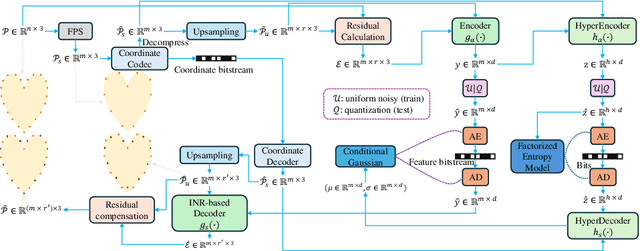

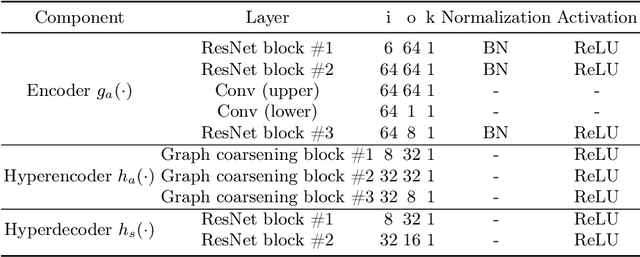
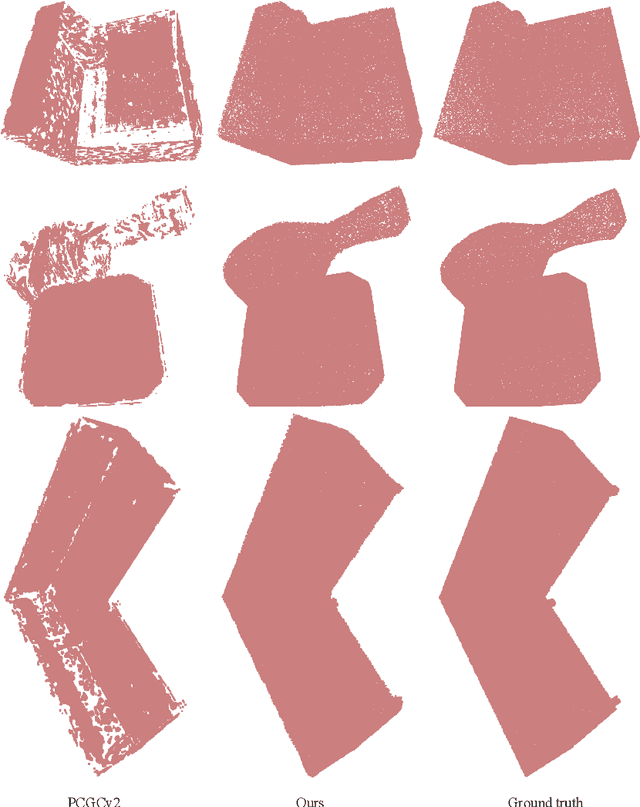
Compressing a set of unordered points is far more challenging than compressing images/videos of regular sample grids, because of the difficulties in characterizing neighboring relations in an irregular layout of points. Many researchers resort to voxelization to introduce regularity, but this approach suffers from quantization loss. In this research, we use the KNN method to determine the neighborhoods of raw surface points. This gives us a means to determine the spatial context in which the latent features of 3D points are compressed by arithmetic coding. As such, the conditional probability model is adaptive to local geometry, leading to significant rate reduction. Additionally, we propose a dual-layer architecture where a non-learning base layer reconstructs the main structures of the point cloud at low complexity, while a learned refinement layer focuses on preserving fine details. This design leads to reductions in model complexity and coding latency by two orders of magnitude compared to SOTA methods. Moreover, we incorporate an implicit neural representation (INR) into the refinement layer, allowing the decoder to sample points on the underlying surface at arbitrary densities. This work is the first to effectively exploit content-aware local contexts for compressing irregular raw point clouds, achieving high rate-distortion performance, low complexity, and the ability to function as an arbitrary-scale upsampling network simultaneously.
Learning Continuous Implicit Field with Local Distance Indicator for Arbitrary-Scale Point Cloud Upsampling
Dec 23, 2023Point cloud upsampling aims to generate dense and uniformly distributed point sets from a sparse point cloud, which plays a critical role in 3D computer vision. Previous methods typically split a sparse point cloud into several local patches, upsample patch points, and merge all upsampled patches. However, these methods often produce holes, outliers or nonuniformity due to the splitting and merging process which does not maintain consistency among local patches. To address these issues, we propose a novel approach that learns an unsigned distance field guided by local priors for point cloud upsampling. Specifically, we train a local distance indicator (LDI) that predicts the unsigned distance from a query point to a local implicit surface. Utilizing the learned LDI, we learn an unsigned distance field to represent the sparse point cloud with patch consistency. At inference time, we randomly sample queries around the sparse point cloud, and project these query points onto the zero-level set of the learned implicit field to generate a dense point cloud. We justify that the implicit field is naturally continuous, which inherently enables the application of arbitrary-scale upsampling without necessarily retraining for various scales. We conduct comprehensive experiments on both synthetic data and real scans, and report state-of-the-art results under widely used benchmarks.