 Add to Chrome
 Add to Firefox
 Add to Edge
Masquerade
Papers and Code
When LoRA Betrays: Backdooring Text-to-Image Models by Masquerading as Benign Adapters
Feb 25, 2026
Low-Rank Adaptation (LoRA) has emerged as a leading technique for efficiently fine-tuning text-to-image diffusion models, and its widespread adoption on open-source platforms has fostered a vibrant culture of model sharing and customization. However, the same modular and plug-and-play flexibility that makes LoRA appealing also introduces a broader attack surface. To highlight this risk, we propose Masquerade-LoRA (MasqLoRA), the first systematic attack framework that leverages an independent LoRA module as the attack vehicle to stealthily inject malicious behavior into text-to-image diffusion models. MasqLoRA operates by freezing the base model parameters and updating only the low-rank adapter weights using a small number of "trigger word-target image" pairs. This enables the attacker to train a standalone backdoor LoRA module that embeds a hidden cross-modal mapping: when the module is loaded and a specific textual trigger is provided, the model produces a predefined visual output; otherwise, it behaves indistinguishably from the benign model, ensuring the stealthiness of the attack. Experimental results demonstrate that MasqLoRA can be trained with minimal resource overhead and achieves a high attack success rate of 99.8%. MasqLoRA reveals a severe and unique threat in the AI supply chain, underscoring the urgent need for dedicated defense mechanisms for the LoRA-centric sharing ecosystem.

SafeThinker: Reasoning about Risk to Deepen Safety Beyond Shallow Alignment
Jan 23, 2026Despite the intrinsic risk-awareness of Large Language Models (LLMs), current defenses often result in shallow safety alignment, rendering models vulnerable to disguised attacks (e.g., prefilling) while degrading utility. To bridge this gap, we propose SafeThinker, an adaptive framework that dynamically allocates defensive resources via a lightweight gateway classifier. Based on the gateway's risk assessment, inputs are routed through three distinct mechanisms: (i) a Standardized Refusal Mechanism for explicit threats to maximize efficiency; (ii) a Safety-Aware Twin Expert (SATE) module to intercept deceptive attacks masquerading as benign queries; and (iii) a Distribution-Guided Think (DDGT) component that adaptively intervenes during uncertain generation. Experiments show that SafeThinker significantly lowers attack success rates across diverse jailbreak strategies without compromising utility, demonstrating that coordinating intrinsic judgment throughout the generation process effectively balances robustness and practicality.
Masquerade: Learning from In-the-wild Human Videos using Data-Editing
Aug 13, 2025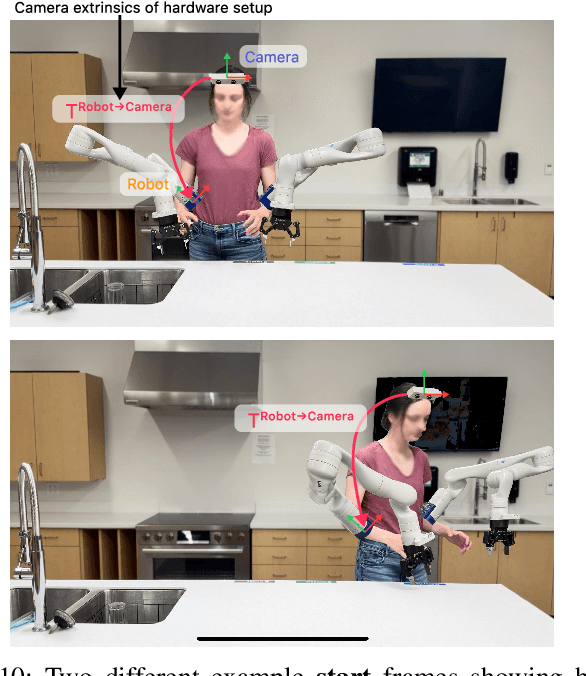
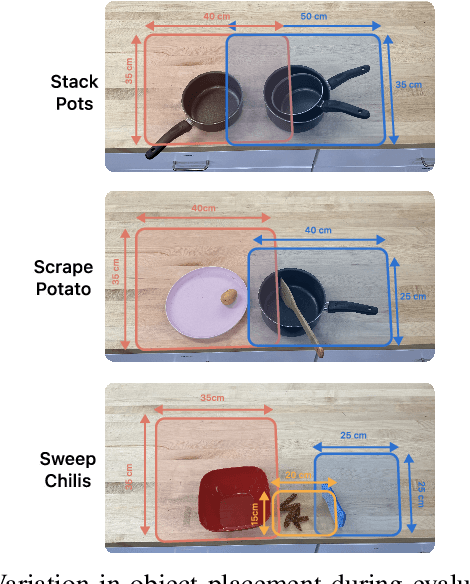
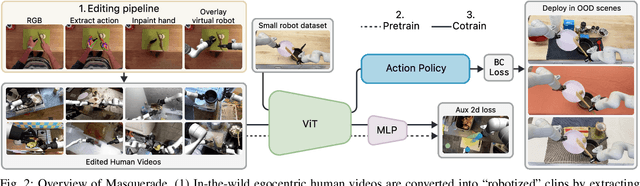
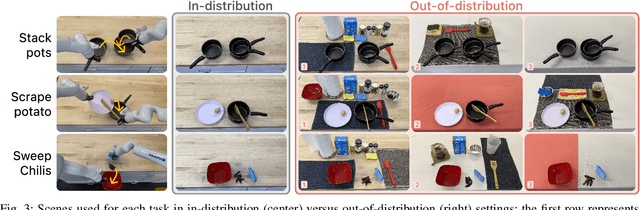
Robot manipulation research still suffers from significant data scarcity: even the largest robot datasets are orders of magnitude smaller and less diverse than those that fueled recent breakthroughs in language and vision. We introduce Masquerade, a method that edits in-the-wild egocentric human videos to bridge the visual embodiment gap between humans and robots and then learns a robot policy with these edited videos. Our pipeline turns each human video into robotized demonstrations by (i) estimating 3-D hand poses, (ii) inpainting the human arms, and (iii) overlaying a rendered bimanual robot that tracks the recovered end-effector trajectories. Pre-training a visual encoder to predict future 2-D robot keypoints on 675K frames of these edited clips, and continuing that auxiliary loss while fine-tuning a diffusion policy head on only 50 robot demonstrations per task, yields policies that generalize significantly better than prior work. On three long-horizon, bimanual kitchen tasks evaluated in three unseen scenes each, Masquerade outperforms baselines by 5-6x. Ablations show that both the robot overlay and co-training are indispensable, and performance scales logarithmically with the amount of edited human video. These results demonstrate that explicitly closing the visual embodiment gap unlocks a vast, readily available source of data from human videos that can be used to improve robot policies.
Multi-Agent Actor-Critic Generative AI for Query Resolution and Analysis
Feb 17, 2025In this paper, we introduce MASQRAD (Multi-Agent Strategic Query Resolution and Diagnostic tool), a transformative framework for query resolution based on the actor-critic model, which utilizes multiple generative AI agents. MASQRAD is excellent at translating imprecise or ambiguous user inquiries into precise and actionable requests. This framework generates pertinent visualizations and responses to these focused queries, as well as thorough analyses and insightful interpretations for users. MASQRAD addresses the common shortcomings of existing solutions in domains that demand fast and precise data interpretation, such as their incapacity to successfully apply AI for generating actionable insights and their challenges with the inherent ambiguity of user queries. MASQRAD functions as a sophisticated multi-agent system but "masquerades" to users as a single AI entity, which lowers errors and enhances data interaction. This approach makes use of three primary AI agents: Actor Generative AI, Critic Generative AI, and Expert Analysis Generative AI. Each is crucial for creating, enhancing, and evaluating data interactions. The Actor AI generates Python scripts to generate data visualizations from large datasets within operational constraints, and the Critic AI rigorously refines these scripts through multi-agent debate. Finally, the Expert Analysis AI contextualizes the outcomes to aid in decision-making. With an accuracy rate of 87\% when handling tasks related to natural language visualization, MASQRAD establishes new benchmarks for automated data interpretation and showcases a noteworthy advancement that has the potential to revolutionize AI-driven applications.
Can Features for Phishing URL Detection Be Trusted Across Diverse Datasets? A Case Study with Explainable AI
Nov 14, 2024


Phishing has been a prevalent cyber threat that manipulates users into revealing sensitive private information through deceptive tactics, designed to masquerade as trustworthy entities. Over the years, proactively detection of phishing URLs (or websites) has been established as an widely-accepted defense approach. In literature, we often find supervised Machine Learning (ML) models with highly competitive performance for detecting phishing websites based on the extracted features from both phishing and benign (i.e., legitimate) websites. However, it is still unclear if these features or indicators are dependent on a particular dataset or they are generalized for overall phishing detection. In this paper, we delve deeper into this issue by analyzing two publicly available phishing URL datasets, where each dataset has its own set of unique and overlapping features related to URL string and website contents. We want to investigate if overlapping features are similar in nature across datasets and how does the model perform when trained on one dataset and tested on the other. We conduct practical experiments and leverage explainable AI (XAI) methods such as SHAP plots to provide insights into different features' contributions in case of phishing detection to answer our primary question, ``Can features for phishing URL detection be trusted across diverse dataset?''. Our case study experiment results show that features for phishing URL detection can often be dataset-dependent and thus may not be trusted across different datasets even though they share same set of feature behaviors.
Detecting Masquerade Attacks in Controller Area Networks Using Graph Machine Learning
Aug 10, 2024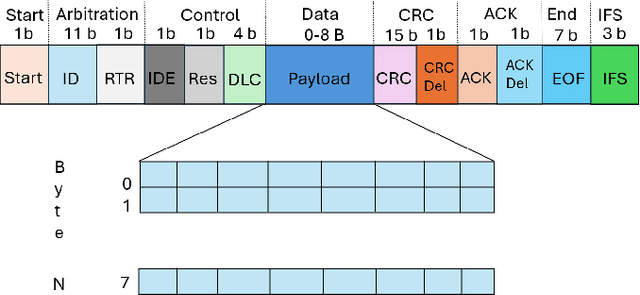
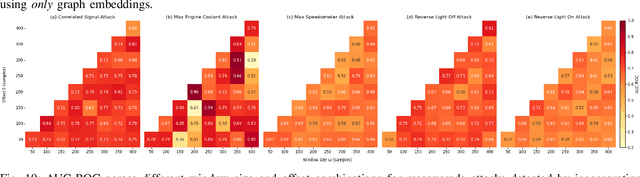
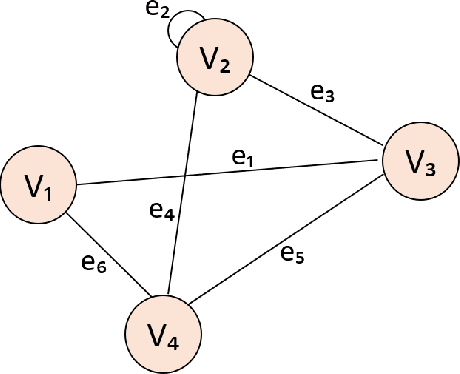
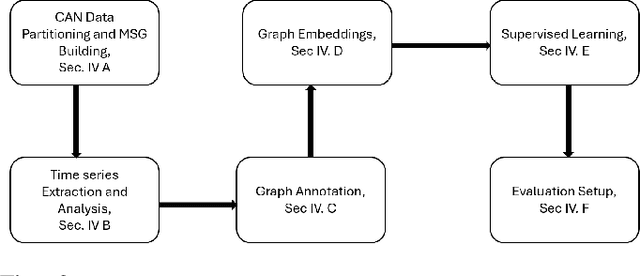
Modern vehicles rely on a myriad of electronic control units (ECUs) interconnected via controller area networks (CANs) for critical operations. Despite their ubiquitous use and reliability, CANs are susceptible to sophisticated cyberattacks, particularly masquerade attacks, which inject false data that mimic legitimate messages at the expected frequency. These attacks pose severe risks such as unintended acceleration, brake deactivation, and rogue steering. Traditional intrusion detection systems (IDS) often struggle to detect these subtle intrusions due to their seamless integration into normal traffic. This paper introduces a novel framework for detecting masquerade attacks in the CAN bus using graph machine learning (ML). We hypothesize that the integration of shallow graph embeddings with time series features derived from CAN frames enhances the detection of masquerade attacks. We show that by representing CAN bus frames as message sequence graphs (MSGs) and enriching each node with contextual statistical attributes from time series, we can enhance detection capabilities across various attack patterns compared to using only graph-based features. Our method ensures a comprehensive and dynamic analysis of CAN frame interactions, improving robustness and efficiency. Extensive experiments on the ROAD dataset validate the effectiveness of our approach, demonstrating statistically significant improvements in the detection rates of masquerade attacks compared to a baseline that uses only graph-based features, as confirmed by Mann-Whitney U and Kolmogorov-Smirnov tests (p < 0.05).
Benchmarking Unsupervised Online IDS for Masquerade Attacks in CAN
Jun 19, 2024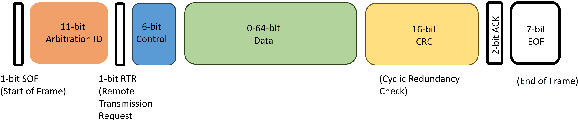
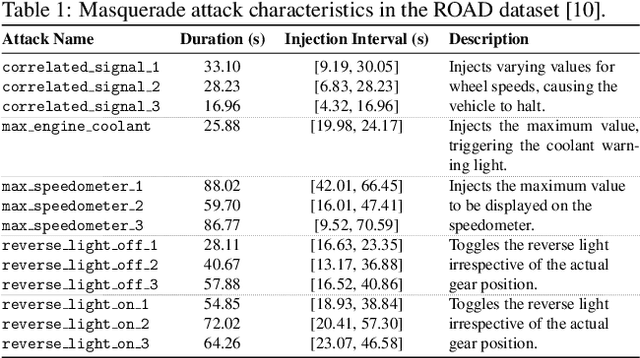
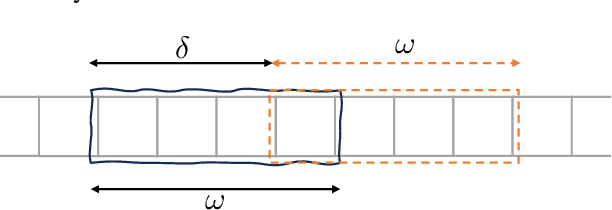
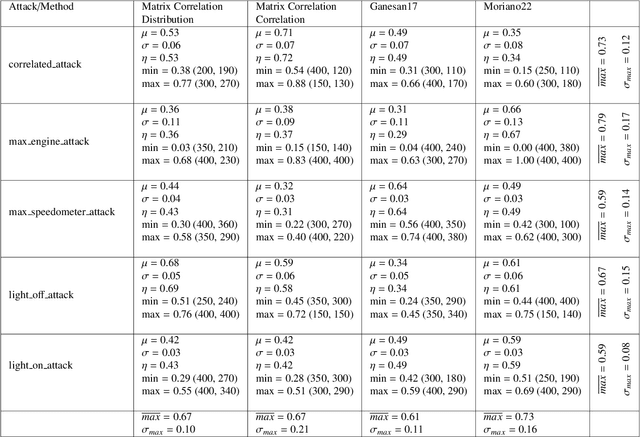
Vehicular controller area networks (CANs) are susceptible to masquerade attacks by malicious adversaries. In masquerade attacks, adversaries silence a targeted ID and then send malicious frames with forged content at the expected timing of benign frames. As masquerade attacks could seriously harm vehicle functionality and are the stealthiest attacks to detect in CAN, recent work has devoted attention to compare frameworks for detecting masquerade attacks in CAN. However, most existing works report offline evaluations using CAN logs already collected using simulations that do not comply with domain's real-time constraints. Here we contribute to advance the state of the art by introducing a benchmark study of four different non-deep learning (DL)-based unsupervised online intrusion detection systems (IDS) for masquerade attacks in CAN. Our approach differs from existing benchmarks in that we analyze the effect of controlling streaming data conditions in a sliding window setting. In doing so, we use realistic masquerade attacks being replayed from the ROAD dataset. We show that although benchmarked IDS are not effective at detecting every attack type, the method that relies on detecting changes at the hierarchical structure of clusters of time series produces the best results at the expense of higher computational overhead. We discuss limitations, open challenges, and how the benchmarked methods can be used for practical unsupervised online CAN IDS for masquerade attacks.
Towards Embedding Dynamic Personas in Interactive Robots: Masquerading Animated Social Kinematics (MASK)
Mar 15, 2024


This paper presents the design and development of an innovative interactive robotic system to enhance audience engagement using character-like personas. Built upon the foundations of persona-driven dialog agents, this work extends the agent application to the physical realm, employing robots to provide a more immersive and interactive experience. The proposed system, named the Masquerading Animated Social Kinematics (MASK), leverages an anthropomorphic robot which interacts with guests using non-verbal interactions, including facial expressions and gestures. A behavior generation system based upon a finite-state machine structure effectively conditions robotic behavior to convey distinct personas. The MASK framework integrates a perception engine, a behavior selection engine, and a comprehensive action library to enable real-time, dynamic interactions with minimal human intervention in behavior design. Throughout the user subject studies, we examined whether the users could recognize the intended character in film-character-based persona conditions. We conclude by discussing the role of personas in interactive agents and the factors to consider for creating an engaging user experience.
On the Role of Similarity in Detecting Masquerading Files
Feb 17, 2024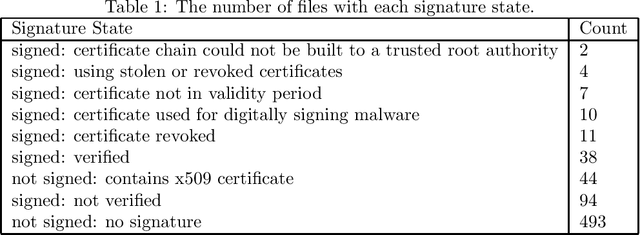
Similarity has been applied to a wide range of security applications, typically used in machine learning models. We examine the problem posed by masquerading samples; that is samples crafted by bad actors to be similar or near identical to legitimate samples. We find that these samples potentially create significant problems for machine learning solutions. The primary problem being that bad actors can circumvent machine learning solutions by using masquerading samples. We then examine the interplay between digital signatures and machine learning solutions. In particular, we focus on executable files and code signing. We offer a taxonomy for masquerading files. We use a combination of similarity and clustering to find masquerading files. We use the insights gathered in this process to offer improvements to similarity based and machine learning security solutions.
Effective In-vehicle Intrusion Detection via Multi-view Statistical Graph Learning on CAN Messages
Nov 13, 2023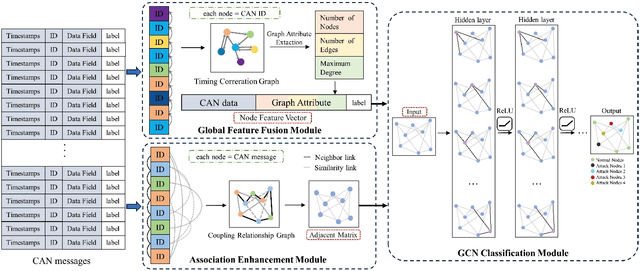
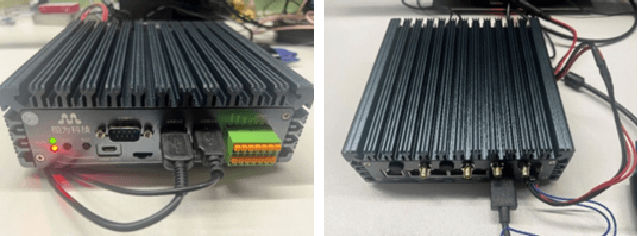
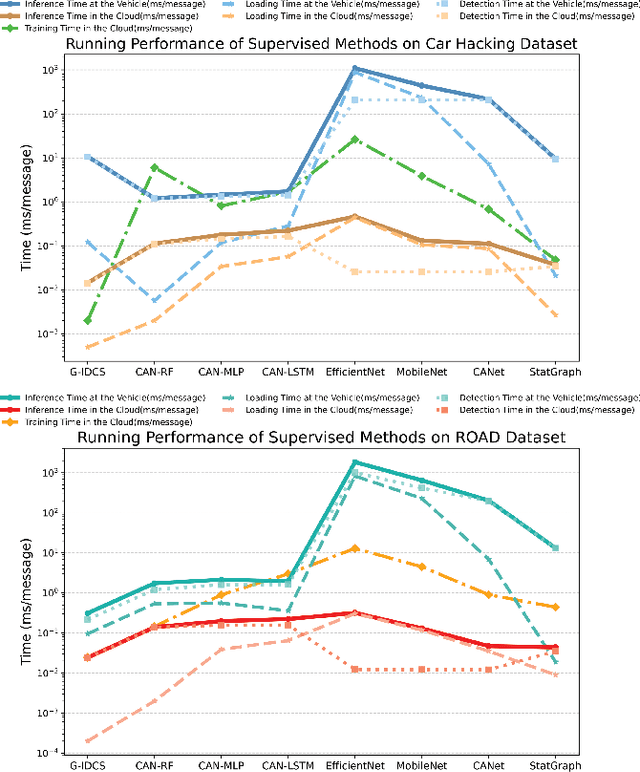
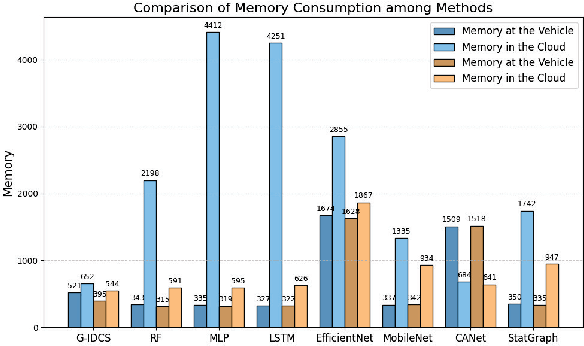
As an important component of internet of vehicles (IoV), intelligent connected vehicles (ICVs) have to communicate with external networks frequently. In this case, the resource-constrained in-vehicle network (IVN) is facing a wide variety of complex and changing external cyber-attacks, especially the masquerade attack with high difficulty of detection while serious damaging effects that few counter measures can identify successfully. Moreover, only coarse-grained recognition can be achieved in current mainstream intrusion detection mechanisms, i.e., whether a whole data flow observation window contains attack labels rather than fine-grained recognition on every single data item within this window. In this paper, we propose StatGraph: an Effective Multi-view Statistical Graph Learning Intrusion Detection to implement the fine-grained intrusion detection. Specifically, StatGraph generates two statistical graphs, timing correlation graph (TCG) and coupling relationship graph (CRG), based on data streams. In given message observation windows, edge attributes in TCGs represent temporal correlation between different message IDs, while edge attributes in CRGs denote the neighbour relationship and contextual similarity. Besides, a lightweight shallow layered GCN network is trained based graph property of TCGs and CRGs, which can learn the universal laws of various patterns more effectively and further enhance the performance of detection. To address the problem of insufficient attack types in previous intrusion detection, we select two real in-vehicle CAN datasets that cover four new attacks never investigated before. Experimental result shows StatGraph improves both detection granularity and detection performance over state-of-the-art intrusion detection methods.