 Add to Chrome
 Add to Firefox
 Add to Edge
Mission-Level Runtime Assurance Framework for Autonomous Driving
Jun 05, 2026
This paper studies runtime safety for autonomous driving when high-level driving commands become faulty or unreliable. Unlike conventional runtime-safety approaches that mainly focus on immediate vehicle safety, the proposed framework evaluates both driving safety and whether the vehicle can still successfully complete its mission before a command is executed. The framework extends highway-env with mission-level fault scenarios such as skipping required checkpoints, entering restricted areas, and generating future routes that can no longer complete the mission successfully. A runtime monitoring system is introduced to detect and reject unsafe or mission-infeasible commands before execution. For comparison, an adapted Simplex-Drive runtime-safety baseline with learning-based driving control, safety fallback control, and runtime controller switching is implemented using the public Simplex-Drive framework. Experimental results show that platform-level runtime safety alone cannot detect mission-level planning faults, while the proposed framework successfully rejects mission-infeasible commands and improves mission success under randomized fault conditions.

Security and Resilience in Autonomous Vehicles: A Proactive Design Approach
Apr 14, 2026Autonomous vehicles (AVs) promise efficient, clean and cost-effective transportation systems, but their reliance on sensors, wireless communications, and decision-making systems makes them vulnerable to cyberattacks and physical threats. This chapter presents novel design techniques to strengthen the security and resilience of AVs. We first provide a taxonomy of potential attacks across different architectural layers, from perception and control manipulation to Vehicle-to-Any (V2X) communication exploits and software supply chain compromises. Building on this analysis, we present an AV Resilient architecture that integrates redundancy, diversity, and adaptive reconfiguration strategies, supported by anomaly- and hash-based intrusion detection techniques. Experimental validation on the Quanser QCar platform demonstrates the effectiveness of these methods in detecting depth camera blinding attacks and software tampering of perception modules. The results highlight how fast anomaly detection combined with fallback and backup mechanisms ensures operational continuity, even under adversarial conditions. By linking layered threat modeling with practical defense implementations, this work advances AV resilience strategies for safer and more trustworthy autonomous vehicles.
RACF: A Resilient Autonomous Car Framework with Object Distance Correction
Apr 14, 2026Autonomous vehicles are increasingly deployed in safety-critical applications, where sensing failures or cyberphysical attacks can lead to unsafe operations resulting in human loss and/or severe physical damages. Reliable real-time perception is therefore critically important for their safe operations and acceptability. For example, vision-based distance estimation is vulnerable to environmental degradation and adversarial perturbations, and existing defenses are often reactive and too slow to promptly mitigate their impacts on safe operations. We present a Resilient Autonomous Car Framework (RACF) that incorporates an Object Distance Correction Algorithm (ODCA) to improve perception-layer robustness through redundancy and diversity across a depth camera, LiDAR, and physics-based kinematics. Within this framework, when obstacle distance estimation produced by depth camera is inconsistent, a cross-sensor gate activates the correction algorithm to fix the detected inconsistency. We have experiment with the proposed resilient car framework and evaluate its performance on a testbed implemented using the Quanser QCar 2 platform. The presented framework achieved up to 35% RMSE reduction under strong corruption and improves stop compliance and braking latency, while operating in real time. These results demonstrate a practical and lightweight approach to resilient perception for safety-critical autonomous driving
AICCE: AI Driven Compliance Checker Engine
Apr 03, 2026For digital infrastructure to be safe, compatible, and standards-aligned, automated communication protocol compliance verification is crucial. Nevertheless, current rule-based systems are becoming less and less effective since they are unable to identify subtle or intricate non-compliance, which attackers frequently use to establish covert communication channels in IPv6 traffic. In order to automate IPv6 compliance verification, this paper presents the Artificial Intelligence Driven Compliance Checker Engine (AICCE), a novel generative system that combines dual-architecture reasoning and retrieval-augmented generation (RAG). Specification segments pertinent to each query can be efficiently retrieved thanks to the semantic encoding of protocol standards into a high-dimensional vector space. Based on this framework, AICCE offers two complementary pipelines: (i) Explainability Mode, which uses parallel LLM agents to render decisions and settle disputes through organized discussions to improve interpretability and robustness, and (ii) Script Execution Mode, which converts clauses into Python rules that can be executed quickly for dataset-wide verification. With the debate mechanism enhancing decision reliability in complicated scenarios and the script-based pipeline lowering per-sample latency, AICCE achieves accuracy and F1-scores of up to 99% when tested on IPv6 packet samples across sixteen cutting-edge generative models. By offering a scalable, auditable, and generalizable mechanism for identifying both routine and covert non-compliance in dynamic communication environments, our results show that AICCE overcomes the blind spots of conventional rule-based compliance checking systems.
Multi-Agent Actor-Critic Generative AI for Query Resolution and Analysis
Feb 17, 2025In this paper, we introduce MASQRAD (Multi-Agent Strategic Query Resolution and Diagnostic tool), a transformative framework for query resolution based on the actor-critic model, which utilizes multiple generative AI agents. MASQRAD is excellent at translating imprecise or ambiguous user inquiries into precise and actionable requests. This framework generates pertinent visualizations and responses to these focused queries, as well as thorough analyses and insightful interpretations for users. MASQRAD addresses the common shortcomings of existing solutions in domains that demand fast and precise data interpretation, such as their incapacity to successfully apply AI for generating actionable insights and their challenges with the inherent ambiguity of user queries. MASQRAD functions as a sophisticated multi-agent system but "masquerades" to users as a single AI entity, which lowers errors and enhances data interaction. This approach makes use of three primary AI agents: Actor Generative AI, Critic Generative AI, and Expert Analysis Generative AI. Each is crucial for creating, enhancing, and evaluating data interactions. The Actor AI generates Python scripts to generate data visualizations from large datasets within operational constraints, and the Critic AI rigorously refines these scripts through multi-agent debate. Finally, the Expert Analysis AI contextualizes the outcomes to aid in decision-making. With an accuracy rate of 87\% when handling tasks related to natural language visualization, MASQRAD establishes new benchmarks for automated data interpretation and showcases a noteworthy advancement that has the potential to revolutionize AI-driven applications.
AI/ML Based Detection and Categorization of Covert Communication in IPv6 Network
Jan 18, 2025
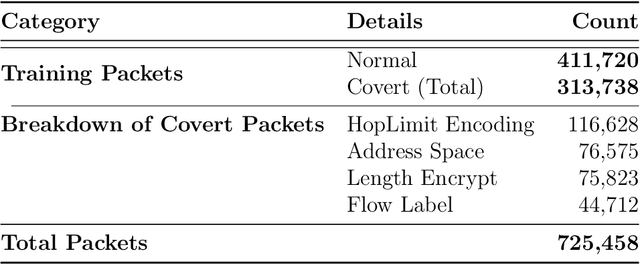
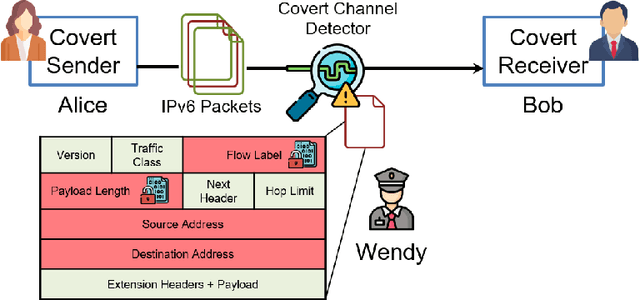
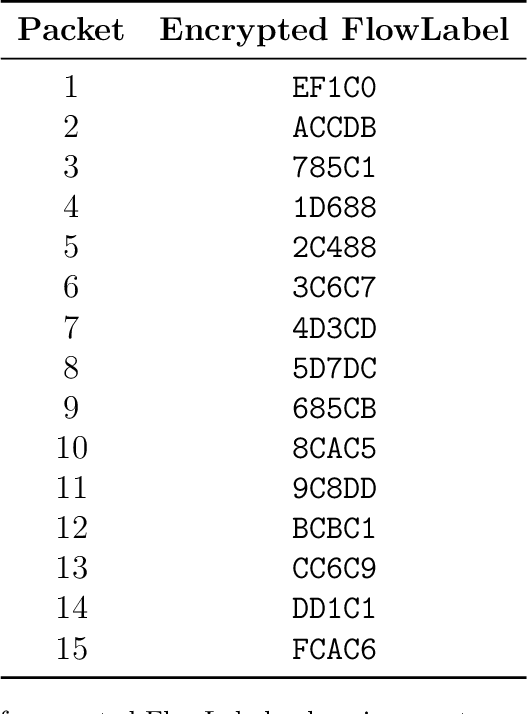
The flexibility and complexity of IPv6 extension headers allow attackers to create covert channels or bypass security mechanisms, leading to potential data breaches or system compromises. The mature development of machine learning has become the primary detection technology option used to mitigate covert communication threats. However, the complexity of detecting covert communication, evolving injection techniques, and scarcity of data make building machine-learning models challenging. In previous related research, machine learning has shown good performance in detecting covert communications, but oversimplified attack scenario assumptions cannot represent the complexity of modern covert technologies and make it easier for machine learning models to detect covert communications. To bridge this gap, in this study, we analyzed the packet structure and network traffic behavior of IPv6, used encryption algorithms, and performed covert communication injection without changing network packet behavior to get closer to real attack scenarios. In addition to analyzing and injecting methods for covert communications, this study also uses comprehensive machine learning techniques to train the model proposed in this study to detect threats, including traditional decision trees such as random forests and gradient boosting, as well as complex neural network architectures such as CNNs and LSTMs, to achieve detection accuracy of over 90\%. This study details the methods used for dataset augmentation and the comparative performance of the applied models, reinforcing insights into the adaptability and resilience of the machine learning application in IPv6 covert communication. In addition, we also proposed a Generative AI-assisted interpretation concept based on prompt engineering as a preliminary study of the role of Generative AI agents in covert communication.
Development of an Edge Resilient ML Ensemble to Tolerate ICS Adversarial Attacks
Sep 26, 2024


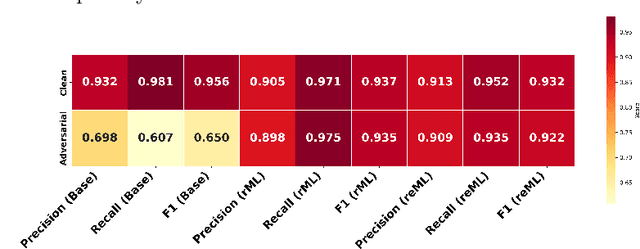
Deploying machine learning (ML) in dynamic data-driven applications systems (DDDAS) can improve the security of industrial control systems (ICS). However, ML-based DDDAS are vulnerable to adversarial attacks because adversaries can alter the input data slightly so that the ML models predict a different result. In this paper, our goal is to build a resilient edge machine learning (reML) architecture that is designed to withstand adversarial attacks by performing Data Air Gap Transformation (DAGT) to anonymize data feature spaces using deep neural networks and randomize the ML models used for predictions. The reML is based on the Resilient DDDAS paradigm, Moving Target Defense (MTD) theory, and TinyML and is applied to combat adversarial attacks on ICS. Furthermore, the proposed approach is power-efficient and privacy-preserving and, therefore, can be deployed on power-constrained devices to enhance ICS security. This approach enables resilient ML inference at the edge by shifting the computation from the computing-intensive platforms to the resource-constrained edge devices. The incorporation of TinyML with TensorFlow Lite ensures efficient resource utilization and, consequently, makes reML suitable for deployment in various industrial control environments. Furthermore, the dynamic nature of reML, facilitated by the resilient DDDAS development environment, allows for continuous adaptation and improvement in response to emerging threats. Lastly, we evaluate our approach on an ICS dataset and demonstrate that reML provides a viable and effective solution for resilient ML inference at the edge devices.
GPS-IDS: An Anomaly-based GPS Spoofing Attack Detection Framework for Autonomous Vehicles
May 14, 2024


Autonomous Vehicles (AVs) heavily rely on sensors and communication networks like Global Positioning System (GPS) to navigate autonomously. Prior research has indicated that networks like GPS are vulnerable to cyber-attacks such as spoofing and jamming, thus posing serious risks like navigation errors and system failures. These threats are expected to intensify with the widespread deployment of AVs, making it crucial to detect and mitigate such attacks. This paper proposes GPS Intrusion Detection System, or GPS-IDS, an Anomaly Behavior Analysis (ABA)-based intrusion detection framework to detect GPS spoofing attacks on AVs. The framework uses a novel physics-based vehicle behavior model where a GPS navigation model is integrated into the conventional dynamic bicycle model for accurate AV behavior representation. Temporal features derived from this behavior model are analyzed using machine learning to detect normal and abnormal navigation behavior. The performance of the GPS-IDS framework is evaluated on the AV-GPS-Dataset - a real-world dataset collected by the team using an AV testbed. The dataset has been publicly released for the global research community. To the best of our knowledge, this dataset is the first of its kind and will serve as a useful resource to address such security challenges.
An Anomaly Behavior Analysis Framework for Securing Autonomous Vehicle Perception
Oct 08, 2023As a rapidly growing cyber-physical platform, Autonomous Vehicles (AVs) are encountering more security challenges as their capabilities continue to expand. In recent years, adversaries are actively targeting the perception sensors of autonomous vehicles with sophisticated attacks that are not easily detected by the vehicles' control systems. This work proposes an Anomaly Behavior Analysis approach to detect a perception sensor attack against an autonomous vehicle. The framework relies on temporal features extracted from a physics-based autonomous vehicle behavior model to capture the normal behavior of vehicular perception in autonomous driving. By employing a combination of model-based techniques and machine learning algorithms, the proposed framework distinguishes between normal and abnormal vehicular perception behavior. To demonstrate the application of the framework in practice, we performed a depth camera attack experiment on an autonomous vehicle testbed and generated an extensive dataset. We validated the effectiveness of the proposed framework using this real-world data and released the dataset for public access. To our knowledge, this dataset is the first of its kind and will serve as a valuable resource for the research community in evaluating their intrusion detection techniques effectively.
Quantized Transformer Language Model Implementations on Edge Devices
Oct 06, 2023Large-scale transformer-based models like the Bidirectional Encoder Representations from Transformers (BERT) are widely used for Natural Language Processing (NLP) applications, wherein these models are initially pre-trained with a large corpus with millions of parameters and then fine-tuned for a downstream NLP task. One of the major limitations of these large-scale models is that they cannot be deployed on resource-constrained devices due to their large model size and increased inference latency. In order to overcome these limitations, such large-scale models can be converted to an optimized FlatBuffer format, tailored for deployment on resource-constrained edge devices. Herein, we evaluate the performance of such FlatBuffer transformed MobileBERT models on three different edge devices, fine-tuned for Reputation analysis of English language tweets in the RepLab 2013 dataset. In addition, this study encompassed an evaluation of the deployed models, wherein their latency, performance, and resource efficiency were meticulously assessed. Our experiment results show that, compared to the original BERT large model, the converted and quantized MobileBERT models have 160$\times$ smaller footprints for a 4.1% drop in accuracy while analyzing at least one tweet per second on edge devices. Furthermore, our study highlights the privacy-preserving aspect of TinyML systems as all data is processed locally within a serverless environment.