 Add to Chrome
 Add to Firefox
 Add to Edge
Hypergraph Partitioning
Papers and Code
COMPOSE: Hypergraph Cover Optimization for Multi-view 3D Human Pose Estimation
Jan 14, 2026
3D pose estimation from sparse multi-views is a critical task for numerous applications, including action recognition, sports analysis, and human-robot interaction. Optimization-based methods typically follow a two-stage pipeline, first detecting 2D keypoints in each view and then associating these detections across views to triangulate the 3D pose. Existing methods rely on mere pairwise associations to model this correspondence problem, treating global consistency between views (i.e., cycle consistency) as a soft constraint. Yet, reconciling these constraints for multiple views becomes brittle when spurious associations propagate errors. We thus propose COMPOSE, a novel framework that formulates multi-view pose correspondence matching as a hypergraph partitioning problem rather than through pairwise association. While the complexity of the resulting integer linear program grows exponentially in theory, we introduce an efficient geometric pruning strategy to substantially reduce the search space. COMPOSE achieves improvements of up to 23% in average precision over previous optimization-based methods and up to 11% over self-supervised end-to-end learned methods, offering a promising solution to a widely studied problem.

A Case for Hypergraphs to Model and Map SNNs on Neuromorphic Hardware
Jan 22, 2026Executing Spiking Neural Networks (SNNs) on neuromorphic hardware poses the problem of mapping neurons to cores. SNNs operate by propagating spikes between neurons that form a graph through synapses. Neuromorphic hardware mimics them through a network-on-chip, transmitting spikes, and a mesh of cores, each managing several neurons. Its operational cost is tied to spike movement and active cores. A mapping comprises two tasks: partitioning the SNN's graph to fit inside cores and placement of each partition on the hardware mesh. Both are NP-hard problems, and as SNNs and hardware scale towards billions of neurons, they become increasingly difficult to tackle effectively. In this work, we propose to raise the abstraction of SNNs from graphs to hypergraphs, redesigning mapping techniques accordingly. The resulting model faithfully captures the replication of spikes inside cores by exposing the notion of hyperedge co-membership between neurons. We further show that the overlap and locality of hyperedges strongly correlate with high-quality mappings, making these properties instrumental in devising mapping algorithms. By exploiting them directly, grouping neurons through shared hyperedges, communication traffic and hardware resource usage can be reduced be yond what just contracting individual connections attains. To substantiate this insight, we consider several partitioning and placement algorithms, some newly devised, others adapted from literature, and compare them over progressively larger and bio-plausible SNNs. Our results show that hypergraph based techniques can achieve better mappings than the state-of-the-art at several execution time regimes. Based on these observations, we identify a promising selection of algorithms to achieve effective mappings at any scale.
A New Decomposition Paradigm for Graph-structured Nonlinear Programs via Message Passing
Dec 31, 2025We study finite-sum nonlinear programs whose decision variables interact locally according to a graph or hypergraph. We propose MP-Jacobi (Message Passing-Jacobi), a graph-compliant decentralized framework that couples min-sum message passing with Jacobi block updates. The (hyper)graph is partitioned into tree clusters. At each iteration, agents update in parallel by solving a cluster subproblem whose objective decomposes into (i) an intra-cluster term evaluated by a single min-sum sweep on the cluster tree (cost-to-go messages) and (ii) inter-cluster couplings handled via a Jacobi correction using neighbors' latest iterates. This design uses only single-hop communication and yields a convergent message-passing method on loopy graphs. For strongly convex objectives we establish global linear convergence and explicit rates that quantify how curvature, coupling strength, and the chosen partition affect scalability and provide guidance for clustering. To mitigate the computation and communication cost of exact message updates, we develop graph-compliant surrogates that preserve convergence while reducing per-iteration complexity. We further extend MP-Jacobi to hypergraphs; in heavily overlapping regimes, a surrogate-based hyperedge-splitting scheme restores finite-time intra-cluster message updates and maintains convergence. Experiments validate the theory and show consistent improvements over decentralized gradient baselines.
A Multi-Level Framework for Multi-Objective Hypergraph Partitioning: Combining Minimum Spanning Tree and Proximal Gradient
Sep 26, 2025
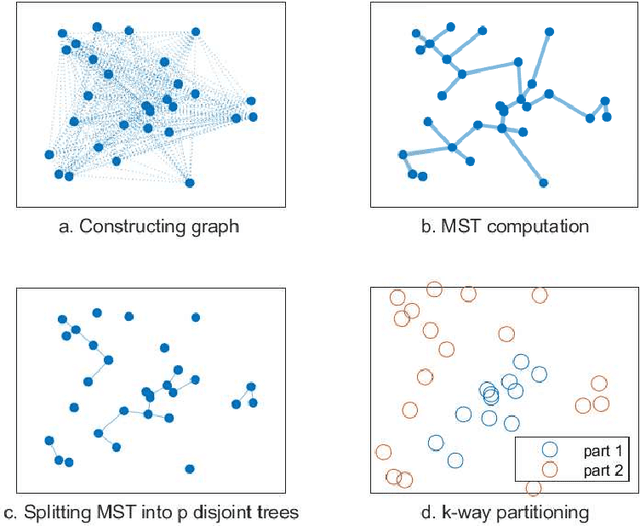
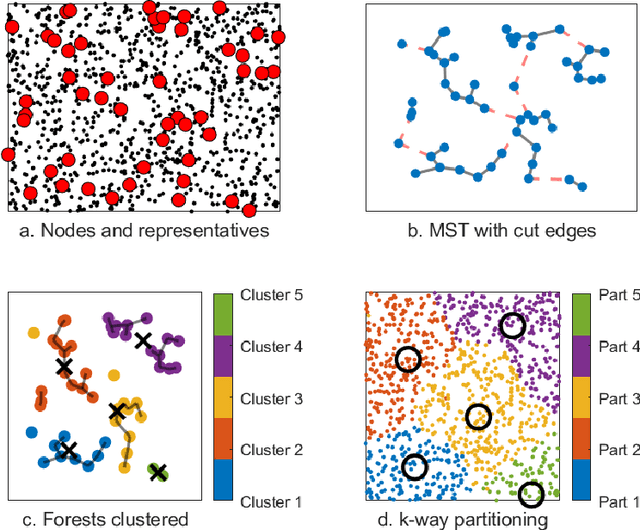
This paper proposes an efficient hypergraph partitioning framework based on a novel multi-objective non-convex constrained relaxation model. A modified accelerated proximal gradient algorithm is employed to generate diverse $k$-dimensional vertex features to avoid local optima and enhance partition quality. Two MST-based strategies are designed for different data scales: for small-scale data, the Prim algorithm constructs a minimum spanning tree followed by pruning and clustering; for large-scale data, a subset of representative nodes is selected to build a smaller MST, while the remaining nodes are assigned accordingly to reduce complexity. To further improve partitioning results, refinement strategies including greedy migration, swapping, and recursive MST-based clustering are introduced for partitions. Experimental results on public benchmark sets demonstrate that the proposed algorithm achieves reductions in cut size of approximately 2\%--5\% on average compared to KaHyPar in 2, 3, and 4-way partitioning, with improvements of up to 35\% on specific instances. Particularly on weighted vertex sets, our algorithm outperforms state-of-the-art partitioners including KaHyPar, hMetis, Mt-KaHyPar, and K-SpecPart, highlighting its superior partitioning quality and competitiveness. Furthermore, the proposed refinement strategy improves hMetis partitions by up to 16\%. A comprehensive evaluation based on virtual instance methodology and parameter sensitivity analysis validates the algorithm's competitiveness and characterizes its performance trade-offs.
Deep k-grouping: An Unsupervised Learning Framework for Combinatorial Optimization on Graphs and Hypergraphs
May 27, 2025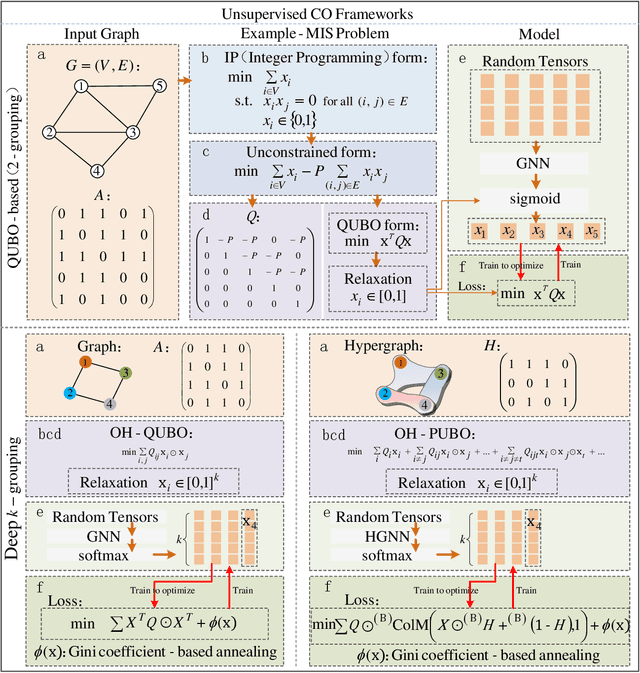

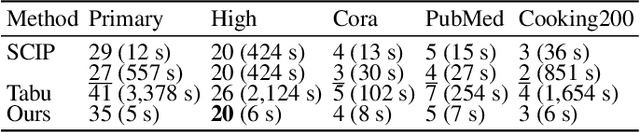
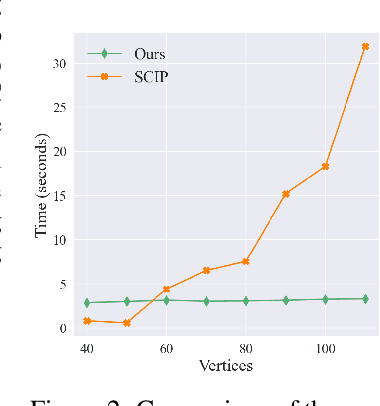
Along with AI computing shining in scientific discovery, its potential in the combinatorial optimization (CO) domain has also emerged in recent years. Yet, existing unsupervised neural network solvers struggle to solve $k$-grouping problems (e.g., coloring, partitioning) on large-scale graphs and hypergraphs, due to limited computational frameworks. In this work, we propose Deep $k$-grouping, an unsupervised learning-based CO framework. Specifically, we contribute: Novel one-hot encoded polynomial unconstrained binary optimization (OH-PUBO), a formulation for modeling k-grouping problems on graphs and hypergraphs (e.g., graph/hypergraph coloring and partitioning); GPU-accelerated algorithms for large-scale k-grouping CO problems. Deep $k$-grouping employs the relaxation of large-scale OH-PUBO objectives as differentiable loss functions and trains to optimize them in an unsupervised manner. To ensure scalability, it leverages GPU-accelerated algorithms to unify the training pipeline; A Gini coefficient-based continuous relaxation annealing strategy to enforce discreteness of solutions while preventing convergence to local optima. Experimental results demonstrate that Deep $k$-grouping outperforms existing neural network solvers and classical heuristics such as SCIP and Tabu.
A packing lemma for VCN${}_k$-dimension and learning high-dimensional data
May 21, 2025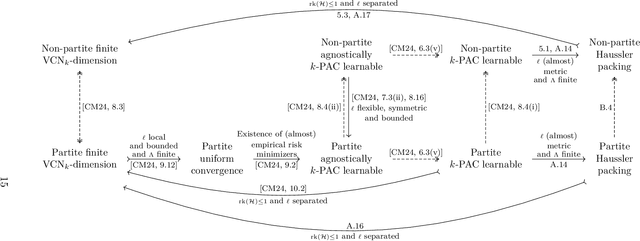
Recently, the authors introduced the theory of high-arity PAC learning, which is well-suited for learning graphs, hypergraphs and relational structures. In the same initial work, the authors proved a high-arity analogue of the Fundamental Theorem of Statistical Learning that almost completely characterizes all notions of high-arity PAC learning in terms of a combinatorial dimension, called the Vapnik--Chervonenkis--Natarajan (VCN${}_k$) $k$-dimension, leaving as an open problem only the characterization of non-partite, non-agnostic high-arity PAC learnability. In this work, we complete this characterization by proving that non-partite non-agnostic high-arity PAC learnability implies a high-arity version of the Haussler packing property, which in turn implies finiteness of VCN${}_k$-dimension. This is done by obtaining direct proofs that classic PAC learnability implies classic Haussler packing property, which in turn implies finite Natarajan dimension and noticing that these direct proofs nicely lift to high-arity.
SHyPar: A Spectral Coarsening Approach to Hypergraph Partitioning
Oct 09, 2024
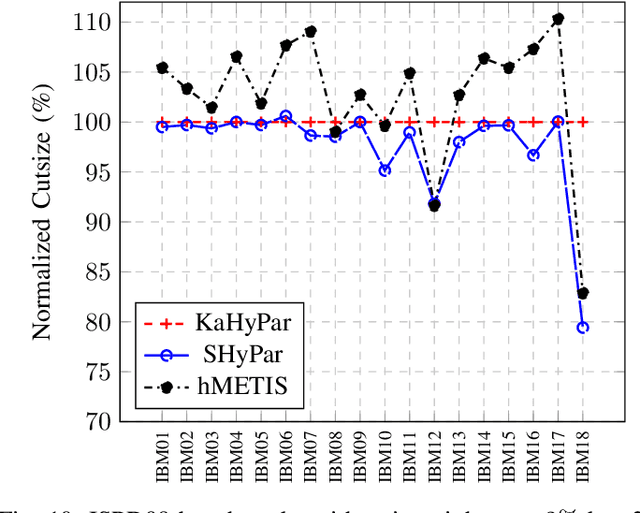
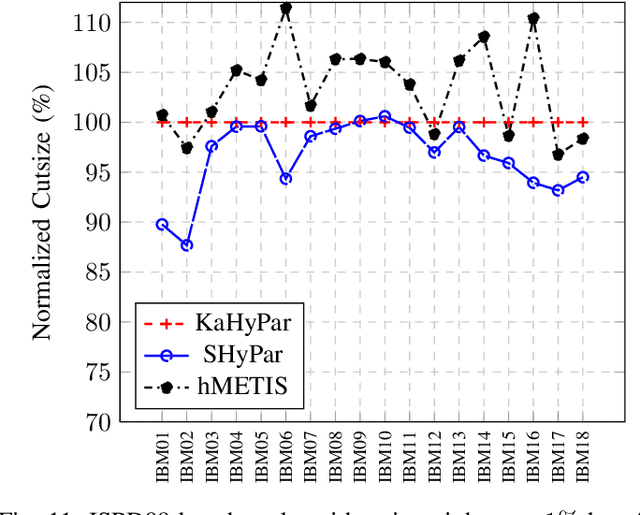
State-of-the-art hypergraph partitioners utilize a multilevel paradigm to construct progressively coarser hypergraphs across multiple layers, guiding cut refinements at each level of the hierarchy. Traditionally, these partitioners employ heuristic methods for coarsening and do not consider the structural features of hypergraphs. In this work, we introduce a multilevel spectral framework, SHyPar, for partitioning large-scale hypergraphs by leveraging hyperedge effective resistances and flow-based community detection techniques. Inspired by the latest theoretical spectral clustering frameworks, such as HyperEF and HyperSF, SHyPar aims to decompose large hypergraphs into multiple subgraphs with few inter-partition hyperedges (cut size). A key component of SHyPar is a flow-based local clustering scheme for hypergraph coarsening, which incorporates a max-flow-based algorithm to produce clusters with substantially improved conductance. Additionally, SHyPar utilizes an effective resistance-based rating function for merging nodes that are strongly connected (coupled). Compared with existing state-of-the-art hypergraph partitioning methods, our extensive experimental results on real-world VLSI designs demonstrate that SHyPar can more effectively partition hypergraphs, achieving state-of-the-art solution quality.
Overlap-aware meta-learning attention to enhance hypergraph neural networks for node classification
Mar 11, 2025
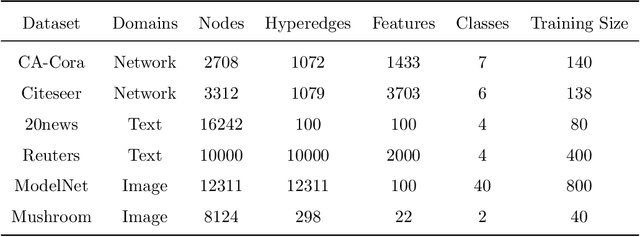
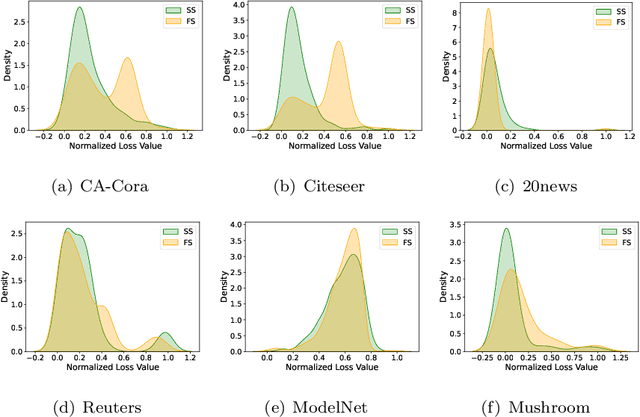
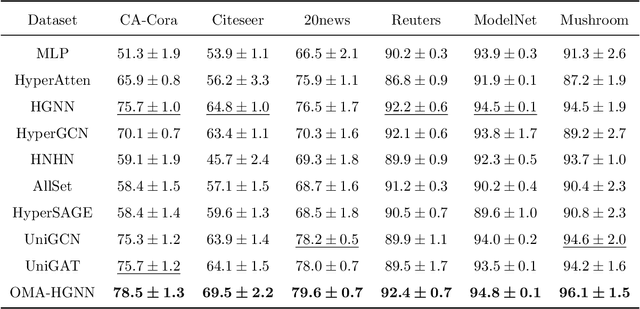
Although hypergraph neural networks (HGNNs) have emerged as a powerful framework for analyzing complex datasets, their practical performance often remains limited. On one hand, existing networks typically employ a single type of attention mechanism, focusing on either structural or feature similarities during message passing. On the other hand, assuming that all nodes in current hypergraph models have the same level of overlap may lead to suboptimal generalization. To overcome these limitations, we propose a novel framework, overlap-aware meta-learning attention for hypergraph neural networks (OMA-HGNN). First, we introduce a hypergraph attention mechanism that integrates both structural and feature similarities. Specifically, we linearly combine their respective losses with weighted factors for the HGNN model. Second, we partition nodes into different tasks based on their diverse overlap levels and develop a multi-task Meta-Weight-Net (MWN) to determine the corresponding weighted factors. Third, we jointly train the internal MWN model with the losses from the external HGNN model and train the external model with the weighted factors from the internal model. To evaluate the effectiveness of OMA-HGNN, we conducted experiments on six real-world datasets and benchmarked its perfor-mance against nine state-of-the-art methods for node classification. The results demonstrate that OMA-HGNN excels in learning superior node representations and outperforms these baselines.
VLSI Hypergraph Partitioning with Deep Learning
Sep 02, 2024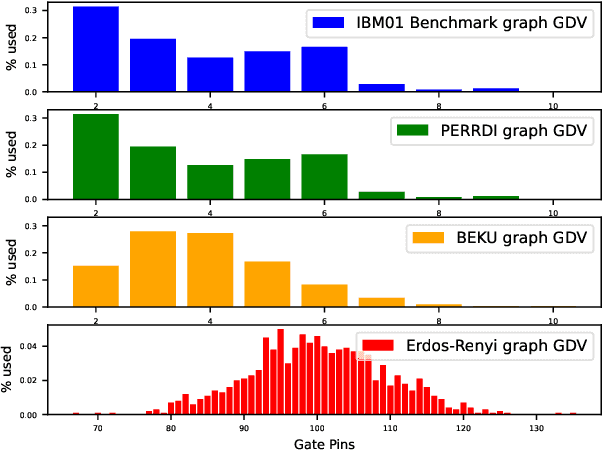
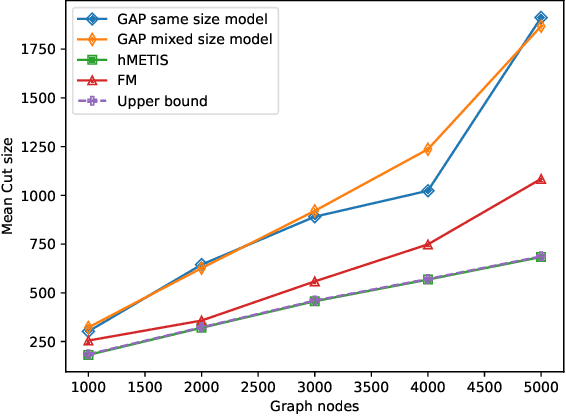
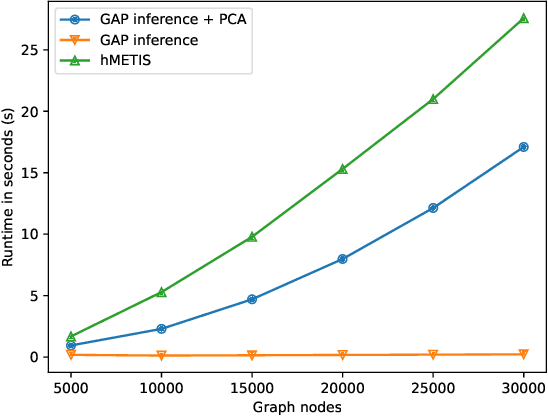
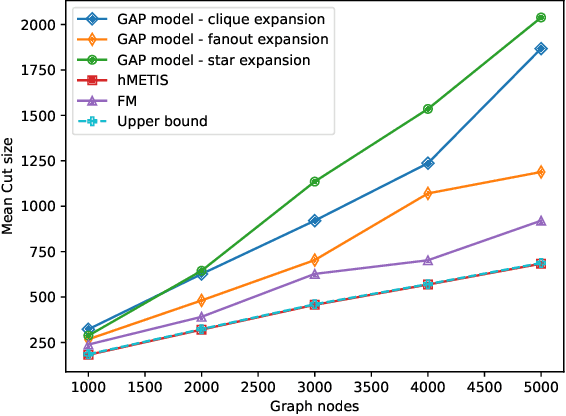
Partitioning is a known problem in computer science and is critical in chip design workflows, as advancements in this area can significantly influence design quality and efficiency. Deep Learning (DL) techniques, particularly those involving Graph Neural Networks (GNNs), have demonstrated strong performance in various node, edge, and graph prediction tasks using both inductive and transductive learning methods. A notable area of recent interest within GNNs are pooling layers and their application to graph partitioning. While these methods have yielded promising results across social, computational, and other random graphs, their effectiveness has not yet been explored in the context of VLSI hypergraph netlists. In this study, we introduce a new set of synthetic partitioning benchmarks that emulate real-world netlist characteristics and possess a known upper bound for solution cut quality. We distinguish these benchmarks with the prior work and evaluate existing state-of-the-art partitioning algorithms alongside GNN-based approaches, highlighting their respective advantages and disadvantages.
Hypergraphs as Weighted Directed Self-Looped Graphs: Spectral Properties, Clustering, Cheeger Inequality
Oct 23, 2024

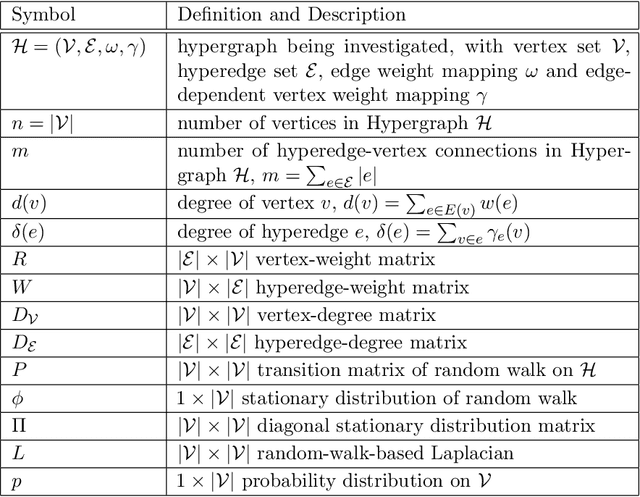

Hypergraphs naturally arise when studying group relations and have been widely used in the field of machine learning. There has not been a unified formulation of hypergraphs, yet the recently proposed edge-dependent vertex weights (EDVW) modeling is one of the most generalized modeling methods of hypergraphs, i.e., most existing hypergraphs can be formulated as EDVW hypergraphs without any information loss to the best of our knowledge. However, the relevant algorithmic developments on EDVW hypergraphs remain nascent: compared to spectral graph theories, the formulations are incomplete, the spectral clustering algorithms are not well-developed, and one result regarding hypergraph Cheeger Inequality is even incorrect. To this end, deriving a unified random walk-based formulation, we propose our definitions of hypergraph Rayleigh Quotient, NCut, boundary/cut, volume, and conductance, which are consistent with the corresponding definitions on graphs. Then, we prove that the normalized hypergraph Laplacian is associated with the NCut value, which inspires our HyperClus-G algorithm for spectral clustering on EDVW hypergraphs. Finally, we prove that HyperClus-G can always find an approximately linearly optimal partitioning in terms of Both NCut and conductance. Additionally, we provide extensive experiments to validate our theoretical findings from an empirical perspective.