 Add to Chrome
 Add to Firefox
 Add to Edge
Efficient Bayesian Deep Ensembles via Analytic Predictive Inference
Jul 07, 2026
We introduce an efficient Bayesian deep ensemble method for predictive regression designed to enhance interpretability while maintaining competitive predictive performance and computational efficiency. Our method combines the statistical rigor of Bayesian inference with the scalability of deep ensembles, providing calibrated uncertainty estimates that enable its use not only for standalone prediction but also as a component within broader learning systems. To achieve these goals, our work relies on three key design components: (i) low-dimensional ensemble representation: predictions are expressed as a combination of a small number of trained neural predictors, enabling scalable inference whose cost depends on ensemble size rather than dataset size; (ii) closed-form Bayesian aggregation: ensemble predictions are combined using Bayesian linear regression, yielding interpretable posterior weights and calibrated uncertainty without approximate inference; and (iii) Independent ensemble training: multiple neural networks are trained separately, producing diverse predictive representations that improve robustness and uncertainty calibration. Empirical results on standard regression benchmarks demonstrate that the proposed approach achieves competitive predictive performance while maintaining reliable uncertainty estimates across settings.

A New Decomposition Paradigm for Graph-structured Nonlinear Programs via Message Passing
Dec 31, 2025We study finite-sum nonlinear programs whose decision variables interact locally according to a graph or hypergraph. We propose MP-Jacobi (Message Passing-Jacobi), a graph-compliant decentralized framework that couples min-sum message passing with Jacobi block updates. The (hyper)graph is partitioned into tree clusters. At each iteration, agents update in parallel by solving a cluster subproblem whose objective decomposes into (i) an intra-cluster term evaluated by a single min-sum sweep on the cluster tree (cost-to-go messages) and (ii) inter-cluster couplings handled via a Jacobi correction using neighbors' latest iterates. This design uses only single-hop communication and yields a convergent message-passing method on loopy graphs. For strongly convex objectives we establish global linear convergence and explicit rates that quantify how curvature, coupling strength, and the chosen partition affect scalability and provide guidance for clustering. To mitigate the computation and communication cost of exact message updates, we develop graph-compliant surrogates that preserve convergence while reducing per-iteration complexity. We further extend MP-Jacobi to hypergraphs; in heavily overlapping regimes, a surrogate-based hyperedge-splitting scheme restores finite-time intra-cluster message updates and maintains convergence. Experiments validate the theory and show consistent improvements over decentralized gradient baselines.
High-Dimensional Inference over Networks: Linear Convergence and Statistical Guarantees
Jan 21, 2022

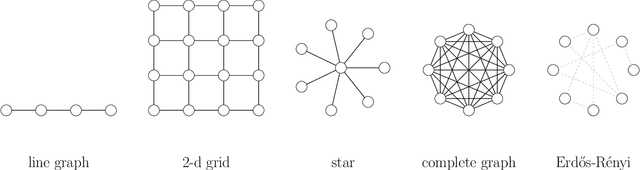

We study sparse linear regression over a network of agents, modeled as an undirected graph and no server node. The estimation of the $s$-sparse parameter is formulated as a constrained LASSO problem wherein each agent owns a subset of the $N$ total observations. We analyze the convergence rate and statistical guarantees of a distributed projected gradient tracking-based algorithm under high-dimensional scaling, allowing the ambient dimension $d$ to grow with (and possibly exceed) the sample size $N$. Our theory shows that, under standard notions of restricted strong convexity and smoothness of the loss functions, suitable conditions on the network connectivity and algorithm tuning, the distributed algorithm converges globally at a {\it linear} rate to an estimate that is within the centralized {\it statistical precision} of the model, $O(s\log d/N)$. When $s\log d/N=o(1)$, a condition necessary for statistical consistency, an $\varepsilon$-optimal solution is attained after $\mathcal{O}(\kappa \log (1/\varepsilon))$ gradient computations and $O (\kappa/(1-\rho) \log (1/\varepsilon))$ communication rounds, where $\kappa$ is the restricted condition number of the loss function and $\rho$ measures the network connectivity. The computation cost matches that of the centralized projected gradient algorithm despite having data distributed; whereas the communication rounds reduce as the network connectivity improves. Overall, our study reveals interesting connections between statistical efficiency, network connectivity \& topology, and convergence rate in high dimensions.