 Add to Chrome
 Add to Firefox
 Add to Edge
Gloss Free Sign Language Translation
Papers and Code
EASLT: Emotion-Aware Sign Language Translation
Jan 07, 2026
Sign Language Translation (SLT) is a complex cross-modal task requiring the integration of Manual Signals (MS) and Non-Manual Signals (NMS). While recent gloss-free SLT methods have made strides in translating manual gestures, they frequently overlook the semantic criticality of facial expressions, resulting in ambiguity when distinct concepts share identical manual articulations. To address this, we present **EASLT** (**E**motion-**A**ware **S**ign **L**anguage **T**ranslation), a framework that treats facial affect not as auxiliary information, but as a robust semantic anchor. Unlike methods that relegate facial expressions to a secondary role, EASLT incorporates a dedicated emotional encoder to capture continuous affective dynamics. These representations are integrated via a novel *Emotion-Aware Fusion* (EAF) module, which adaptively recalibrates spatio-temporal sign features based on affective context to resolve semantic ambiguities. Extensive evaluations on the PHOENIX14T and CSL-Daily benchmarks demonstrate that EASLT establishes advanced performance among gloss-free methods, achieving BLEU-4 scores of 26.15 and 22.80, and BLEURT scores of 61.0 and 57.8, respectively. Ablation studies confirm that explicitly modeling emotion effectively decouples affective semantics from manual dynamics, significantly enhancing translation fidelity. Code is available at https://github.com/TuGuobin/EASLT.

RVLF: A Reinforcing Vision-Language Framework for Gloss-Free Sign Language Translation
Dec 08, 2025Gloss-free sign language translation (SLT) is hindered by two key challenges: **inadequate sign representation** that fails to capture nuanced visual cues, and **sentence-level semantic misalignment** in current LLM-based methods, which limits translation quality. To address these issues, we propose a three-stage **r**einforcing **v**ision-**l**anguage **f**ramework (**RVLF**). We build a large vision-language model (LVLM) specifically designed for sign language, and then combine it with reinforcement learning (RL) to adaptively enhance translation performance. First, for a sufficient representation of sign language, RVLF introduces an effective semantic representation learning mechanism that fuses skeleton-based motion cues with semantically rich visual features extracted via DINOv2, followed by instruction tuning to obtain a strong SLT-SFT baseline. Then, to improve sentence-level semantic misalignment, we introduce a GRPO-based optimization strategy that fine-tunes the SLT-SFT model with a reward function combining translation fidelity (BLEU) and sentence completeness (ROUGE), yielding the optimized model termed SLT-GRPO. Our conceptually simple framework yields substantial gains under the gloss-free SLT setting without pre-training on any external large-scale sign language datasets, improving BLEU-4 scores by +5.1, +1.11, +1.4, and +1.61 on the CSL-Daily, PHOENIX-2014T, How2Sign, and OpenASL datasets, respectively. To the best of our knowledge, this is the first work to incorporate GRPO into SLT. Extensive experiments and ablation studies validate the effectiveness of GRPO-based optimization in enhancing both translation quality and semantic consistency.
Beyond Gloss: A Hand-Centric Framework for Gloss-Free Sign Language Translation
Jul 31, 2025Sign Language Translation (SLT) is a challenging task that requires bridging the modality gap between visual and linguistic information while capturing subtle variations in hand shapes and movements. To address these challenges, we introduce \textbf{BeyondGloss}, a novel gloss-free SLT framework that leverages the spatio-temporal reasoning capabilities of Video Large Language Models (VideoLLMs). Since existing VideoLLMs struggle to model long videos in detail, we propose a novel approach to generate fine-grained, temporally-aware textual descriptions of hand motion. A contrastive alignment module aligns these descriptions with video features during pre-training, encouraging the model to focus on hand-centric temporal dynamics and distinguish signs more effectively. To further enrich hand-specific representations, we distill fine-grained features from HaMeR. Additionally, we apply a contrastive loss between sign video representations and target language embeddings to reduce the modality gap in pre-training. \textbf{BeyondGloss} achieves state-of-the-art performance on the Phoenix14T and CSL-Daily benchmarks, demonstrating the effectiveness of the proposed framework. We will release the code upon acceptance of the paper.
Hierarchical Feature Alignment for Gloss-Free Sign Language Translation
Jul 09, 2025Sign Language Translation (SLT) attempts to convert sign language videos into spoken sentences. However, many existing methods struggle with the disparity between visual and textual representations during end-to-end learning. Gloss-based approaches help to bridge this gap by leveraging structured linguistic information. While, gloss-free methods offer greater flexibility and remove the burden of annotation, they require effective alignment strategies. Recent advances in Large Language Models (LLMs) have enabled gloss-free SLT by generating text-like representations from sign videos. In this work, we introduce a novel hierarchical pre-training strategy inspired by the structure of sign language, incorporating pseudo-glosses and contrastive video-language alignment. Our method hierarchically extracts features at frame, segment, and video levels, aligning them with pseudo-glosses and the spoken sentence to enhance translation quality. Experiments demonstrate that our approach improves BLEU-4 and ROUGE scores while maintaining efficiency.
Multilingual Gloss-free Sign Language Translation: Towards Building a Sign Language Foundation Model
May 30, 2025Sign Language Translation (SLT) aims to convert sign language (SL) videos into spoken language text, thereby bridging the communication gap between the sign and the spoken community. While most existing works focus on translating a single sign language into a single spoken language (one-to-one SLT), leveraging multilingual resources could mitigate low-resource issues and enhance accessibility. However, multilingual SLT (MLSLT) remains unexplored due to language conflicts and alignment difficulties across SLs and spoken languages. To address these challenges, we propose a multilingual gloss-free model with dual CTC objectives for token-level SL identification and spoken text generation. Our model supports 10 SLs and handles one-to-one, many-to-one, and many-to-many SLT tasks, achieving competitive performance compared to state-of-the-art methods on three widely adopted benchmarks: multilingual SP-10, PHOENIX14T, and CSL-Daily.
Exploring Pose-based Sign Language Translation: Ablation Studies and Attention Insights
Jul 02, 2025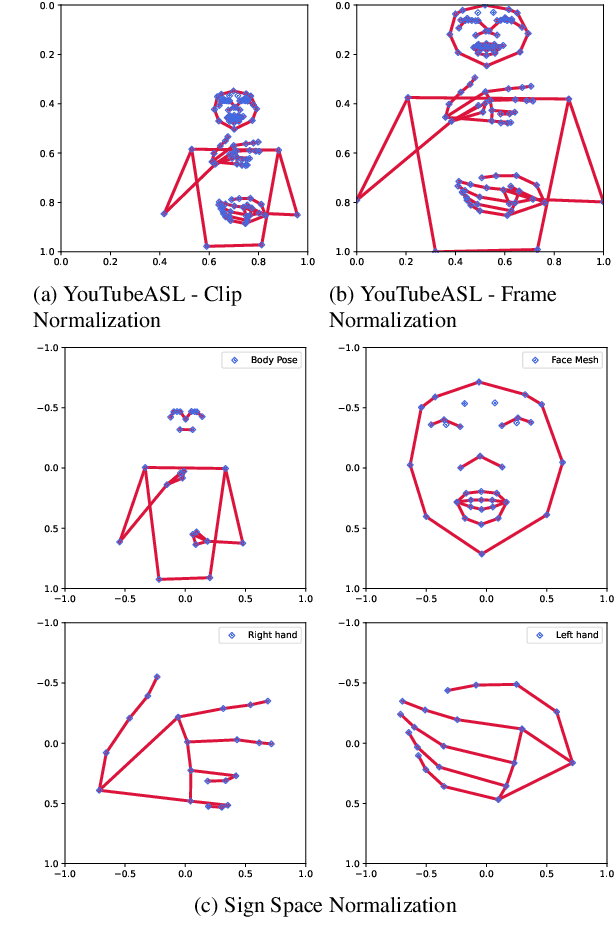
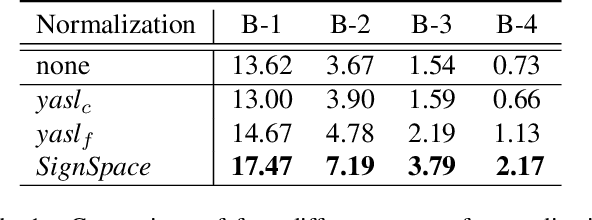
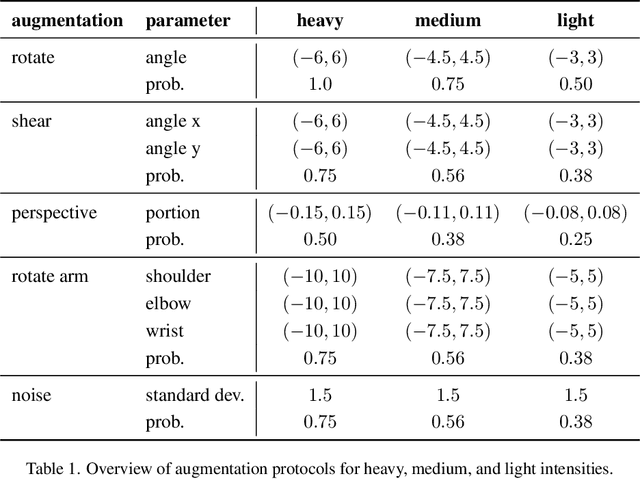
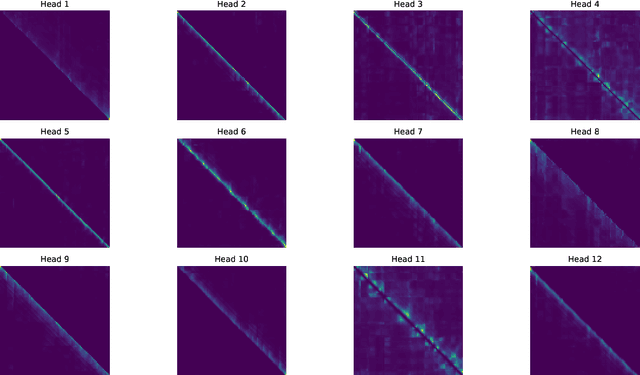
Sign Language Translation (SLT) has evolved significantly, moving from isolated recognition approaches to complex, continuous gloss-free translation systems. This paper explores the impact of pose-based data preprocessing techniques - normalization, interpolation, and augmentation - on SLT performance. We employ a transformer-based architecture, adapting a modified T5 encoder-decoder model to process pose representations. Through extensive ablation studies on YouTubeASL and How2Sign datasets, we analyze how different preprocessing strategies affect translation accuracy. Our results demonstrate that appropriate normalization, interpolation, and augmentation techniques can significantly improve model robustness and generalization abilities. Additionally, we provide a deep analysis of the model's attentions and reveal interesting behavior suggesting that adding a dedicated register token can improve overall model performance. We publish our code on our GitHub repository, including the preprocessed YouTubeASL data.
Bridging Sign and Spoken Languages: Pseudo Gloss Generation for Sign Language Translation
May 21, 2025Sign Language Translation (SLT) aims to map sign language videos to spoken language text. A common approach relies on gloss annotations as an intermediate representation, decomposing SLT into two sub-tasks: video-to-gloss recognition and gloss-to-text translation. While effective, this paradigm depends on expert-annotated gloss labels, which are costly and rarely available in existing datasets, limiting its scalability. To address this challenge, we propose a gloss-free pseudo gloss generation framework that eliminates the need for human-annotated glosses while preserving the structured intermediate representation. Specifically, we prompt a Large Language Model (LLM) with a few example text-gloss pairs using in-context learning to produce draft sign glosses from spoken language text. To enhance the correspondence between LLM-generated pseudo glosses and the sign sequences in video, we correct the ordering in the pseudo glosses for better alignment via a weakly supervised learning process. This reordering facilitates the incorporation of auxiliary alignment objectives, and allows for the use of efficient supervision via a Connectionist Temporal Classification (CTC) loss. We train our SLT mode, which consists of a vision encoder and a translator, through a three-stage pipeline, which progressively narrows the modality gap between sign language and spoken language. Despite its simplicity, our approach outperforms previous state-of-the-art gloss-free frameworks on two SLT benchmarks and achieves competitive results compared to gloss-based methods.
Leveraging the Power of MLLMs for Gloss-Free Sign Language Translation
Nov 25, 2024Sign language translation (SLT) is a challenging task that involves translating sign language images into spoken language. For SLT models to perform this task successfully, they must bridge the modality gap and identify subtle variations in sign language components to understand their meanings accurately. To address these challenges, we propose a novel gloss-free SLT framework called Multimodal Sign Language Translation (MMSLT), which leverages the representational capabilities of off-the-shelf multimodal large language models (MLLMs). Specifically, we generate detailed textual descriptions of sign language components using MLLMs. Then, through our proposed multimodal-language pre-training module, we integrate these description features with sign video features to align them within the spoken sentence space. Our approach achieves state-of-the-art performance on benchmark datasets PHOENIX14T and CSL-Daily, highlighting the potential of MLLMs to be effectively utilized in SLT.
DiffSLT: Enhancing Diversity in Sign Language Translation via Diffusion Model
Nov 26, 2024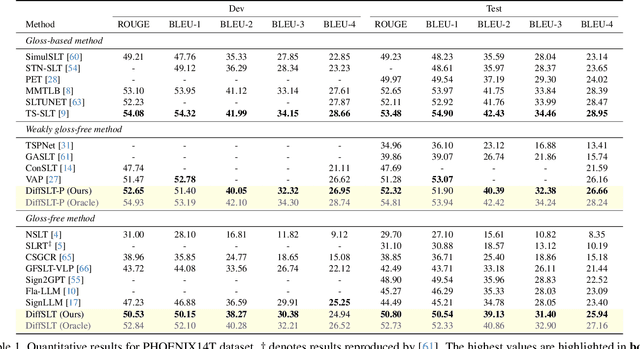

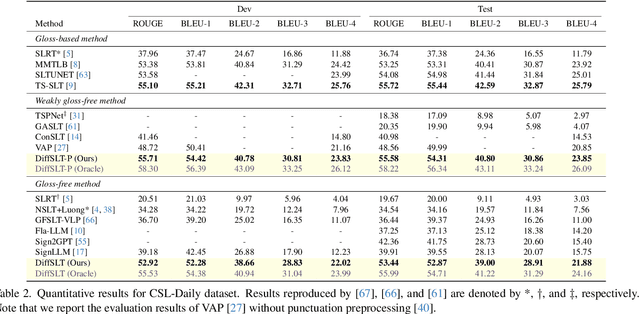
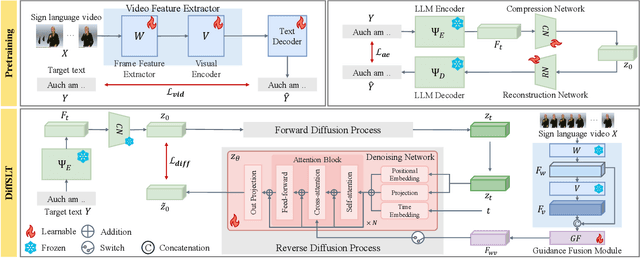
Sign language translation (SLT) is challenging, as it involves converting sign language videos into natural language. Previous studies have prioritized accuracy over diversity. However, diversity is crucial for handling lexical and syntactic ambiguities in machine translation, suggesting it could similarly benefit SLT. In this work, we propose DiffSLT, a novel gloss-free SLT framework that leverages a diffusion model, enabling diverse translations while preserving sign language semantics. DiffSLT transforms random noise into the target latent representation, conditioned on the visual features of input video. To enhance visual conditioning, we design Guidance Fusion Module, which fully utilizes the multi-level spatiotemporal information of the visual features. We also introduce DiffSLT-P, a DiffSLT variant that conditions on pseudo-glosses and visual features, providing key textual guidance and reducing the modality gap. As a result, DiffSLT and DiffSLT-P significantly improve diversity over previous gloss-free SLT methods and achieve state-of-the-art performance on two SLT datasets, thereby markedly improving translation quality.
Signformer is all you need: Towards Edge AI for Sign Language
Nov 19, 2024Sign language translation, especially in gloss-free paradigm, is confronting a dilemma of impracticality and unsustainability due to growing resource-intensive methodologies. Contemporary state-of-the-arts (SOTAs) have significantly hinged on pretrained sophiscated backbones such as Large Language Models (LLMs), embedding sources, or extensive datasets, inducing considerable parametric and computational inefficiency for sustainable use in real-world scenario. Despite their success, following this research direction undermines the overarching mission of this domain to create substantial value to bridge hard-hearing and common populations. Committing to the prevailing trend of LLM and Natural Language Processing (NLP) studies, we pursue a profound essential change in architecture to achieve ground-up improvements without external aid from pretrained models, prior knowledge transfer, or any NLP strategies considered not-from-scratch. Introducing Signformer, a from-scratch Feather-Giant transforming the area towards Edge AI that redefines extremities of performance and efficiency with LLM-competence and edgy-deployable compactness. In this paper, we present nature analysis of sign languages to inform our algorithmic design and deliver a scalable transformer pipeline with convolution and attention novelty. We achieve new 2nd place on leaderboard with a parametric reduction of 467-1807x against the finests as of 2024 and outcompete almost every other methods in a lighter configuration of 0.57 million parameters.