 Add to Chrome
 Add to Firefox
 Add to Edge
PointCSP: Cross-Sample Semantic Propagation and Stability Preservation in Self-Supervised Point Cloud Learning
May 03, 2026
Scene-level point cloud self-supervised learning (PC-SSL) has demonstrated potential in enhancing the generalization capability of 3D vision models. Despite the advances in the field through existing methods, the sample-independent modeling paradigm still poses significant limitations in terms of maintaining consistent semantic representations across scenes. This challenge hinders the construction of a unified and transferable semantic space. To address this issue, we propose a PC-SSL framework based on cross-sample semantic propagation (CSP), in which samples within a batch are serialized into continuous input and processed by a state-space model to enable semantic state propagation. This mechanism explicitly models the dynamic dependencies across samples in the state space, allowing the network to establish cross-sample semantic consistency in the latent space and achieve global semantic alignment. Since serialization-based pretraining requires batch-level input organization, we further introduce an asymmetric semantic preservation distillation (SPD) during finetuning to achieve structural alignment of semantic transfer and eliminate inconsistencies caused by batch dependency. The proposed SPD ensures stable transfer of pretrained semantics through a heterogeneous input mechanism and a semantic feature alignment constraint. This enables the model to maintain structured semantic consistency and robustness under single-scene testing conditions. Extensive experiments on multiple benchmark datasets demonstrate that our method consistently outperforms state-of-the-art methods in both performance and semantic consistency.

RVLF: A Reinforcing Vision-Language Framework for Gloss-Free Sign Language Translation
Dec 08, 2025Gloss-free sign language translation (SLT) is hindered by two key challenges: **inadequate sign representation** that fails to capture nuanced visual cues, and **sentence-level semantic misalignment** in current LLM-based methods, which limits translation quality. To address these issues, we propose a three-stage **r**einforcing **v**ision-**l**anguage **f**ramework (**RVLF**). We build a large vision-language model (LVLM) specifically designed for sign language, and then combine it with reinforcement learning (RL) to adaptively enhance translation performance. First, for a sufficient representation of sign language, RVLF introduces an effective semantic representation learning mechanism that fuses skeleton-based motion cues with semantically rich visual features extracted via DINOv2, followed by instruction tuning to obtain a strong SLT-SFT baseline. Then, to improve sentence-level semantic misalignment, we introduce a GRPO-based optimization strategy that fine-tunes the SLT-SFT model with a reward function combining translation fidelity (BLEU) and sentence completeness (ROUGE), yielding the optimized model termed SLT-GRPO. Our conceptually simple framework yields substantial gains under the gloss-free SLT setting without pre-training on any external large-scale sign language datasets, improving BLEU-4 scores by +5.1, +1.11, +1.4, and +1.61 on the CSL-Daily, PHOENIX-2014T, How2Sign, and OpenASL datasets, respectively. To the best of our knowledge, this is the first work to incorporate GRPO into SLT. Extensive experiments and ablation studies validate the effectiveness of GRPO-based optimization in enhancing both translation quality and semantic consistency.
Rethinking Visual Dependency in Long-Context Reasoning for Large Vision-Language Models
Oct 25, 2024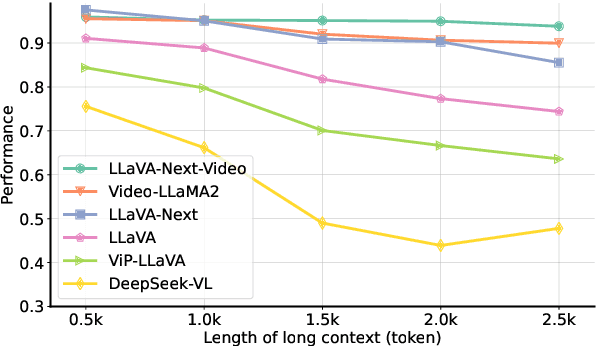
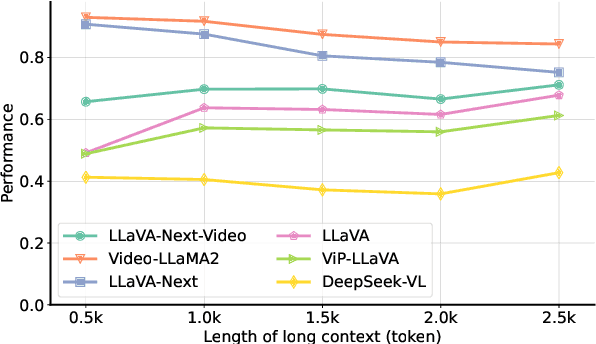
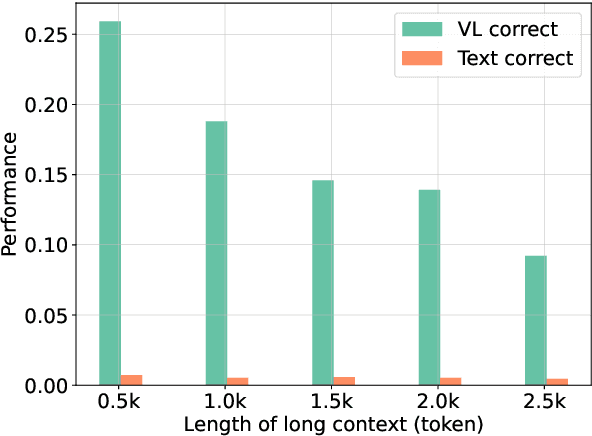
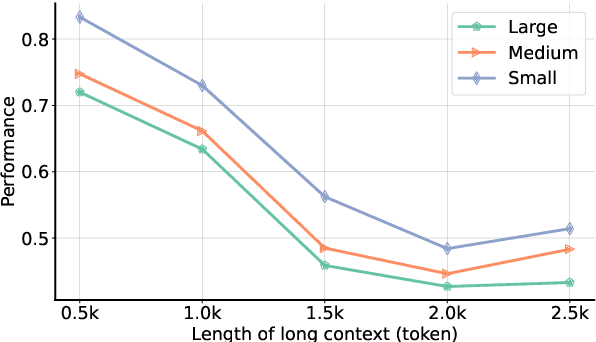
Large Vision-Language Models (LVLMs) excel in cross-model tasks but experience performance declines in long-context reasoning due to overreliance on textual information and reduced visual dependency. In this study, we empirically analyze LVLMs in long-context reasoning, revealing that increased context length leads to a higher dependence on language at the expense of visual dependency. To address this issue, we propose a novel training-free context pruning method that selectively removes less critical textual information. Our approach enhances visual dependency and reduces textual noise, thereby improving LVLM performance in long-context reasoning. We validate our method by constructing a long-context dataset, demonstrating its effectiveness across various LVLMs. Moreover, further analysis confirms the robustness of different token pruning strategies and preliminary explores scaling laws between pruning rates and context length.