 Add to Chrome
 Add to Firefox
 Add to Edge
Sign Language Recognition in the Age of LLMs
Apr 13, 2026
Recent Vision Language Models (VLMs) have demonstrated strong performance across a wide range of multimodal reasoning tasks. This raises the question of whether such general-purpose models can also address specialized visual recognition problems such as isolated sign language recognition (ISLR) without task-specific training. In this work, we investigate the capability of modern VLMs to perform ISLR in a zero-shot setting. We evaluate several open-source and proprietary VLMs on the WLASL300 benchmark. Our experiments show that, under prompt-only zero-shot inference, current open-source VLMs remain far behind classic supervised ISLR classifiers by a wide margin. However, follow-up experiments reveal that these models capture partial visual-semantic alignment between signs and text descriptions. Larger proprietary models achieve substantially higher accuracy, highlighting the importance of model scale and training data diversity. All our code is publicly available on GitHub.

Beyond a Single Reference: Training and Evaluation with Paraphrases in Sign Language Translation
Jan 29, 2026Most Sign Language Translation (SLT) corpora pair each signed utterance with a single written-language reference, despite the highly non-isomorphic relationship between sign and spoken languages, where multiple translations can be equally valid. This limitation constrains both model training and evaluation, particularly for n-gram-based metrics such as BLEU. In this work, we investigate the use of Large Language Models to automatically generate paraphrased variants of written-language translations as synthetic alternative references for SLT. First, we compare multiple paraphrasing strategies and models using an adapted ParaScore metric. Second, we study the impact of paraphrases on both training and evaluation of the pose-based T5 model on the YouTubeASL and How2Sign datasets. Our results show that naively incorporating paraphrases during training does not improve translation performance and can even be detrimental. In contrast, using paraphrases during evaluation leads to higher automatic scores and better alignment with human judgments. To formalize this observation, we introduce BLEUpara, an extension of BLEU that evaluates translations against multiple paraphrased references. Human evaluation confirms that BLEUpara correlates more strongly with perceived translation quality. We release all generated paraphrases, generation and evaluation code to support reproducible and more reliable evaluation of SLT systems.
Soiling detection for Advanced Driver Assistance Systems
Nov 12, 2025Soiling detection for automotive cameras is a crucial part of advanced driver assistance systems to make them more robust to external conditions like weather, dust, etc. In this paper, we regard the soiling detection as a semantic segmentation problem. We provide a comprehensive comparison of popular segmentation methods and show their superiority in performance while comparing them to tile-level classification approaches. Moreover, we present an extensive analysis of the Woodscape dataset showing that the original dataset contains a data-leakage and imprecise annotations. To address these problems, we create a new data subset, which, despite being much smaller, provides enough information for the segmentation method to reach comparable results in a much shorter time. All our codes and dataset splits are available at https://github.com/filipberanek/woodscape_revision.
Pandar128 dataset for lane line detection
Nov 10, 2025We present Pandar128, the largest public dataset for lane line detection using a 128-beam LiDAR. It contains over 52,000 camera frames and 34,000 LiDAR scans, captured in diverse real-world conditions in Germany. The dataset includes full sensor calibration (intrinsics, extrinsics) and synchronized odometry, supporting tasks such as projection, fusion, and temporal modeling. To complement the dataset, we also introduce SimpleLidarLane, a light-weight baseline method for lane line reconstruction that combines BEV segmentation, clustering, and polyline fitting. Despite its simplicity, our method achieves strong performance under challenging various conditions (e.g., rain, sparse returns), showing that modular pipelines paired with high-quality data and principled evaluation can compete with more complex approaches. Furthermore, to address the lack of standardized evaluation, we propose a novel polyline-based metric - Interpolation-Aware Matching F1 (IAM-F1) - that employs interpolation-aware lateral matching in BEV space. All data and code are publicly released to support reproducibility in LiDAR-based lane detection.
Exploring Pose-based Sign Language Translation: Ablation Studies and Attention Insights
Jul 02, 2025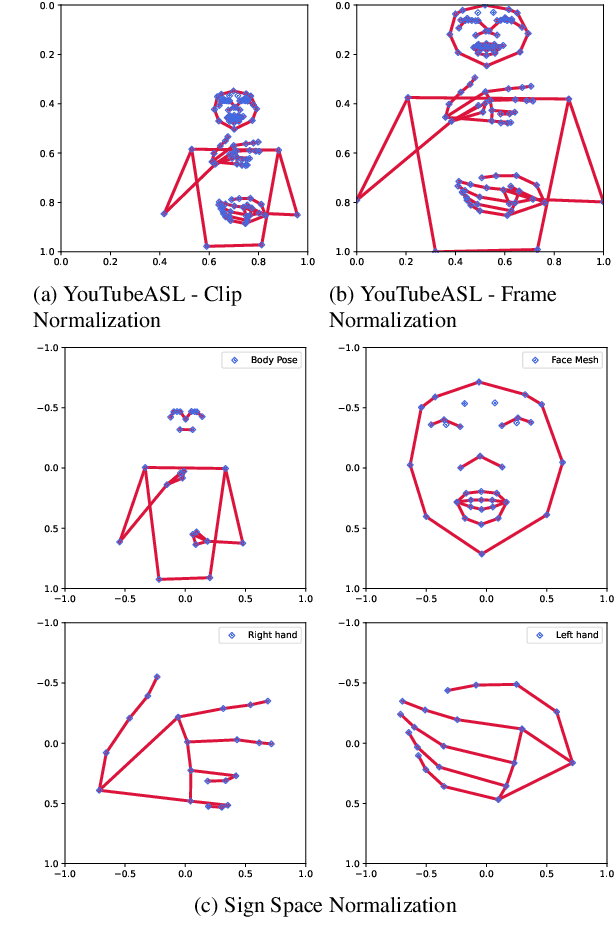
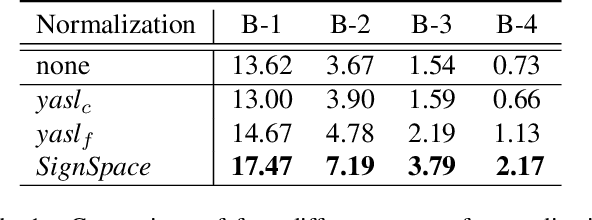
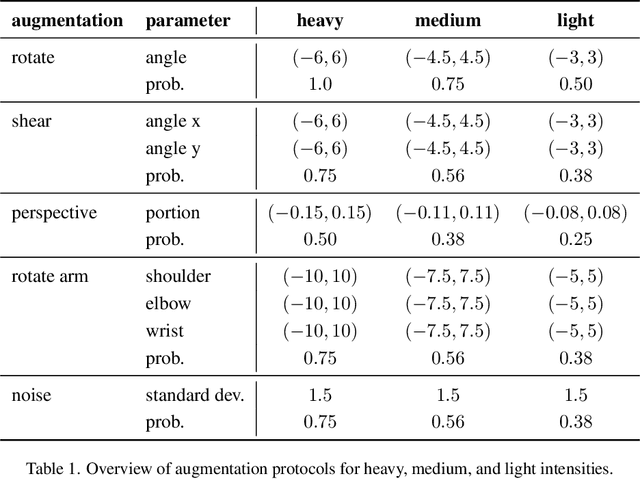
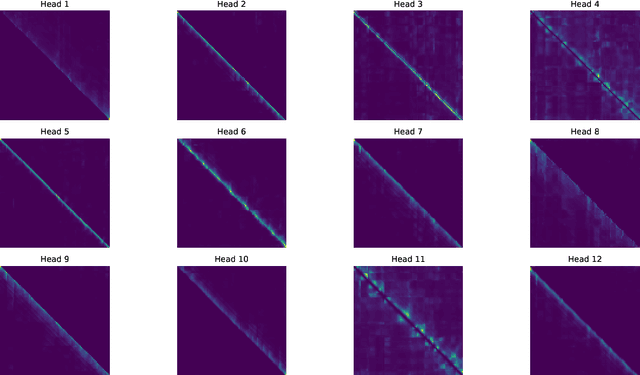
Sign Language Translation (SLT) has evolved significantly, moving from isolated recognition approaches to complex, continuous gloss-free translation systems. This paper explores the impact of pose-based data preprocessing techniques - normalization, interpolation, and augmentation - on SLT performance. We employ a transformer-based architecture, adapting a modified T5 encoder-decoder model to process pose representations. Through extensive ablation studies on YouTubeASL and How2Sign datasets, we analyze how different preprocessing strategies affect translation accuracy. Our results demonstrate that appropriate normalization, interpolation, and augmentation techniques can significantly improve model robustness and generalization abilities. Additionally, we provide a deep analysis of the model's attentions and reveal interesting behavior suggesting that adding a dedicated register token can improve overall model performance. We publish our code on our GitHub repository, including the preprocessed YouTubeASL data.