 Add to Chrome
 Add to Firefox
 Add to Edge
Gait Identification
Papers and Code
Affinity Contrastive Learning for Skeleton-based Human Activity Understanding
Jan 23, 2026
In skeleton-based human activity understanding, existing methods often adopt the contrastive learning paradigm to construct a discriminative feature space. However, many of these approaches fail to exploit the structural inter-class similarities and overlook the impact of anomalous positive samples. In this study, we introduce ACLNet, an Affinity Contrastive Learning Network that explores the intricate clustering relationships among human activity classes to improve feature discrimination. Specifically, we propose an affinity metric to refine similarity measurements, thereby forming activity superclasses that provide more informative contrastive signals. A dynamic temperature schedule is also introduced to adaptively adjust the penalty strength for various superclasses. In addition, we employ a margin-based contrastive strategy to improve the separation of hard positive and negative samples within classes. Extensive experiments on NTU RGB+D 60, NTU RGB+D 120, Kinetics-Skeleton, PKU-MMD, FineGYM, and CASIA-B demonstrate the superiority of our method in skeleton-based action recognition, gait recognition, and person re-identification. The source code is available at https://github.com/firework8/ACLNet.
* Accepted by TBIOM

Why Commodity WiFi Sensors Fail at Multi-Person Gait Identification: A Systematic Analysis Using ESP32
Jan 05, 2026WiFi Channel State Information (CSI) has shown promise for single-person gait identification, with numerous studies reporting high accuracy. However, multi-person identification remains largely unexplored, with the limited existing work relying on complex, expensive setups requiring modified firmware. A critical question remains unanswered: is poor multi-person performance an algorithmic limitation or a fundamental hardware constraint? We systematically evaluate six diverse signal separation methods (FastICA, SOBI, PCA, NMF, Wavelet, Tensor Decomposition) across seven scenarios with 1-10 people using commodity ESP32 WiFi sensors--a simple, low-cost, off-the-shelf solution. Through novel diagnostic metrics (intra-subject variability, inter-subject distinguishability, performance degradation rate), we reveal that all methods achieve similarly low accuracy (45-56\%, $σ$=3.74\%) with statistically insignificant differences (p $>$ 0.05). Even the best-performing method, NMF, achieves only 56\% accuracy. Our analysis reveals high intra-subject variability, low inter-subject distinguishability, and severe performance degradation as person count increases, indicating that commodity ESP32 sensors cannot provide sufficient signal quality for reliable multi-person separation.
Towards Radar-Agnostic Gait Analysis Across UWB and FMCW Systems
Jan 07, 2026Radar sensing has emerged in recent years as a promising solution for unobtrusive and continuous in-home gait monitoring. This study evaluates whether a unified processing framework can be applied to radar-based spatiotemporal gait analysis independent of radar modality. The framework is validated using collocated impulse-radio ultra-wideband (IR-UWB) and frequency-modulated continuous-wave (FMCW) radars under identical processing settings, without modality-specific tuning, during repeated overground walking trials with 10 healthy participants. A modality-independent approach for automatic walking-segment identification is also introduced to ensure fair and reproducible modality performance assessment. Clinically relevant spatiotemporal gait parameters, including stride time, stride length, walking speed, swing time, and stance time, extracted from each modality were compared against gold-standard motion capture reference estimates. Across all parameters, both radar modalities achieved comparably high mean estimation accuracy in the range of 85-98%, with inter-modality differences remaining below 4.1%, resulting in highly overlapping accuracy distributions. Correlation and Bland-Altman analyses revealed minimal bias, comparable limits of agreement, and strong agreement with reference estimates, while intraclass correlation analysis demonstrated high consistency between radar modalities. These findings indicate that no practically meaningful performance differences arise from radar modality when using a shared processing framework, supporting the feasibility of radar-agnostic gait analysis systems.
Is Visual Realism Enough? Evaluating Gait Biometric Fidelity in Generative AI Human Animation
Dec 22, 2025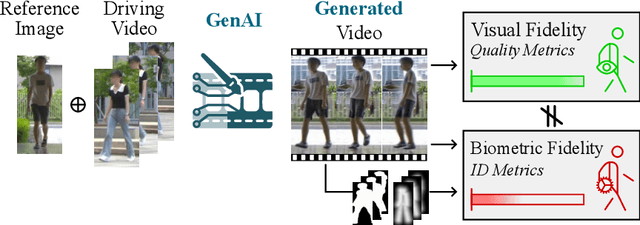

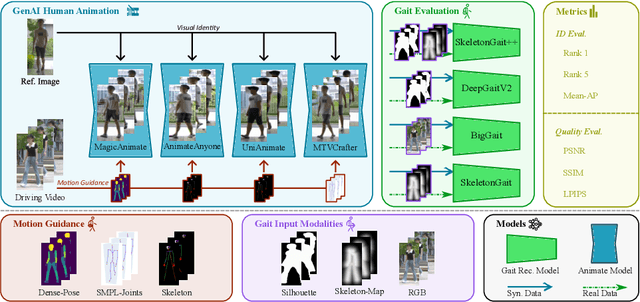
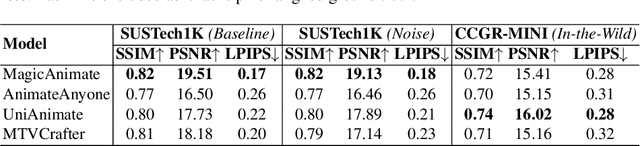
Generative AI (GenAI) models have revolutionized animation, enabling the synthesis of humans and motion patterns with remarkable visual fidelity. However, generating truly realistic human animation remains a formidable challenge, where even minor inconsistencies can make a subject appear unnatural. This limitation is particularly critical when AI-generated videos are evaluated for behavioral biometrics, where subtle motion cues that define identity are easily lost or distorted. The present study investigates whether state-of-the-art GenAI human animation models can preserve the subtle spatio-temporal details needed for person identification through gait biometrics. Specifically, we evaluate four different GenAI models across two primary evaluation tasks to assess their ability to i) restore gait patterns from reference videos under varying conditions of complexity, and ii) transfer these gait patterns to different visual identities. Our results show that while visual quality is mostly high, biometric fidelity remains low in tasks focusing on identification, suggesting that current GenAI models struggle to disentangle identity from motion. Furthermore, through an identity transfer task, we expose a fundamental flaw in appearance-based gait recognition: when texture is disentangled from motion, identification collapses, proving current GenAI models rely on visual attributes rather than temporal dynamics.
DINOv2 Driven Gait Representation Learning for Video-Based Visible-Infrared Person Re-identification
Nov 06, 2025Video-based Visible-Infrared person re-identification (VVI-ReID) aims to retrieve the same pedestrian across visible and infrared modalities from video sequences. Existing methods tend to exploit modality-invariant visual features but largely overlook gait features, which are not only modality-invariant but also rich in temporal dynamics, thus limiting their ability to model the spatiotemporal consistency essential for cross-modal video matching. To address these challenges, we propose a DINOv2-Driven Gait Representation Learning (DinoGRL) framework that leverages the rich visual priors of DINOv2 to learn gait features complementary to appearance cues, facilitating robust sequence-level representations for cross-modal retrieval. Specifically, we introduce a Semantic-Aware Silhouette and Gait Learning (SASGL) model, which generates and enhances silhouette representations with general-purpose semantic priors from DINOv2 and jointly optimizes them with the ReID objective to achieve semantically enriched and task-adaptive gait feature learning. Furthermore, we develop a Progressive Bidirectional Multi-Granularity Enhancement (PBMGE) module, which progressively refines feature representations by enabling bidirectional interactions between gait and appearance streams across multiple spatial granularities, fully leveraging their complementarity to enhance global representations with rich local details and produce highly discriminative features. Extensive experiments on HITSZ-VCM and BUPT datasets demonstrate the superiority of our approach, significantly outperforming existing state-of-the-art methods.
GaitSnippet: Gait Recognition Beyond Unordered Sets and Ordered Sequences
Aug 11, 2025Recent advancements in gait recognition have significantly enhanced performance by treating silhouettes as either an unordered set or an ordered sequence. However, both set-based and sequence-based approaches exhibit notable limitations. Specifically, set-based methods tend to overlook short-range temporal context for individual frames, while sequence-based methods struggle to capture long-range temporal dependencies effectively. To address these challenges, we draw inspiration from human identification and propose a new perspective that conceptualizes human gait as a composition of individualized actions. Each action is represented by a series of frames, randomly selected from a continuous segment of the sequence, which we term a snippet. Fundamentally, the collection of snippets for a given sequence enables the incorporation of multi-scale temporal context, facilitating more comprehensive gait feature learning. Moreover, we introduce a non-trivial solution for snippet-based gait recognition, focusing on Snippet Sampling and Snippet Modeling as key components. Extensive experiments on four widely-used gait datasets validate the effectiveness of our proposed approach and, more importantly, highlight the potential of gait snippets. For instance, our method achieves the rank-1 accuracy of 77.5% on Gait3D and 81.7% on GREW using a 2D convolution-based backbone.
HAMoBE: Hierarchical and Adaptive Mixture of Biometric Experts for Video-based Person ReID
Aug 07, 2025Recently, research interest in person re-identification (ReID) has increasingly focused on video-based scenarios, which are essential for robust surveillance and security in varied and dynamic environments. However, existing video-based ReID methods often overlook the necessity of identifying and selecting the most discriminative features from both videos in a query-gallery pair for effective matching. To address this issue, we propose a novel Hierarchical and Adaptive Mixture of Biometric Experts (HAMoBE) framework, which leverages multi-layer features from a pre-trained large model (e.g., CLIP) and is designed to mimic human perceptual mechanisms by independently modeling key biometric features--appearance, static body shape, and dynamic gait--and adaptively integrating them. Specifically, HAMoBE includes two levels: the first level extracts low-level features from multi-layer representations provided by the frozen large model, while the second level consists of specialized experts focusing on long-term, short-term, and temporal features. To ensure robust matching, we introduce a new dual-input decision gating network that dynamically adjusts the contributions of each expert based on their relevance to the input scenarios. Extensive evaluations on benchmarks like MEVID demonstrate that our approach yields significant performance improvements (e.g., +13.0% Rank-1 accuracy).
OptiGait-LGBM: An Efficient Approach of Gait-based Person Re-identification in Non-Overlapping Regions
May 10, 2025Gait recognition, known for its ability to identify individuals from a distance, has gained significant attention in recent times due to its non-intrusive verification. While video-based gait identification systems perform well on large public datasets, their performance drops when applied to real-world, unconstrained gait data due to various factors. Among these, uncontrolled outdoor environments, non-overlapping camera views, varying illumination, and computational efficiency are core challenges in gait-based authentication. Currently, no dataset addresses all these challenges simultaneously. In this paper, we propose an OptiGait-LGBM model capable of recognizing person re-identification under these constraints using a skeletal model approach, which helps mitigate inconsistencies in a person's appearance. The model constructs a dataset from landmark positions, minimizing memory usage by using non-sequential data. A benchmark dataset, RUET-GAIT, is introduced to represent uncontrolled gait sequences in complex outdoor environments. The process involves extracting skeletal joint landmarks, generating numerical datasets, and developing an OptiGait-LGBM gait classification model. Our aim is to address the aforementioned challenges with minimal computational cost compared to existing methods. A comparative analysis with ensemble techniques such as Random Forest and CatBoost demonstrates that the proposed approach outperforms them in terms of accuracy, memory usage, and training time. This method provides a novel, low-cost, and memory-efficient video-based gait recognition solution for real-world scenarios.
Parkinson's Disease Freezing of Gait (FoG) Symptom Detection Using Machine Learning from Wearable Sensor Data
Jun 14, 2025Freezing of gait (FoG) is a special symptom found in patients with Parkinson's disease (PD). Patients who have FoG abruptly lose the capacity to walk as they normally would. Accelerometers worn by patients can record movement data during these episodes, and machine learning algorithms can be useful to categorize this information. Thus, the combination may be able to identify FoG in real time. In order to identify FoG events in accelerometer data, we introduce the Transformer Encoder-Bi-LSTM fusion model in this paper. The model's capability to differentiate between FoG episodes and normal movement was used to evaluate its performance, and on the Kaggle Parkinson's Freezing of Gait dataset, the proposed Transformer Encoder-Bi-LSTM fusion model produced 92.6% accuracy, 80.9% F1 score, and 52.06% in terms of mean average precision. The findings highlight how Deep Learning-based approaches may progress the field of FoG identification and help PD patients receive better treatments and management plans.
CVVNet: A Cross-Vertical-View Network for Gait Recognition
May 03, 2025Gait recognition enables contact-free, long-range person identification that is robust to clothing variations and non-cooperative scenarios. While existing methods perform well in controlled indoor environments, they struggle with cross-vertical view scenarios, where surveillance angles vary significantly in elevation. Our experiments show up to 60\% accuracy degradation in low-to-high vertical view settings due to severe deformations and self-occlusions of key anatomical features. Current CNN and self-attention-based methods fail to effectively handle these challenges, due to their reliance on single-scale convolutions or simplistic attention mechanisms that lack effective multi-frequency feature integration. To tackle this challenge, we propose CVVNet (Cross-Vertical-View Network), a frequency aggregation architecture specifically designed for robust cross-vertical-view gait recognition. CVVNet employs a High-Low Frequency Extraction module (HLFE) that adopts parallel multi-scale convolution/max-pooling path and self-attention path as high- and low-frequency mixers for effective multi-frequency feature extraction from input silhouettes. We also introduce the Dynamic Gated Aggregation (DGA) mechanism to adaptively adjust the fusion ratio of high- and low-frequency features. The integration of our core Multi-Scale Attention Gated Aggregation (MSAGA) module, HLFE and DGA enables CVVNet to effectively handle distortions from view changes, significantly improving the recognition robustness across different vertical views. Experimental results show that our CVVNet achieves state-of-the-art performance, with $8.6\%$ improvement on DroneGait and $2\%$ on Gait3D compared with the best existing methods.