 Add to Chrome
 Add to Firefox
 Add to Edge
Explainable Kg
Papers and Code
A Human-in-the-Loop, LLM-Centered Architecture for Knowledge-Graph Question Answering
Feb 05, 2026
Large Language Models (LLMs) excel at language understanding but remain limited in knowledge-intensive domains due to hallucinations, outdated information, and limited explainability. Text-based retrieval-augmented generation (RAG) helps ground model outputs in external sources but struggles with multi-hop reasoning. Knowledge Graphs (KGs), in contrast, support precise, explainable querying, yet require a knowledge of query languages. This work introduces an interactive framework in which LLMs generate and explain Cypher graph queries and users iteratively refine them through natural language. Applied to real-world KGs, the framework improves accessibility to complex datasets while preserving factual accuracy and semantic rigor and provides insight into how model performance varies across domains. Our core quantitative evaluation is a 90-query benchmark on a synthetic movie KG that measures query explanation quality and fault detection across multiple LLMs, complemented by two smaller real-life query-generation experiments on a Hyena KG and the MaRDI (Mathematical Research Data Initiative) KG.

When to Trust: A Causality-Aware Calibration Framework for Accurate Knowledge Graph Retrieval-Augmented Generation
Jan 14, 2026Knowledge Graph Retrieval-Augmented Generation (KG-RAG) extends the RAG paradigm by incorporating structured knowledge from knowledge graphs, enabling Large Language Models (LLMs) to perform more precise and explainable reasoning. While KG-RAG improves factual accuracy in complex tasks, existing KG-RAG models are often severely overconfident, producing high-confidence predictions even when retrieved sub-graphs are incomplete or unreliable, which raises concerns for deployment in high-stakes domains. To address this issue, we propose Ca2KG, a Causality-aware Calibration framework for KG-RAG. Ca2KG integrates counterfactual prompting, which exposes retrieval-dependent uncertainties in knowledge quality and reasoning reliability, with a panel-based re-scoring mechanism that stabilises predictions across interventions. Extensive experiments on two complex QA datasets demonstrate that Ca2KG consistently improves calibration while maintaining or even enhancing predictive accuracy.
Assessing Automated Fact-Checking for Medical LLM Responses with Knowledge Graphs
Nov 16, 2025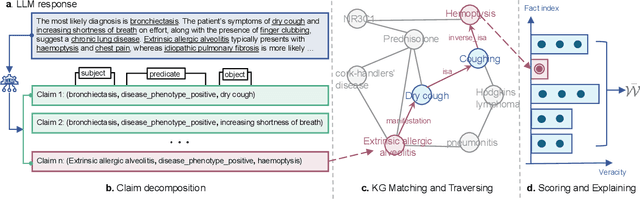
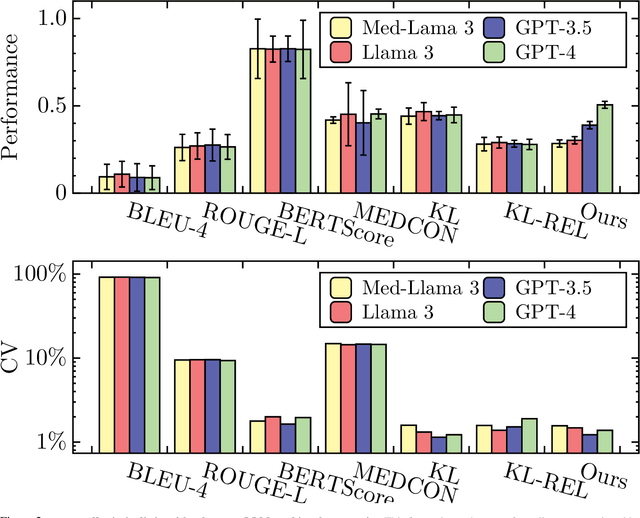
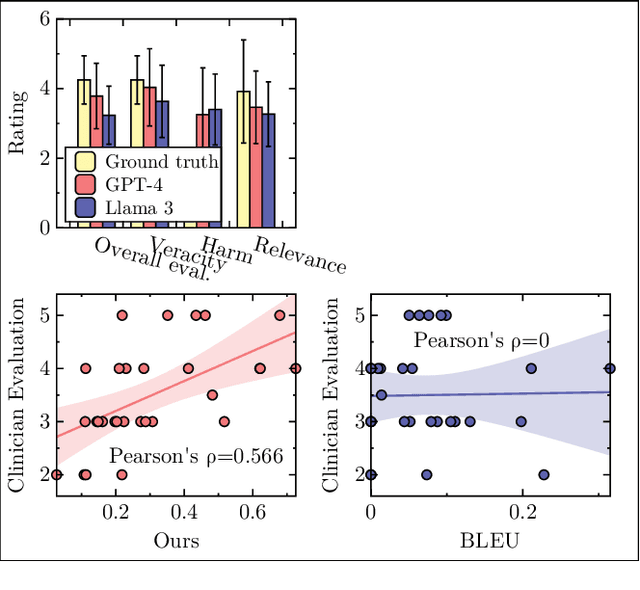
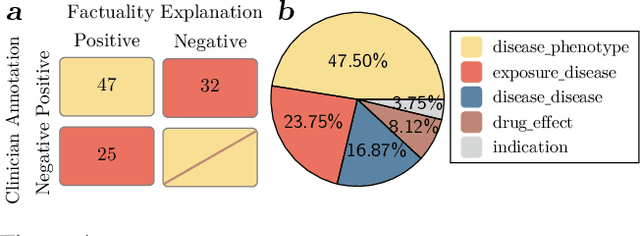
The recent proliferation of large language models (LLMs) holds the potential to revolutionize healthcare, with strong capabilities in diverse medical tasks. Yet, deploying LLMs in high-stakes healthcare settings requires rigorous verification and validation to understand any potential harm. This paper investigates the reliability and viability of using medical knowledge graphs (KGs) for the automated factuality evaluation of LLM-generated responses. To ground this investigation, we introduce FAITH, a framework designed to systematically probe the strengths and limitations of this KG-based approach. FAITH operates without reference answers by decomposing responses into atomic claims, linking them to a medical KG, and scoring them based on evidence paths. Experiments on diverse medical tasks with human subjective evaluations demonstrate that KG-grounded evaluation achieves considerably higher correlations with clinician judgments and can effectively distinguish LLMs with varying capabilities. It is also robust to textual variances. The inherent explainability of its scoring can further help users understand and mitigate the limitations of current LLMs. We conclude that while limitations exist, leveraging KGs is a prominent direction for automated factuality assessment in healthcare.
A Knowledge-Graph Translation Layer for Mission-Aware Multi-Agent Path Planning in Spatiotemporal Dynamics
Oct 24, 2025The coordination of autonomous agents in dynamic environments is hampered by the semantic gap between high-level mission objectives and low-level planner inputs. To address this, we introduce a framework centered on a Knowledge Graph (KG) that functions as an intelligent translation layer. The KG's two-plane architecture compiles declarative facts into per-agent, mission-aware ``worldviews" and physics-aware traversal rules, decoupling mission semantics from a domain-agnostic planner. This allows complex, coordinated paths to be modified simply by changing facts in the KG. A case study involving Autonomous Underwater Vehicles (AUVs) in the Gulf of Mexico visually demonstrates the end-to-end process and quantitatively proves that different declarative policies produce distinct, high-performing outcomes. This work establishes the KG not merely as a data repository, but as a powerful, stateful orchestrator for creating adaptive and explainable autonomous systems.
LLM-empowered knowledge graph construction: A survey
Oct 23, 2025Knowledge Graphs (KGs) have long served as a fundamental infrastructure for structured knowledge representation and reasoning. With the advent of Large Language Models (LLMs), the construction of KGs has entered a new paradigm-shifting from rule-based and statistical pipelines to language-driven and generative frameworks. This survey provides a comprehensive overview of recent progress in LLM-empowered knowledge graph construction, systematically analyzing how LLMs reshape the classical three-layered pipeline of ontology engineering, knowledge extraction, and knowledge fusion. We first revisit traditional KG methodologies to establish conceptual foundations, and then review emerging LLM-driven approaches from two complementary perspectives: schema-based paradigms, which emphasize structure, normalization, and consistency; and schema-free paradigms, which highlight flexibility, adaptability, and open discovery. Across each stage, we synthesize representative frameworks, analyze their technical mechanisms, and identify their limitations. Finally, the survey outlines key trends and future research directions, including KG-based reasoning for LLMs, dynamic knowledge memory for agentic systems, and multimodal KG construction. Through this systematic review, we aim to clarify the evolving interplay between LLMs and knowledge graphs, bridging symbolic knowledge engineering and neural semantic understanding toward the development of adaptive, explainable, and intelligent knowledge systems.
Explainable Knowledge Graph Retrieval-Augmented Generation (KG-RAG) with KG-SMILE
Sep 03, 2025Generative AI, such as Large Language Models (LLMs), has achieved impressive progress but still produces hallucinations and unverifiable claims, limiting reliability in sensitive domains. Retrieval-Augmented Generation (RAG) improves accuracy by grounding outputs in external knowledge, especially in domains like healthcare, where precision is vital. However, RAG remains opaque and essentially a black box, heavily dependent on data quality. We developed a method-agnostic, perturbation-based framework that provides token and component-level interoperability for Graph RAG using SMILE and named it as Knowledge-Graph (KG)-SMILE. By applying controlled perturbations, computing similarities, and training weighted linear surrogates, KG-SMILE identifies the graph entities and relations most influential to generated outputs, thereby making RAG more transparent. We evaluate KG-SMILE using comprehensive attribution metrics, including fidelity, faithfulness, consistency, stability, and accuracy. Our findings show that KG-SMILE produces stable, human-aligned explanations, demonstrating its capacity to balance model effectiveness with interpretability and thereby fostering greater transparency and trust in machine learning technologies.
Towards Explainable Job Title Matching: Leveraging Semantic Textual Relatedness and Knowledge Graphs
Sep 11, 2025Semantic Textual Relatedness (STR) captures nuanced relationships between texts that extend beyond superficial lexical similarity. In this study, we investigate STR in the context of job title matching - a key challenge in resume recommendation systems, where overlapping terms are often limited or misleading. We introduce a self-supervised hybrid architecture that combines dense sentence embeddings with domain-specific Knowledge Graphs (KGs) to improve both semantic alignment and explainability. Unlike previous work that evaluated models on aggregate performance, our approach emphasizes data stratification by partitioning the STR score continuum into distinct regions: low, medium, and high semantic relatedness. This stratified evaluation enables a fine-grained analysis of model performance across semantically meaningful subspaces. We evaluate several embedding models, both with and without KG integration via graph neural networks. The results show that fine-tuned SBERT models augmented with KGs produce consistent improvements in the high-STR region, where the RMSE is reduced by 25% over strong baselines. Our findings highlight not only the benefits of combining KGs with text embeddings, but also the importance of regional performance analysis in understanding model behavior. This granular approach reveals strengths and weaknesses hidden by global metrics, and supports more targeted model selection for use in Human Resources (HR) systems and applications where fairness, explainability, and contextual matching are essential.
Knowledge Graph-Based Explainable and Generalized Zero-Shot Semantic Communications
Jul 03, 2025Data-driven semantic communication is based on superficial statistical patterns, thereby lacking interpretability and generalization, especially for applications with the presence of unseen data. To address these challenges, we propose a novel knowledge graph-enhanced zero-shot semantic communication (KGZS-SC) network. Guided by the structured semantic information from a knowledge graph-based semantic knowledge base (KG-SKB), our scheme provides generalized semantic representations and enables reasoning for unseen cases. Specifically, the KG-SKB aligns the semantic features in a shared category semantics embedding space and enhances the generalization ability of the transmitter through aligned semantic features, thus reducing communication overhead by selectively transmitting compact visual semantics. At the receiver, zero-shot learning (ZSL) is leveraged to enable direct classification for unseen cases without the demand for retraining or additional computational overhead, thereby enhancing the adaptability and efficiency of the classification process in dynamic or resource-constrained environments. The simulation results conducted on the APY datasets show that the proposed KGZS-SC network exhibits robust generalization and significantly outperforms existing SC frameworks in classifying unseen categories across a range of SNR levels.
HealthGenie: Empowering Users with Healthy Dietary Guidance through Knowledge Graph and Large Language Models
Apr 20, 2025Seeking dietary guidance often requires navigating complex professional knowledge while accommodating individual health conditions. Knowledge Graphs (KGs) offer structured and interpretable nutritional information, whereas Large Language Models (LLMs) naturally facilitate conversational recommendation delivery. In this paper, we present HealthGenie, an interactive system that combines the strengths of LLMs and KGs to provide personalized dietary recommendations along with hierarchical information visualization for a quick and intuitive overview. Upon receiving a user query, HealthGenie performs query refinement and retrieves relevant information from a pre-built KG. The system then visualizes and highlights pertinent information, organized by defined categories, while offering detailed, explainable recommendation rationales. Users can further tailor these recommendations by adjusting preferences interactively. Our evaluation, comprising a within-subject comparative experiment and an open-ended discussion, demonstrates that HealthGenie effectively supports users in obtaining personalized dietary guidance based on their health conditions while reducing interaction effort and cognitive load. These findings highlight the potential of LLM-KG integration in supporting decision-making through explainable and visualized information. We examine the system's usefulness and effectiveness with an N=12 within-subject study and provide design considerations for future systems that integrate conversational LLM and KG.
Knowledge Graph Fusion with Large Language Models for Accurate, Explainable Manufacturing Process Planning
Jun 16, 2025Precision process planning in Computer Numerical Control (CNC) machining demands rapid, context-aware decisions on tool selection, feed-speed pairs, and multi-axis routing, placing immense cognitive and procedural burdens on engineers from design specification through final part inspection. Conventional rule-based computer-aided process planning and knowledge-engineering shells freeze domain know-how into static tables, which become limited when dealing with unseen topologies, novel material states, shifting cost-quality-sustainability weightings, or shop-floor constraints such as tool unavailability and energy caps. Large language models (LLMs) promise flexible, instruction-driven reasoning for tasks but they routinely hallucinate numeric values and provide no provenance. We present Augmented Retrieval Knowledge Network Enhanced Search & Synthesis (ARKNESS), the end-to-end framework that fuses zero-shot Knowledge Graph (KG) construction with retrieval-augmented generation to deliver verifiable, numerically exact answers for CNC process planning. ARKNESS (1) automatically distills heterogeneous machining documents, G-code annotations, and vendor datasheets into augmented triple, multi-relational graphs without manual labeling, and (2) couples any on-prem LLM with a retriever that injects the minimal, evidence-linked subgraph needed to answer a query. Benchmarked on 155 industry-curated questions spanning tool sizing and feed-speed optimization, a lightweight 3B-parameter Llama-3 augmented by ARKNESS matches GPT-4o accuracy while achieving a +25 percentage point gain in multiple-choice accuracy, +22.4 pp in F1, and 8.1x ROUGE-L on open-ended responses.