 Add to Chrome
 Add to Firefox
 Add to Edge
A Browser-Native Digital Test Range for Benchmarking 4D Ocean-Glider Planning Algorithms
Aug 13, 2026
Repeated in-situ evaluation of ocean-glider planners requires scarce vehicles, operators, deployment and recovery resources, and ocean conditions that cannot be reset for competing algorithms. We present a guided, installation-free browser-native digital test range that transforms a selected region into a reproducible four-dimensional experiment. The system leads users from regional domain selection through mission-scoped bathymetry, time/depth forcing, science objectives, optional task decomposition, route specification, current-advected execution, observation generation, and scoring. Its primary contribution is a common plan-to-observation contract unifying vehicle, sensing, and evaluator assumptions across manual routes, transparent built-in algorithms, and imported classical or learned-planner outputs, while exported artifacts form dataset-ready records. A controlled Observing System Simulation Experiment (OSSE) evaluates five classical planners in two episodes, three deterministic seeds, and a calibrated 60-hour horizon. All 54 missions completed and recovered without hard violations, while planner rankings and dive-policy effects revealed operational-scientific tradeoffs. An authentic public deployment supplied a field-referenced audit to scope current kinematic boundaries. Separately, source-locked GliderFlight 1.2.0 achieved native-to-browser parity through Pyodide/WebAssembly, establishing a pathway for high-fidelity multi-tier simulation. The resulting operational space is scientifically traceable and component-qualified for mission-scale pre-deployment experimentation.

Learned Response-Field Inertia Operator for HEC-RAS 2D Water-Surface Elevation Prediction
Jun 04, 2026This article presents a cross-dataset evaluation of learned native-cell surrogate models for solver-consistent water-surface elevation (WSE) prediction in HEC-RAS 2D. To avoid raster remapping error and information-access confounding, surrogates are evaluated directly on the original nonuniform computational cells under an explicit policy that separates static project inputs, current hydraulic state, project-input forcing, calibration-derived quantities, and future solver-output targets. We introduce the Learned Response-Field Inertia Operator (LRFIO), a no-forcing, increment-based learned surrogate that calibrates an inertial response operator from solved HEC-RAS trajectories and deploys the retained operator through closed-form native-cell rollout. LRFIO evaluates a base-case-first response hierarchy consisting of persistence, global calibrated inertia, and segmented response-field inertia. Segmentation, residual correction, and neuralized inertia are treated as learnable modeling choices, with added complexity retained only when validation evidence justifies its cost. Evaluated across four diverse HEC-RAS 2D benchmarks, LRFIO retains different response structures for different domains, demonstrating adaptive learned complexity. The selector audit shows controlled complexity with a maximum validation regret of 4.30%. During deployment, retained rollout times range from 0.003 s to 0.242 s, and the Beaver Bayou measured-solve comparison gives an estimated 2.75 x 10^4 horizon-normalized speedup over HEC-RAS. These results indicate that the current native-cell increment is a strong solver-conditioned predictive scaffold and that added response-field, neural, or spatial complexity should be retained only when empirically justified.
A Knowledge-Graph Translation Layer for Mission-Aware Multi-Agent Path Planning in Spatiotemporal Dynamics
Oct 24, 2025The coordination of autonomous agents in dynamic environments is hampered by the semantic gap between high-level mission objectives and low-level planner inputs. To address this, we introduce a framework centered on a Knowledge Graph (KG) that functions as an intelligent translation layer. The KG's two-plane architecture compiles declarative facts into per-agent, mission-aware ``worldviews" and physics-aware traversal rules, decoupling mission semantics from a domain-agnostic planner. This allows complex, coordinated paths to be modified simply by changing facts in the KG. A case study involving Autonomous Underwater Vehicles (AUVs) in the Gulf of Mexico visually demonstrates the end-to-end process and quantitatively proves that different declarative policies produce distinct, high-performing outcomes. This work establishes the KG not merely as a data repository, but as a powerful, stateful orchestrator for creating adaptive and explainable autonomous systems.
Physics-Informed Neural Network Surrogate Models for River Stage Prediction
Mar 21, 2025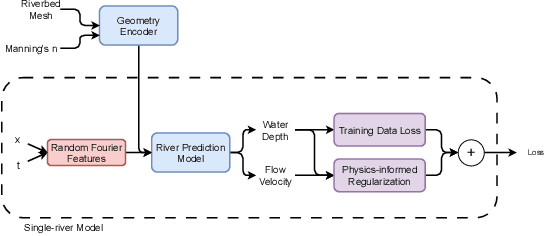
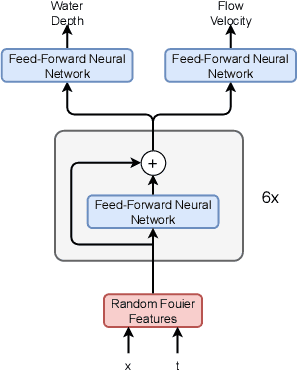
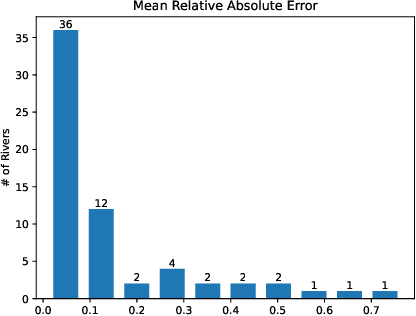
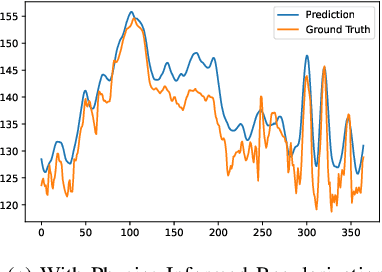
This work investigates the feasibility of using Physics-Informed Neural Networks (PINNs) as surrogate models for river stage prediction, aiming to reduce computational cost while maintaining predictive accuracy. Our primary contribution demonstrates that PINNs can successfully approximate HEC-RAS numerical solutions when trained on a single river, achieving strong predictive accuracy with generally low relative errors, though some river segments exhibit higher deviations. By integrating the governing Saint-Venant equations into the learning process, the proposed PINN-based surrogate model enforces physical consistency and significantly improves computational efficiency compared to HEC-RAS. We evaluate the model's performance in terms of accuracy and computational speed, demonstrating that it closely approximates HEC-RAS predictions while enabling real-time inference. These results highlight the potential of PINNs as effective surrogate models for single-river hydrodynamics, offering a promising alternative for computationally efficient river stage forecasting. Future work will explore techniques to enhance PINN training stability and robustness across a more generalized multi-river model.
Data Visualization to Evaluate and Facilitate Targeted Data Acquisitions in Support of a Real-time Ocean Forecasting System
Sep 20, 2024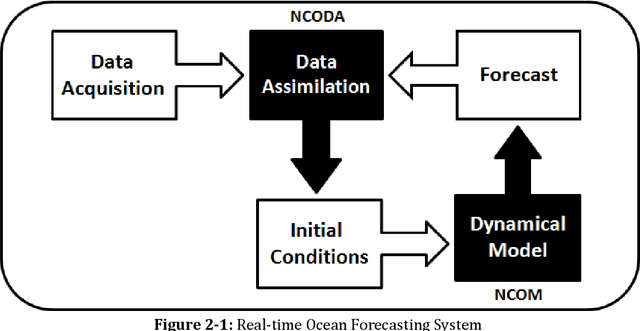
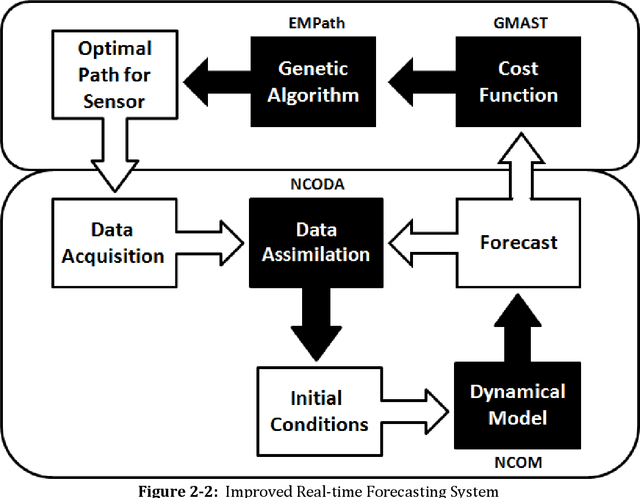
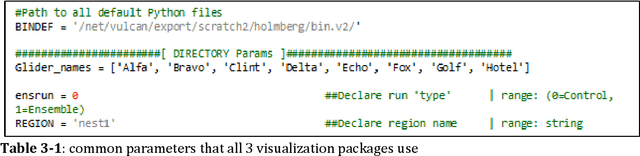
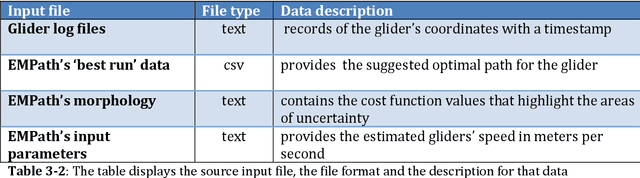
A robust evaluation toolset has been designed for Naval Research Laboratory's Real-Time Ocean Forecasting System RELO with the purpose of facilitating an adaptive sampling strategy and providing more educated guidance for routing underwater gliders. The major challenges are to integrate into the existing operational system and provide a bridge between the modeling and operative environments. Visualization is the selected approach, and the developed software is divided into 3 packages. The first package verifies that the glider is actually following the waypoints and predicts the position of the glider for the next cycle's instructions. The second package ensures that the delivered waypoints are both useful and feasible. The third package provides the confidence levels for the suggested path. This software's implementation is in Python for portability and modularity to allow for easy expansion of new visuals.