 Add to Chrome
 Add to Firefox
 Add to Edge
De Novo Peptide Sequencing
Papers and Code
Regressor-guided Diffusion Model for De Novo Peptide Sequencing with Explicit Mass Control
Feb 23, 2026
The discovery of novel proteins relies on sensitive protein identification, for which de novo peptide sequencing (DNPS) from mass spectra is a crucial approach. While deep learning has advanced DNPS, existing models inadequately enforce the fundamental mass consistency constraint, that a predicted peptide's mass must match the experimental measured precursor mass. Previous DNPS methods often treat this critical information as a simple input feature or use it in post-processing, leading to numerous implausible predictions that do not adhere to this fundamental physical property. To address this limitation, we introduce DiffuNovo, a novel regressor-guided diffusion model for de novo peptide sequencing that provides explicit peptide-level mass control. Our approach integrates the mass constraint at two critical stages: during training, a novel peptide-level mass loss guides model optimization, while at inference, regressor-based guidance from gradient-based updates in the latent space steers the generation to compel the predicted peptide adheres to the mass constraint. Comprehensive evaluations on established benchmarks demonstrate that DiffuNovo surpasses state-of-the-art methods in DNPS accuracy. Additionally, as the first DNPS model to employ a diffusion model as its core backbone, DiffuNovo leverages the powerful controllability of diffusion architecture and achieves a significant reduction in mass error, thereby producing much more physically plausible peptides. These innovations represent a substantial advancement toward robust and broadly applicable DNPS. The source code is available in the supplementary material.

ProDCARL: Reinforcement Learning-Aligned Diffusion Models for De Novo Antimicrobial Peptide Design
Jan 29, 2026Antimicrobial resistance threatens healthcare sustainability and motivates low-cost computational discovery of antimicrobial peptides (AMPs). De novo peptide generation must optimize antimicrobial activity and safety through low predicted toxicity, but likelihood-trained generators do not enforce these goals explicitly. We introduce ProDCARL, a reinforcement-learning alignment framework that couples a diffusion-based protein generator (EvoDiff OA-DM 38M) with sequence property predictors for AMP activity and peptide toxicity. We fine-tune the diffusion prior on AMP sequences to obtain a domain-aware generator. Top-k policy-gradient updates use classifier-derived rewards plus entropy regularization and early stopping to preserve diversity and reduce reward hacking. In silico experiments show ProDCARL increases the mean predicted AMP score from 0.081 after fine-tuning to 0.178. The joint high-quality hit rate reaches 6.3\% with pAMP $>$0.7 and pTox $<$0.3. ProDCARL maintains high diversity, with $1-$mean pairwise identity equal to 0.929. Qualitative analyses with AlphaFold3 and ProtBERT embeddings suggest candidates show plausible AMP-like structural and semantic characteristics. ProDCARL serves as a candidate generator that narrows experimental search space, and experimental validation remains future work.
Surface-based Molecular Design with Multi-modal Flow Matching
Jan 08, 2026Therapeutic peptides show promise in targeting previously undruggable binding sites, with recent advancements in deep generative models enabling full-atom peptide co-design for specific protein receptors. However, the critical role of molecular surfaces in protein-protein interactions (PPIs) has been underexplored. To bridge this gap, we propose an omni-design peptides generation paradigm, called SurfFlow, a novel surface-based generative algorithm that enables comprehensive co-design of sequence, structure, and surface for peptides. SurfFlow employs a multi-modality conditional flow matching (CFM) architecture to learn distributions of surface geometries and biochemical properties, enhancing peptide binding accuracy. Evaluated on the comprehensive PepMerge benchmark, SurfFlow consistently outperforms full-atom baselines across all metrics. These results highlight the advantages of considering molecular surfaces in de novo peptide discovery and demonstrate the potential of integrating multiple protein modalities for more effective therapeutic peptide discovery.
Accurate de novo sequencing of the modified proteome with OmniNovo
Dec 13, 2025Post-translational modifications (PTMs) serve as a dynamic chemical language regulating protein function, yet current proteomic methods remain blind to a vast portion of the modified proteome. Standard database search algorithms suffer from a combinatorial explosion of search spaces, limiting the identification of uncharacterized or complex modifications. Here we introduce OmniNovo, a unified deep learning framework for reference-free sequencing of unmodified and modified peptides directly from tandem mass spectra. Unlike existing tools restricted to specific modification types, OmniNovo learns universal fragmentation rules to decipher diverse PTMs within a single coherent model. By integrating a mass-constrained decoding algorithm with rigorous false discovery rate estimation, OmniNovo achieves state-of-the-art accuracy, identifying 51\% more peptides than standard approaches at a 1\% false discovery rate. Crucially, the model generalizes to biological sites unseen during training, illuminating the dark matter of the proteome and enabling unbiased comprehensive analysis of cellular regulation.
Curriculum Learning for Biological Sequence Prediction: The Case of De Novo Peptide Sequencing
Jun 16, 2025Peptide sequencing-the process of identifying amino acid sequences from mass spectrometry data-is a fundamental task in proteomics. Non-Autoregressive Transformers (NATs) have proven highly effective for this task, outperforming traditional methods. Unlike autoregressive models, which generate tokens sequentially, NATs predict all positions simultaneously, leveraging bidirectional context through unmasked self-attention. However, existing NAT approaches often rely on Connectionist Temporal Classification (CTC) loss, which presents significant optimization challenges due to CTC's complexity and increases the risk of training failures. To address these issues, we propose an improved non-autoregressive peptide sequencing model that incorporates a structured protein sequence curriculum learning strategy. This approach adjusts protein's learning difficulty based on the model's estimated protein generational capabilities through a sampling process, progressively learning peptide generation from simple to complex sequences. Additionally, we introduce a self-refining inference-time module that iteratively enhances predictions using learned NAT token embeddings, improving sequence accuracy at a fine-grained level. Our curriculum learning strategy reduces NAT training failures frequency by more than 90% based on sampled training over various data distributions. Evaluations on nine benchmark species demonstrate that our approach outperforms all previous methods across multiple metrics and species.
Universal Biological Sequence Reranking for Improved De Novo Peptide Sequencing
May 23, 2025De novo peptide sequencing is a critical task in proteomics. However, the performance of current deep learning-based methods is limited by the inherent complexity of mass spectrometry data and the heterogeneous distribution of noise signals, leading to data-specific biases. We present RankNovo, the first deep reranking framework that enhances de novo peptide sequencing by leveraging the complementary strengths of multiple sequencing models. RankNovo employs a list-wise reranking approach, modeling candidate peptides as multiple sequence alignments and utilizing axial attention to extract informative features across candidates. Additionally, we introduce two new metrics, PMD (Peptide Mass Deviation) and RMD (residual Mass Deviation), which offer delicate supervision by quantifying mass differences between peptides at both the sequence and residue levels. Extensive experiments demonstrate that RankNovo not only surpasses its base models used to generate training candidates for reranking pre-training, but also sets a new state-of-the-art benchmark. Moreover, RankNovo exhibits strong zero-shot generalization to unseen models whose generations were not exposed during training, highlighting its robustness and potential as a universal reranking framework for peptide sequencing. Our work presents a novel reranking strategy that fundamentally challenges existing single-model paradigms and advances the frontier of accurate de novo sequencing. Our source code is provided on GitHub.
Disentangling the Complex Multiplexed DIA Spectra in De Novo Peptide Sequencing
Nov 24, 2024Data-Independent Acquisition (DIA) was introduced to improve sensitivity to cover all peptides in a range rather than only sampling high-intensity peaks as in Data-Dependent Acquisition (DDA) mass spectrometry. However, it is not very clear how useful DIA data is for de novo peptide sequencing as the DIA data are marred with coeluted peptides, high noises, and varying data quality. We present a new deep learning method DIANovo, and address each of these difficulties, and improves the previous established system DeepNovo-DIA by from 25% to 81%, averaging 48%, for amino acid recall, and by from 27% to 89%, averaging 57%, for peptide recall, by equipping the model with a deeper understanding of coeluted DIA spectra. This paper also provides criteria about when DIA data could be used for de novo peptide sequencing and when not to by providing a comparison between DDA and DIA, in both de novo and database search mode. We find that while DIA excels with narrow isolation windows on older-generation instruments, it loses its advantage with wider windows. However, with Orbitrap Astral, DIA consistently outperforms DDA due to narrow window mode enabled. We also provide a theoretical explanation of this phenomenon, emphasizing the critical role of the signal-to-noise profile in the successful application of de novo sequencing.
Gumbel-Softmax Flow Matching with Straight-Through Guidance for Controllable Biological Sequence Generation
Mar 21, 2025Flow matching in the continuous simplex has emerged as a promising strategy for DNA sequence design, but struggles to scale to higher simplex dimensions required for peptide and protein generation. We introduce Gumbel-Softmax Flow and Score Matching, a generative framework on the simplex based on a novel Gumbel-Softmax interpolant with a time-dependent temperature. Using this interpolant, we introduce Gumbel-Softmax Flow Matching by deriving a parameterized velocity field that transports from smooth categorical distributions to distributions concentrated at a single vertex of the simplex. We alternatively present Gumbel-Softmax Score Matching which learns to regress the gradient of the probability density. Our framework enables high-quality, diverse generation and scales efficiently to higher-dimensional simplices. To enable training-free guidance, we propose Straight-Through Guided Flows (STGFlow), a classifier-based guidance method that leverages straight-through estimators to steer the unconditional velocity field toward optimal vertices of the simplex. STGFlow enables efficient inference-time guidance using classifiers pre-trained on clean sequences, and can be used with any discrete flow method. Together, these components form a robust framework for controllable de novo sequence generation. We demonstrate state-of-the-art performance in conditional DNA promoter design, sequence-only protein generation, and target-binding peptide design for rare disease treatment.
E(3)-invariant diffusion model for pocket-aware peptide generation
Oct 31, 2024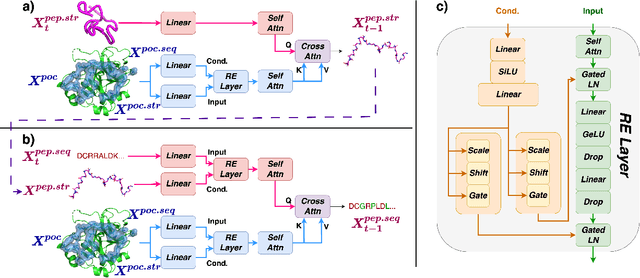


Biologists frequently desire protein inhibitors for a variety of reasons, including use as research tools for understanding biological processes and application to societal problems in agriculture, healthcare, etc. Immunotherapy, for instance, relies on immune checkpoint inhibitors to block checkpoint proteins, preventing their binding with partner proteins and boosting immune cell function against abnormal cells. Inhibitor discovery has long been a tedious process, which in recent years has been accelerated by computational approaches. Advances in artificial intelligence now provide an opportunity to make inhibitor discovery smarter than ever before. While extensive research has been conducted on computer-aided inhibitor discovery, it has mainly focused on either sequence-to-structure mapping, reverse mapping, or bio-activity prediction, making it unrealistic for biologists to utilize such tools. Instead, our work proposes a new method of computer-assisted inhibitor discovery: de novo pocket-aware peptide structure and sequence generation network. Our approach consists of two sequential diffusion models for end-to-end structure generation and sequence prediction. By leveraging angle and dihedral relationships between backbone atoms, we ensure an E(3)-invariant representation of peptide structures. Our results demonstrate that our method achieves comparable performance to state-of-the-art models, highlighting its potential in pocket-aware peptide design. This work offers a new approach for precise drug discovery using receptor-specific peptide generation.
E(3)-invaraint diffusion model for pocket-aware peptide generation
Oct 27, 2024Biologists frequently desire protein inhibitors for a variety of reasons, including use as research tools for understanding biological processes and application to societal problems in agriculture, healthcare, etc. Immunotherapy, for instance, relies on immune checkpoint inhibitors to block checkpoint proteins, preventing their binding with partner proteins and boosting immune cell function against abnormal cells. Inhibitor discovery has long been a tedious process, which in recent years has been accelerated by computational approaches. Advances in artificial intelligence now provide an opportunity to make inhibitor discovery smarter than ever before. While extensive research has been conducted on computer-aided inhibitor discovery, it has mainly focused on either sequence-to-structure mapping, reverse mapping, or bio-activity prediction, making it unrealistic for biologists to utilize such tools. Instead, our work proposes a new method of computer-assisted inhibitor discovery: de novo pocket-aware peptide structure and sequence generation network. Our approach consists of two sequential diffusion models for end-to-end structure generation and sequence prediction. By leveraging angle and dihedral relationships between backbone atoms, we ensure an E(3)-invariant representation of peptide structures. Our results demonstrate that our method achieves comparable performance to state-of-the-art models, highlighting its potential in pocket-aware peptide design. This work offers a new approach for precise drug discovery using receptor-specific peptide generation.