 Add to Chrome
 Add to Firefox
 Add to Edge
Cyclone Data
Papers and Code
Zero-Shot Statistical Downscaling via Diffusion Posterior Sampling
Jan 29, 2026
Conventional supervised climate downscaling struggles to generalize to Global Climate Models (GCMs) due to the lack of paired training data and inherent domain gaps relative to reanalysis. Meanwhile, current zero-shot methods suffer from physical inconsistencies and vanishing gradient issues under large scaling factors. We propose Zero-Shot Statistical Downscaling (ZSSD), a zero-shot framework that performs statistical downscaling without paired data during training. ZSSD leverages a Physics-Consistent Climate Prior learned from reanalysis data, conditioned on geophysical boundaries and temporal information to enforce physical validity. Furthermore, to enable robust inference across varying GCMs, we introduce Unified Coordinate Guidance. This strategy addresses the vanishing gradient problem in vanilla DPS and ensures consistency with large-scale fields. Results show that ZSSD significantly outperforms existing zero-shot baselines in 99th percentile errors and successfully reconstructs complex weather events, such as tropical cyclones, across heterogeneous GCMs.

Learning a Stochastic Differential Equation Model of Tropical Cyclone Intensification from Reanalysis and Observational Data
Jan 13, 2026Tropical cyclones are dangerous natural hazards, but their hazard is challenging to quantify directly from historical datasets due to limited dataset size and quality. Models of cyclone intensification fill this data gap by simulating huge ensembles of synthetic hurricanes based on estimates of the storm's large scale environment. Both physics-based and statistical/ML intensification models have been developed to tackle this problem, but an open question is: can a physically reasonable and simple physics-style differential equation model of intensification be learned from data? In this paper, we answer this question in the affirmative by presenting a 10-term cubic stochastic differential equation model of Tropical Cyclone intensification. The model depends on a well-vetted suite of engineered environmental features known to drive intensification and is trained using a high quality dataset of hurricane intensity (IBTrACS) with estimates of the cyclone's large scale environment from a data-assimilated simulation (ERA5 reanalysis), restricted to the Northern Hemisphere. The model generates synthetic intensity series which capture many aspects of historical intensification statistics and hazard estimates in the Northern Hemisphere. Our results show promise that interpretable, physics style models of complex earth system dynamics can be learned using automated system identification techniques.
Towards mechanistic understanding in a data-driven weather model: internal activations reveal interpretable physical features
Dec 30, 2025Large data-driven physics models like DeepMind's weather model GraphCast have empirically succeeded in parameterizing time operators for complex dynamical systems with an accuracy reaching or in some cases exceeding that of traditional physics-based solvers. Unfortunately, how these data-driven models perform computations is largely unknown and whether their internal representations are interpretable or physically consistent is an open question. Here, we adapt tools from interpretability research in Large Language Models to analyze intermediate computational layers in GraphCast, leveraging sparse autoencoders to discover interpretable features in the neuron space of the model. We uncover distinct features on a wide range of length and time scales that correspond to tropical cyclones, atmospheric rivers, diurnal and seasonal behavior, large-scale precipitation patterns, specific geographical coding, and sea-ice extent, among others. We further demonstrate how the precise abstraction of these features can be probed via interventions on the prediction steps of the model. As a case study, we sparsely modify a feature corresponding to tropical cyclones in GraphCast and observe interpretable and physically consistent modifications to evolving hurricanes. Such methods offer a window into the black-box behavior of data-driven physics models and are a step towards realizing their potential as trustworthy predictors and scientifically valuable tools for discovery.
A unified multimodal understanding and generation model for cross-disciplinary scientific research
Jan 04, 2026Scientific discovery increasingly relies on integrating heterogeneous, high-dimensional data across disciplines nowadays. While AI models have achieved notable success across various scientific domains, they typically remain domain-specific or lack the capability of simultaneously understanding and generating multimodal scientific data, particularly for high-dimensional data. Yet, many pressing global challenges and scientific problems are inherently cross-disciplinary and require coordinated progress across multiple fields. Here, we present FuXi-Uni, a native unified multimodal model for scientific understanding and high-fidelity generation across scientific domains within a single architecture. Specifically, FuXi-Uni aligns cross-disciplinary scientific tokens within natural language tokens and employs science decoder to reconstruct scientific tokens, thereby supporting both natural language conversation and scientific numerical prediction. Empirically, we validate FuXi-Uni in Earth science and Biomedicine. In Earth system modeling, the model supports global weather forecasting, tropical cyclone (TC) forecast editing, and spatial downscaling driven by only language instructions. FuXi-Uni generates 10-day global forecasts at 0.25° resolution that outperform the SOTA physical forecasting system. It shows superior performance for both TC track and intensity prediction relative to the SOTA physical model, and generates high-resolution regional weather fields that surpass standard interpolation baselines. Regarding biomedicine, FuXi-Uni outperforms leading multimodal large language models on multiple biomedical visual question answering benchmarks. By unifying heterogeneous scientific modalities within a native shared latent space while maintaining strong domain-specific performance, FuXi-Uni provides a step forward more general-purpose, multimodal scientific models.
SynWeather: Weather Observation Data Synthesis across Multiple Regions and Variables via a General Diffusion Transformer
Nov 15, 2025With the advancement of meteorological instruments, abundant data has become available. Current approaches are typically focus on single-variable, single-region tasks and primarily rely on deterministic modeling. This limits unified synthesis across variables and regions, overlooks cross-variable complementarity and often leads to over-smoothed results. To address above challenges, we introduce SynWeather, the first dataset designed for Unified Multi-region and Multi-variable Weather Observation Data Synthesis. SynWeather covers four representative regions: the Continental United States, Europe, East Asia, and Tropical Cyclone regions, as well as provides high-resolution observations of key weather variables, including Composite Radar Reflectivity, Hourly Precipitation, Visible Light, and Microwave Brightness Temperature. In addition, we introduce SynWeatherDiff, a general and probabilistic weather synthesis model built upon the Diffusion Transformer framework to address the over-smoothed problem. Experiments on the SynWeather dataset demonstrate the effectiveness of our network compared with both task-specific and general models.
Spatiotemporal deep learning models for detection of rapid intensification in cyclones
Jun 10, 2025Cyclone rapid intensification is the rapid increase in cyclone wind intensity, exceeding a threshold of 30 knots, within 24 hours. Rapid intensification is considered an extreme event during a cyclone, and its occurrence is relatively rare, contributing to a class imbalance in the dataset. A diverse array of factors influences the likelihood of a cyclone undergoing rapid intensification, further complicating the task for conventional machine learning models. In this paper, we evaluate deep learning, ensemble learning and data augmentation frameworks to detect cyclone rapid intensification based on wind intensity and spatial coordinates. We note that conventional data augmentation methods cannot be utilised for generating spatiotemporal patterns replicating cyclones that undergo rapid intensification. Therefore, our framework employs deep learning models to generate spatial coordinates and wind intensity that replicate cyclones to address the class imbalance problem of rapid intensification. We also use a deep learning model for the classification module within the data augmentation framework to differentiate between rapid and non-rapid intensification events during a cyclone. Our results show that data augmentation improves the results for rapid intensification detection in cyclones, and spatial coordinates play a critical role as input features to the given models. This paves the way for research in synthetic data generation for spatiotemporal data with extreme events.
Quantum-Driven Multihead Inland Waterbody Detection With Transformer-Encoded CYGNSS Delay-Doppler Map Data
May 22, 2025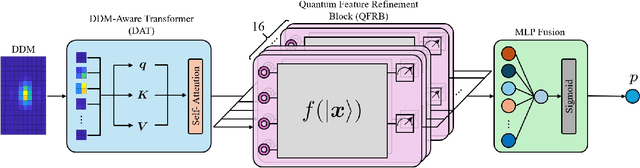
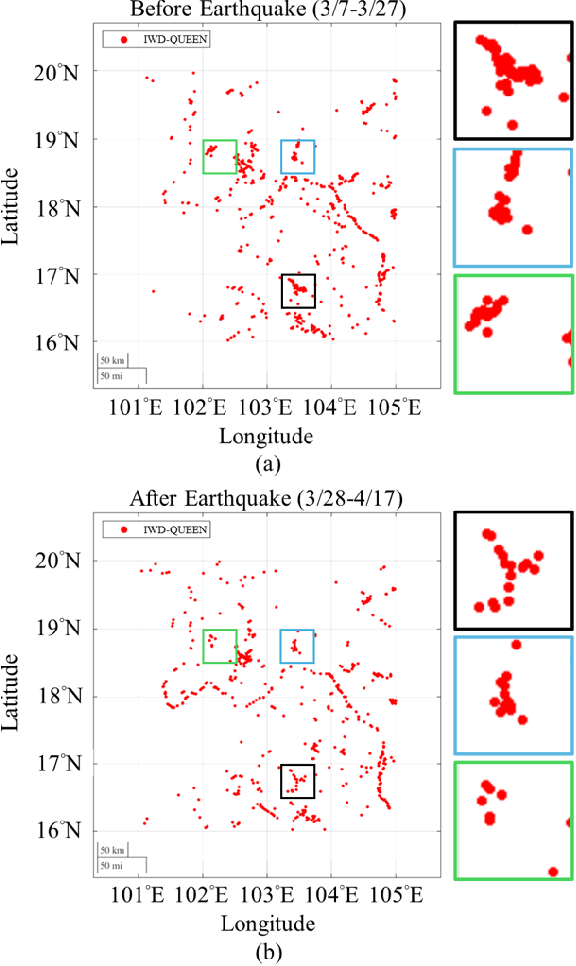
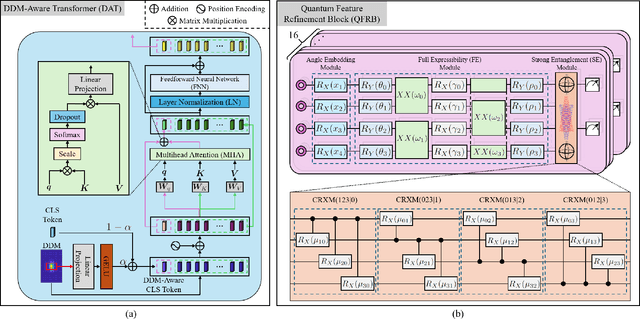
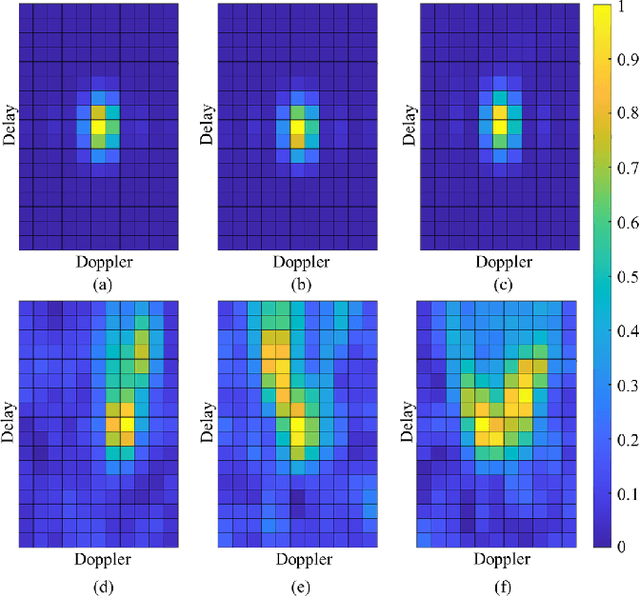
Inland waterbody detection (IWD) is critical for water resources management and agricultural planning. However, the development of high-fidelity IWD mapping technology remains unresolved. We aim to propose a practical solution based on the easily accessible data, i.e., the delay-Doppler map (DDM) provided by NASA's Cyclone Global Navigation Satellite System (CYGNSS), which facilitates effective estimation of physical parameters on the Earth's surface with high temporal resolution and wide spatial coverage. Specifically, as quantum deep network (QUEEN) has revealed its strong proficiency in addressing classification-like tasks, we encode the DDM using a customized transformer, followed by feeding the transformer-encoded DDM (tDDM) into a highly entangled QUEEN to distinguish whether the tDDM corresponds to a hydrological region. In recent literature, QUEEN has achieved outstanding performances in numerous challenging remote sensing tasks (e.g., hyperspectral restoration, change detection, and mixed noise removal, etc.), and its high effectiveness stems from the fundamentally different way it adopts to extract features (the so-called quantum unitary-computing features). The meticulously designed IWD-QUEEN retrieves high-precision river textures, such as those in Amazon River Basin in South America, demonstrating its superiority over traditional classification methods and existing global hydrography maps. IWD-QUEEN, together with its parallel quantum multihead scheme, works in a near-real-time manner (i.e., millisecond-level computing per DDM). To broaden accessibility for users of traditional computers, we also provide the non-quantum counterpart of our method, called IWD-Transformer, thereby increasing the impact of this work.
ExEBench: Benchmarking Foundation Models on Extreme Earth Events
May 13, 2025Our planet is facing increasingly frequent extreme events, which pose major risks to human lives and ecosystems. Recent advances in machine learning (ML), especially with foundation models (FMs) trained on extensive datasets, excel in extracting features and show promise in disaster management. Nevertheless, these models often inherit biases from training data, challenging their performance over extreme values. To explore the reliability of FM in the context of extreme events, we introduce \textbf{ExE}Bench (\textbf{Ex}treme \textbf{E}arth Benchmark), a collection of seven extreme event categories across floods, wildfires, storms, tropical cyclones, extreme precipitation, heatwaves, and cold waves. The dataset features global coverage, varying data volumes, and diverse data sources with different spatial, temporal, and spectral characteristics. To broaden the real-world impact of FMs, we include multiple challenging ML tasks that are closely aligned with operational needs in extreme events detection, monitoring, and forecasting. ExEBench aims to (1) assess FM generalizability across diverse, high-impact tasks and domains, (2) promote the development of novel ML methods that benefit disaster management, and (3) offer a platform for analyzing the interactions and cascading effects of extreme events to advance our understanding of Earth system, especially under the climate change expected in the decades to come. The dataset and code are public https://github.com/zhaoshan2/EarthExtreme-Bench.
Cause or Trigger? From Philosophy to Causal Modeling
Apr 02, 2025Not much has been written about the role of triggers in the literature on causal reasoning, causal modeling, or philosophy. In this paper, we focus on describing triggers and causes in the metaphysical sense and on characterizations that differentiate them from each other. We carry out a philosophical analysis of these differences. From this, we formulate a definition that clearly differentiates triggers from causes and can be used for causal reasoning in natural sciences. We propose a mathematical model and the Cause-Trigger algorithm, which, based on given data to observable processes, is able to determine whether a process is a cause or a trigger of an effect. The possibility to distinguish triggers from causes directly from data makes the algorithm a useful tool in natural sciences using observational data, but also for real-world scenarios. For example, knowing the processes that trigger causes of a tropical storm could give politicians time to develop actions such as evacuation the population. Similarly, knowing the triggers of processes that cause global warming could help politicians focus on effective actions. We demonstrate our algorithm on the climatological data of two recent cyclones, Freddy and Zazu. The Cause-Trigger algorithm detects processes that trigger high wind speed in both storms during their cyclogenesis. The findings obtained agree with expert knowledge.
Enhancing Tropical Cyclone Path Forecasting with an Improved Transformer Network
May 01, 2025A storm is a type of extreme weather. Therefore, forecasting the path of a storm is extremely important for protecting human life and property. However, storm forecasting is very challenging because storm trajectories frequently change. In this study, we propose an improved deep learning method using a Transformer network to predict the movement trajectory of a storm over the next 6 hours. The storm data used to train the model was obtained from the National Oceanic and Atmospheric Administration (NOAA) [1]. Simulation results show that the proposed method is more accurate than traditional methods. Moreover, the proposed method is faster and more cost-effective