 Add to Chrome
 Add to Firefox
 Add to Edge
Classification On Time Series With Missing
Papers and Code
ShapeCond: Fast Shapelet-Guided Dataset Condensation for Time Series Classification
Feb 09, 2026
Time series data supports many domains (e.g., finance and climate science), but its rapid growth strains storage and computation. Dataset condensation can alleviate this by synthesizing a compact training set that preserves key information. Yet most condensation methods are image-centric and often fail on time series because they miss time-series-specific temporal structure, especially local discriminative motifs such as shapelets. In this work, we propose ShapeCond, a novel and efficient condensation framework for time series classification that leverages shapelet-based dataset knowledge via a shapelet-guided optimization strategy. Our shapelet-assisted synthesis cost is independent of sequence length: longer series yield larger speedups in synthesis (e.g., 29$\times$ faster over prior state-of-the-art method CondTSC for time-series condensation, and up to 10,000$\times$ over naively using shapelets on the Sleep dataset with 3,000 timesteps). By explicitly preserving critical local patterns, ShapeCond improves downstream accuracy and consistently outperforms all prior state-of-the-art time series dataset condensation methods across extensive experiments. Code is available at https://github.com/lunaaa95/ShapeCond.

Tabular Foundation Models Can Do Survival Analysis
Jan 29, 2026While tabular foundation models have achieved remarkable success in classification and regression, adapting them to model time-to-event outcomes for survival analysis is non-trivial due to right-censoring, where data observations may end before the event occurs. We develop a classification-based framework that reformulates both static and dynamic survival analysis as a series of binary classification problems by discretizing event times. Censored observations are naturally handled as examples with missing labels at certain time points. This classification formulation enables existing tabular foundation models to perform survival analysis through in-context learning without explicit training. We prove that under standard censoring assumptions, minimizing our binary classification loss recovers the true survival probabilities as the training set size increases. We demonstrate through evaluation across $53$ real-world datasets that off-the-shelf tabular foundation models with this classification formulation outperform classical and deep learning baselines on average over multiple survival metrics.
Rethinking Large Language Models For Irregular Time Series Classification In Critical Care
Jan 26, 2026Time series data from the Intensive Care Unit (ICU) provides critical information for patient monitoring. While recent advancements in applying Large Language Models (LLMs) to time series modeling (TSM) have shown great promise, their effectiveness on the irregular ICU data, characterized by particularly high rates of missing values, remains largely unexplored. This work investigates two key components underlying the success of LLMs for TSM: the time series encoder and the multimodal alignment strategy. To this end, we establish a systematic testbed to evaluate their impact across various state-of-the-art LLM-based methods on benchmark ICU datasets against strong supervised and self-supervised baselines. Results reveal that the encoder design is more critical than the alignment strategy. Encoders that explicitly model irregularity achieve substantial performance gains, yielding an average AUPRC increase of $12.8\%$ over the vanilla Transformer. While less impactful, the alignment strategy is also noteworthy, with the best-performing semantically rich, fusion-based strategy achieving a modest $2.9\%$ improvement over cross-attention. However, LLM-based methods require at least 10$\times$ longer training than the best-performing irregular supervised models, while delivering only comparable performance. They also underperform in data-scarce few-shot learning settings. These findings highlight both the promise and current limitations of LLMs for irregular ICU time series. The code is available at https://github.com/mHealthUnimelb/LLMTS.
Continuum Dropout for Neural Differential Equations
Nov 18, 2025Neural Differential Equations (NDEs) excel at modeling continuous-time dynamics, effectively handling challenges such as irregular observations, missing values, and noise. Despite their advantages, NDEs face a fundamental challenge in adopting dropout, a cornerstone of deep learning regularization, making them susceptible to overfitting. To address this research gap, we introduce Continuum Dropout, a universally applicable regularization technique for NDEs built upon the theory of alternating renewal processes. Continuum Dropout formulates the on-off mechanism of dropout as a stochastic process that alternates between active (evolution) and inactive (paused) states in continuous time. This provides a principled approach to prevent overfitting and enhance the generalization capabilities of NDEs. Moreover, Continuum Dropout offers a structured framework to quantify predictive uncertainty via Monte Carlo sampling at test time. Through extensive experiments, we demonstrate that Continuum Dropout outperforms existing regularization methods for NDEs, achieving superior performance on various time series and image classification tasks. It also yields better-calibrated and more trustworthy probability estimates, highlighting its effectiveness for uncertainty-aware modeling.
TANDEM: Temporal Attention-guided Neural Differential Equations for Missingness in Time Series Classification
Aug 24, 2025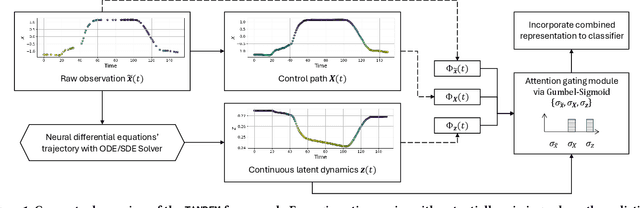
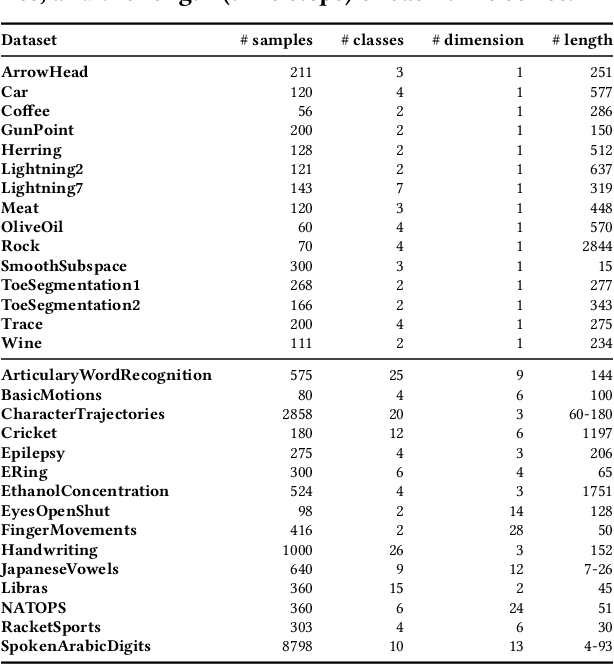
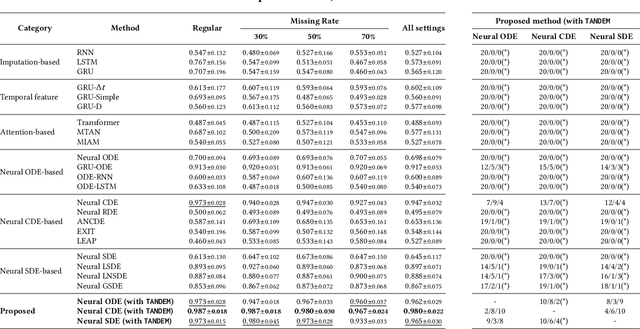
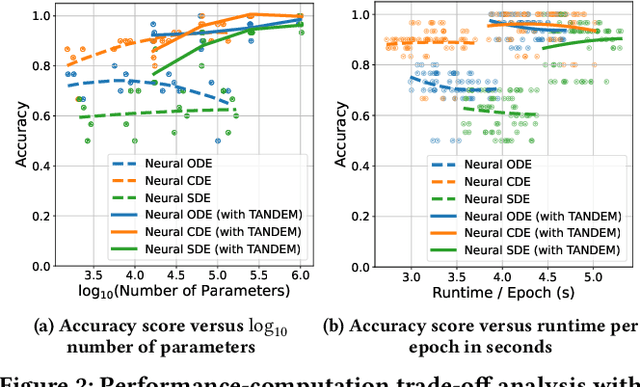
Handling missing data in time series classification remains a significant challenge in various domains. Traditional methods often rely on imputation, which may introduce bias or fail to capture the underlying temporal dynamics. In this paper, we propose TANDEM (Temporal Attention-guided Neural Differential Equations for Missingness), an attention-guided neural differential equation framework that effectively classifies time series data with missing values. Our approach integrates raw observation, interpolated control path, and continuous latent dynamics through a novel attention mechanism, allowing the model to focus on the most informative aspects of the data. We evaluate TANDEM on 30 benchmark datasets and a real-world medical dataset, demonstrating its superiority over existing state-of-the-art methods. Our framework not only improves classification accuracy but also provides insights into the handling of missing data, making it a valuable tool in practice.
Unlocking the Power of Mixture-of-Experts for Task-Aware Time Series Analytics
Sep 26, 2025Time Series Analysis is widely used in various real-world applications such as weather forecasting, financial fraud detection, imputation for missing data in IoT systems, and classification for action recognization. Mixture-of-Experts (MoE), as a powerful architecture, though demonstrating effectiveness in NLP, still falls short in adapting to versatile tasks in time series analytics due to its task-agnostic router and the lack of capability in modeling channel correlations. In this study, we propose a novel, general MoE-based time series framework called PatchMoE to support the intricate ``knowledge'' utilization for distinct tasks, thus task-aware. Based on the observation that hierarchical representations often vary across tasks, e.g., forecasting vs. classification, we propose a Recurrent Noisy Gating to utilize the hierarchical information in routing, thus obtaining task-sepcific capability. And the routing strategy is operated on time series tokens in both temporal and channel dimensions, and encouraged by a meticulously designed Temporal \& Channel Load Balancing Loss to model the intricate temporal and channel correlations. Comprehensive experiments on five downstream tasks demonstrate the state-of-the-art performance of PatchMoE.
Warping and Matching Subsequences Between Time Series
Jun 18, 2025Comparing time series is essential in various tasks such as clustering and classification. While elastic distance measures that allow warping provide a robust quantitative comparison, a qualitative comparison on top of them is missing. Traditional visualizations focus on point-to-point alignment and do not convey the broader structural relationships at the level of subsequences. This limitation makes it difficult to understand how and where one time series shifts, speeds up or slows down with respect to another. To address this, we propose a novel technique that simplifies the warping path to highlight, quantify and visualize key transformations (shift, compression, difference in amplitude). By offering a clearer representation of how subsequences match between time series, our method enhances interpretability in time series comparison.
PYRREGULAR: A Unified Framework for Irregular Time Series, with Classification Benchmarks
May 09, 2025Irregular temporal data, characterized by varying recording frequencies, differing observation durations, and missing values, presents significant challenges across fields like mobility, healthcare, and environmental science. Existing research communities often overlook or address these challenges in isolation, leading to fragmented tools and methods. To bridge this gap, we introduce a unified framework, and the first standardized dataset repository for irregular time series classification, built on a common array format to enhance interoperability. This repository comprises 34 datasets on which we benchmark 12 classifier models from diverse domains and communities. This work aims to centralize research efforts and enable a more robust evaluation of irregular temporal data analysis methods.
A Joint Learning Framework with Feature Reconstruction and Prediction for Incomplete Satellite Image Time Series in Agricultural Semantic Segmentation
May 25, 2025Satellite Image Time Series (SITS) is crucial for agricultural semantic segmentation. However, Cloud contamination introduces time gaps in SITS, disrupting temporal dependencies and causing feature shifts, leading to degraded performance of models trained on complete SITS. Existing methods typically address this by reconstructing the entire SITS before prediction or using data augmentation to simulate missing data. Yet, full reconstruction may introduce noise and redundancy, while the data-augmented model can only handle limited missing patterns, leading to poor generalization. We propose a joint learning framework with feature reconstruction and prediction to address incomplete SITS more effectively. During training, we simulate data-missing scenarios using temporal masks. The two tasks are guided by both ground-truth labels and the teacher model trained on complete SITS. The prediction task constrains the model from selectively reconstructing critical features from masked inputs that align with the teacher's temporal feature representations. It reduces unnecessary reconstruction and limits noise propagation. By integrating reconstructed features into the prediction task, the model avoids learning shortcuts and maintains its ability to handle varied missing patterns and complete SITS. Experiments on SITS from Hunan Province, Western France, and Catalonia show that our method improves mean F1-scores by 6.93% in cropland extraction and 7.09% in crop classification over baselines. It also generalizes well across satellite sensors, including Sentinel-2 and PlanetScope, under varying temporal missing rates and model backbones.
A Novel Multi-Task Teacher-Student Architecture with Self-Supervised Pretraining for 48-Hour Vasoactive-Inotropic Trend Analysis in Sepsis Mortality Prediction
Feb 24, 2025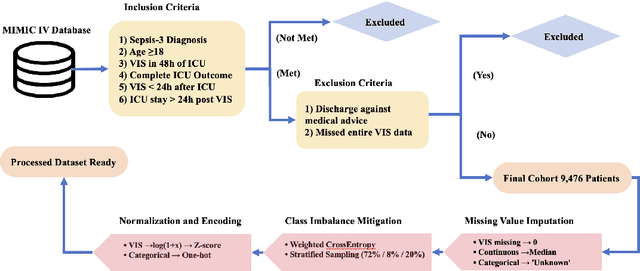
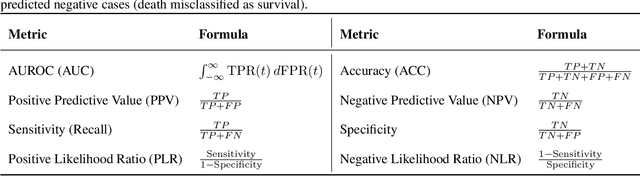
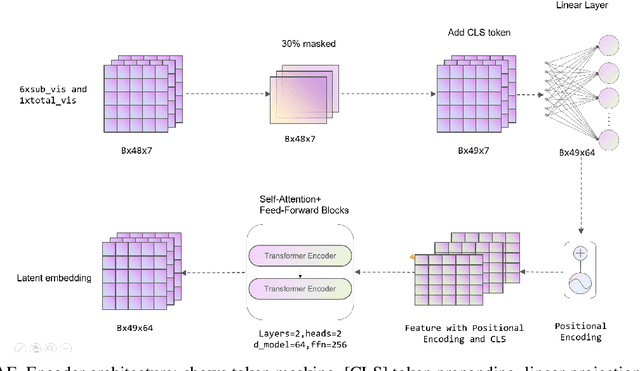
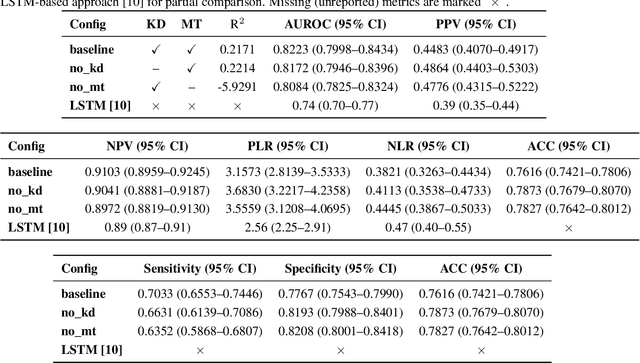
Sepsis is a major cause of ICU mortality, where early recognition and effective interventions are essential for improving patient outcomes. However, the vasoactive-inotropic score (VIS) varies dynamically with a patient's hemodynamic status, complicated by irregular medication patterns, missing data, and confounders, making sepsis prediction challenging. To address this, we propose a novel Teacher-Student multitask framework with self-supervised VIS pretraining via a Masked Autoencoder (MAE). The teacher model performs mortality classification and severity-score regression, while the student distills robust time-series representations, enhancing adaptation to heterogeneous VIS data. Compared to LSTM-based methods, our approach achieves an AUROC of 0.82 on MIMIC-IV 3.0 (9,476 patients), outperforming the baseline (0.74). SHAP analysis revealed that SOFA score (0.147) had the greatest impact on ICU mortality, followed by LODS (0.033), single marital status (0.031), and Medicaid insurance (0.023), highlighting the role of sociodemographic factors. SAPSII (0.020) also contributed significantly. These findings suggest that both clinical and social factors should be considered in ICU decision-making. Our novel multitask and distillation strategies enable earlier identification of high-risk patients, improving prediction accuracy and disease management, offering new tools for ICU decision support.